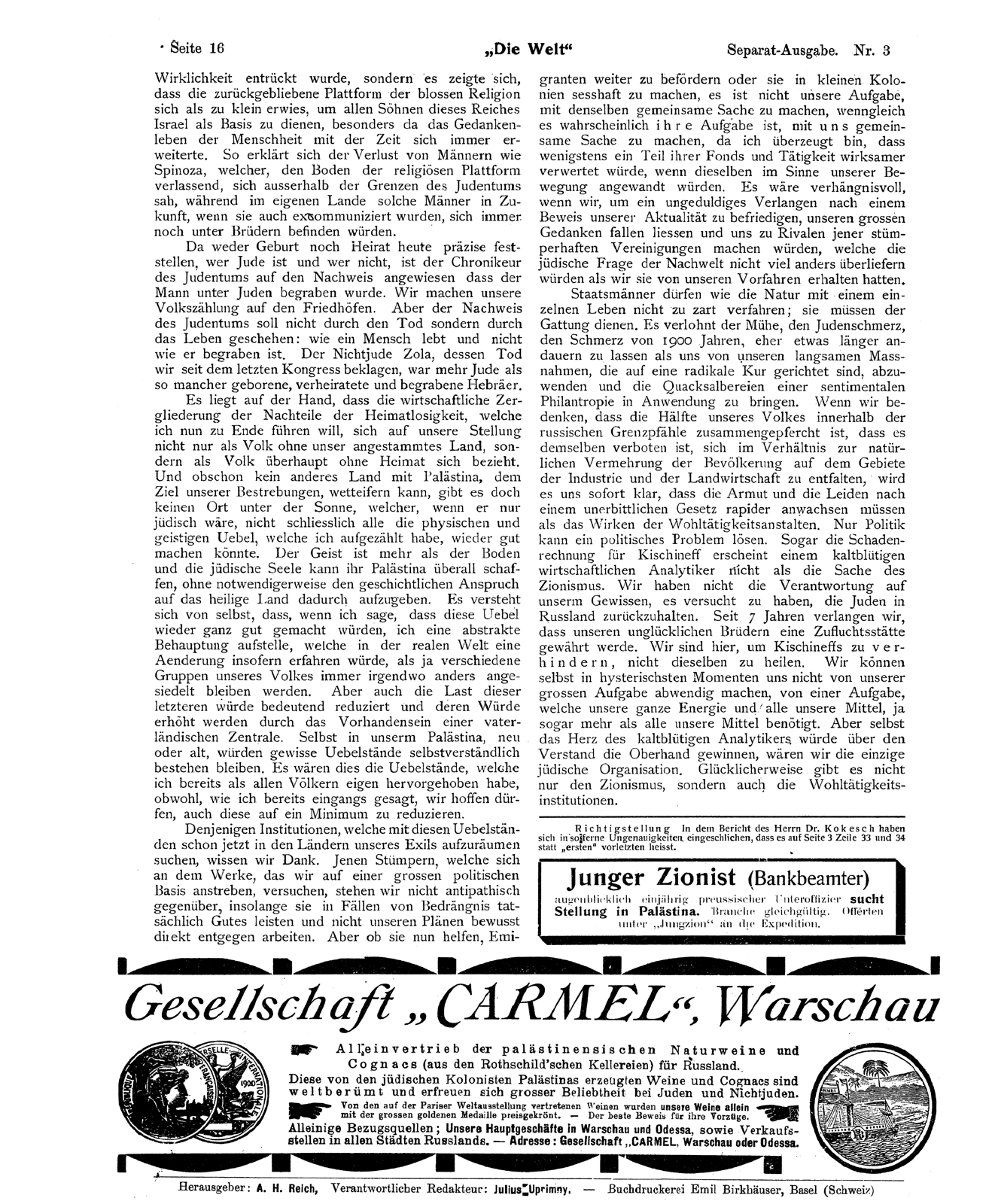
Page 16 — "Die Welt" — Special Edition. No. 3
(continued from page 15)
…was removed from reality, but it became evident that the platform of mere religion which remained proved too small to serve as a basis for all the sons of this kingdom of Israel, especially since the thought-life of mankind has continually widened with time. Thus is explained the loss of men like Spinoza, who, leaving the ground of the religious platform, saw himself outside the bounds of Judaism, whereas in their own land such men would in future, even if they were excommunicated, still always find themselves among brothers.
Since neither birth nor marriage to-day determines precisely who is a Jew and who is not, the chronicler of Judaism is dependent upon the proof that the man was buried among Jews. We take our census in the cemeteries. But the proof of Jewishness should be furnished not by death but by life: by how a man lives and not by how he is buried. The non-Jew Zola, whose death we have mourned since the last Congress, was more of a Jew than many a Hebrew born, married and buried.
It is obvious that the economic analysis of the disadvantages of homelessness, which I shall now bring to a close, relates to our position not only as a people without our ancestral land, but as a people without any home at all. And although no other land can vie with Palestine, the goal of our endeavours, there is yet no place under the sun which, if only it were Jewish, could not in the end make good all the physical and spiritual ills that I have enumerated. The spirit is more than the soil, and the Jewish soul can create its Palestine anywhere, without thereby necessarily surrendering its historical claim to the Holy Land. It goes without saying that when I say these ills would be made wholly good again, I am putting forward an abstract proposition, which in the real world would undergo a modification in so far as various groups of our people will always remain settled somewhere else. But the burden of these latter, too, would be considerably reduced, and their dignity heightened, by the existence of a national centre. Even in our Palestine, new or old, certain ills would of course persist. These would be the ills which I have already pointed out as common to all peoples, although, as I said at the outset, we may hope to reduce these too to a minimum.
To those institutions which even now seek to clear away these ills in the lands of our exile, we are grateful. Towards those bunglers who try their hands at the work which we are pursuing upon a great political basis we feel no antipathy, so long as in cases of distress they actually do good and do not consciously work directly against our plans. But whether they help to forward emigrants further, or to settle them in small colonies, it is not our task to make common cause with them, although it is probably their task to make common cause with us, since I am convinced that at least a part of their funds and activity would be more effectively employed if applied in the spirit of our movement. It would be fatal if, in order to satisfy an impatient craving for proof of our actuality, we were to let fall our great idea and make ourselves the rivals of those storm-driven associations which would hand down the Jewish question to posterity not much otherwise than we had received it from our forefathers.
Statesmen, like Nature, may not deal too tenderly with the single life; they must serve the species. It is worth while rather to let the Jewish pain, the pain of 1900 years, endure somewhat longer than to turn away from our slow measures, which are directed towards a radical cure, and to apply the quackeries of a sentimental philanthropy. When we consider that half our people is penned together within the Russian boundary-posts, that it is forbidden to expand in the fields of industry and agriculture in proportion to the natural increase of the population, it becomes at once clear to us that poverty and suffering must, by an inexorable law, grow more rapidly than the working of the charitable institutions. Only politics can solve a political problem. Even the bill of damages for Kischineff does not appear to a cold-blooded economic analyst as the affair of Zionism. We do not have upon our conscience the responsibility of having tried to keep the Jews in Russia. For 7 years we have been demanding that a place of refuge be granted to our unhappy brethren. We are here to prevent Kischineffs, not to heal them. We cannot, even in the most hysterical moments, let ourselves be turned aside from our great task, from a task which requires all our energy and all our means, nay, even more than all our means. But even the heart of the cold-blooded analyst would gain the upper hand over his reason, were we the only Jewish organisation. Happily there is not only Zionism, but also the charitable institutions.
Correction. Inaccuracies have crept into the report of Dr. Kokesch, in so far as on page 3, lines 33 and 34, it should read penultimate instead of "first."
Young Zionist (Bank Clerk)
at present a one-year Prussian non-commissioned officer, seeks a position in Palestine. Line of business immaterial. Offers under "Jungzion" to the office of this paper.
"CARMEL" Company, Warsaw
Sole distribution for Russia of the natural wines and cognacs of Palestine (from the Rothschild cellars).
These wines and cognacs, produced by the Jewish colonists of Palestine, are world-famous and enjoy great popularity among Jews and non-Jews alike.
Of the wines represented at the Paris World's Exhibition, our wines alone were awarded the grand gold medal. — The best proof of their merits.
Sole sources of supply: our main establishments in Warsaw and Odessa, as well as sales agencies in all the towns of Russia. — Address: "CARMEL" Company, Warsaw or Odessa.
Publisher: A. H. Reich. Responsible editor: Julius Uprimny. — Printing works of Emil Birkhäuser, Basle (Switzerland)