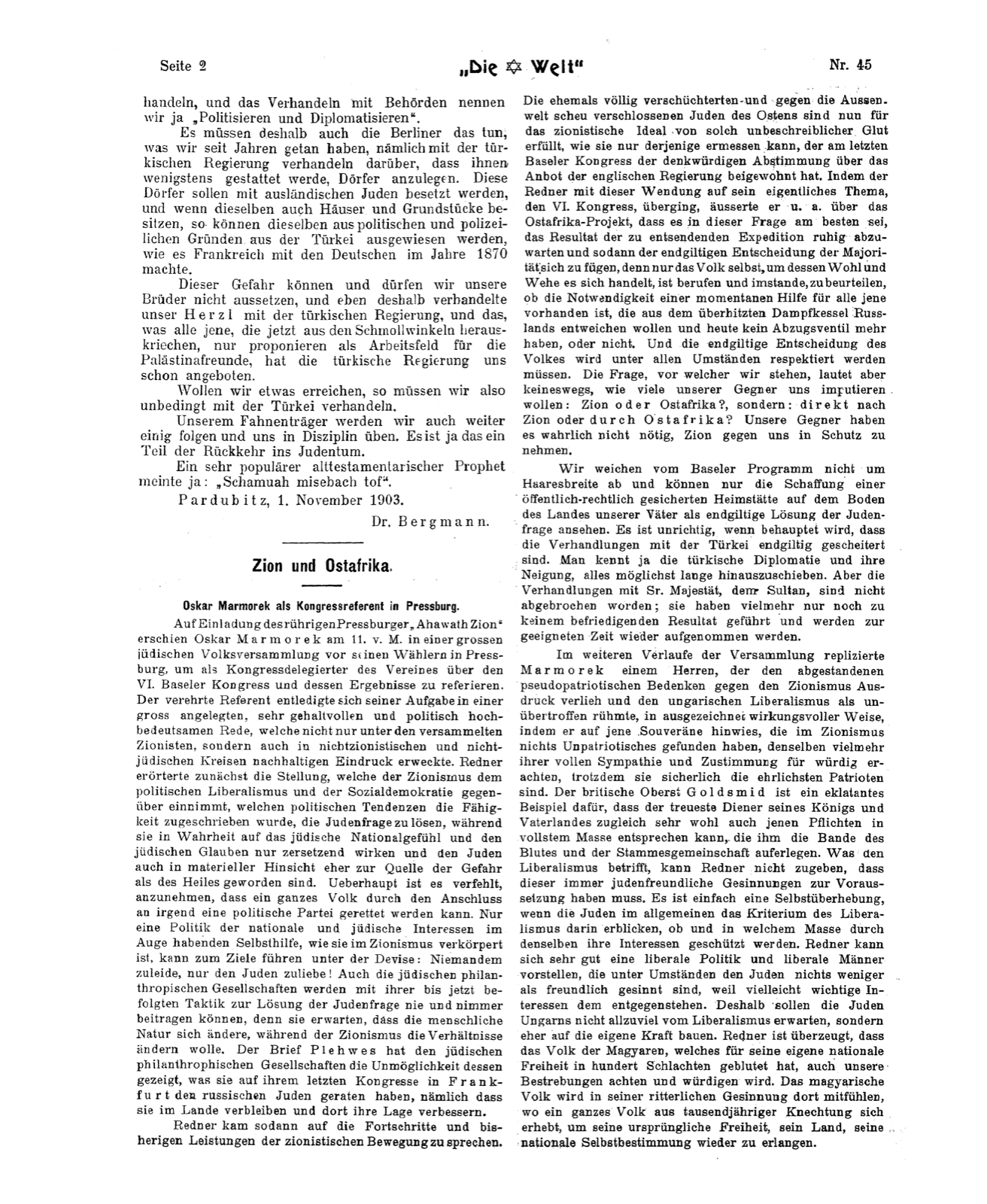
Page 2 — "Die ✡ Welt" — No. 45
(continued from page 1)
...gotiate with the Turkish authorities, and negotiating with authorities is, after all, what we call "politicking and diplomatising".
The Berliners, too, must therefore do what we have been doing for years, namely negotiate with the Turkish Government that they may at least be permitted to lay out villages. These villages are to be peopled with foreign Jews, and even if these own houses and land, they can be expelled from Turkey on political and police grounds, as France did with the Germans in the year 1870.
To this danger we cannot and may not expose our brethren, and it was precisely for this reason that our Herzl negotiated with the Turkish Government; and what all those who are now creeping out of their sulking-corners merely propose as a field of work for the friends of Palestine, the Turkish Government has already offered us.
If we wish to achieve anything, then, we must unconditionally negotiate with Turkey.
We shall continue to follow our standard-bearer in unity and to practise ourselves in discipline. That, indeed, is a part of the return to Judaism.
A very popular prophet of the Old Testament said, after all: "Schamuah misebach tof".
Pardubitz, 1 November 1903.
Dr. Bergmann.
Zion and East Africa.
Oskar Marmorek as Congress Reporter in Pressburg.
At the invitation of the active Pressburg "Ahawath Zion", Oskar Marmorek appeared on the 11th ult. before his electors in Pressburg at a large Jewish public meeting, in order to report, as the society's Congress delegate, on the Sixth Basle Congress and its results. The honoured speaker acquitted himself of his task in a broadly conceived, most substantial and politically highly significant address, which made a lasting impression not only among the Zionists assembled but also in non-Zionist and non-Jewish circles. The speaker first discussed the position which Zionism takes towards political Liberalism and towards Social Democracy — political tendencies to which the capacity to solve the Jewish question had been ascribed, whereas in truth they act only as a solvent upon Jewish national feeling and the Jewish faith, and have become for the Jews, in material respects as well, a source of danger rather than of salvation. It is altogether mistaken to suppose that a whole people can be saved by joining any political party whatever. Only a policy of self-help, keeping national and Jewish interests in view, such as is embodied in Zionism, can lead to the goal, under the device: To the harm of none, only for the good of the Jews! Nor will the Jewish philanthropic societies, with the tactics they have followed hitherto, ever be able to contribute to the solution of the Jewish question, for they expect human nature to change, whereas Zionism would change conditions. Plehve's letter has shown the Jewish philanthropic societies the impossibility of what they advised the Russian Jews at their last congress in Frankfort, namely that they should remain in the country and improve their lot there.
The speaker then came to speak of the progress and the achievements to date of the Zionist movement. The Jews of the East, once utterly cowed and timidly shut off from the outside world, are now filled with such indescribable ardour for the Zionist ideal as only he can measure who was present at the last Basle Congress at the memorable vote on the offer of the English Government. Passing with this turn to his proper theme, the Sixth Congress, the speaker remarked among other things on the East Africa project that in this question it was best calmly to await the result of the expedition about to be sent out and then to submit to the final decision of the majority; for only the people itself, whose weal and woe are at stake, is called and able to judge whether or not there exists the necessity of momentary help for all those who wish to escape from the overheated boiler of Russia and to-day have no safety-valve left. And the final decision of the people will have to be respected under all circumstances. The question before us, however, is by no means, as many of our opponents would impute to us: Zion or East Africa?, but rather: directly to Zion, or by way of East Africa? Our opponents truly have no need to take Zion under their protection against us.
We do not depart by a hair's breadth from the Basle Programme, and we can regard only the creation of a home secured by public law on the soil of the land of our fathers as the final solution of the Jewish question. It is incorrect to assert that the negotiations with Turkey have definitively failed. One knows Turkish diplomacy and its inclination to put everything off as long as possible. But the negotiations with His Majesty the Sultan have not been broken off; they have merely not yet led to any satisfactory result, and they will be resumed at the proper time.
In the further course of the meeting Marmorek replied, with excellent effect, to a gentleman who gave expression to the stale pseudo-patriotic objections to Zionism and extolled Hungarian Liberalism as unsurpassed, by pointing to those sovereigns who have found nothing unpatriotic in Zionism but rather have deemed it worthy of their full sympathy and approval, although they are assuredly the most honest of patriots. The British Colonel Goldsmid is a striking example of how the most faithful servant of his King and country can at the same time very well fulfil in the fullest measure those duties which the bonds of blood and of common descent lay upon him. As regards Liberalism, the speaker cannot admit that it must always presuppose sentiments friendly to the Jews. It is simply presumption when the Jews in general see the criterion of Liberalism in whether, and in what measure, their interests are protected by it. The speaker can very well imagine a Liberal policy and Liberal men who, under certain circumstances, are anything but friendly towards the Jews, because important interests perhaps stand in the way. Therefore the Jews of Hungary should not expect overmuch from Liberalism, but should rather build upon their own strength. The speaker is convinced that the Magyar people, which has bled in a hundred battles for its own national freedom, will also respect and appreciate our aspirations. The Magyar people, in its chivalrous spirit, will feel with a whole people that rises from a thousand years of bondage to regain its original freedom, its land, its national self-determination.