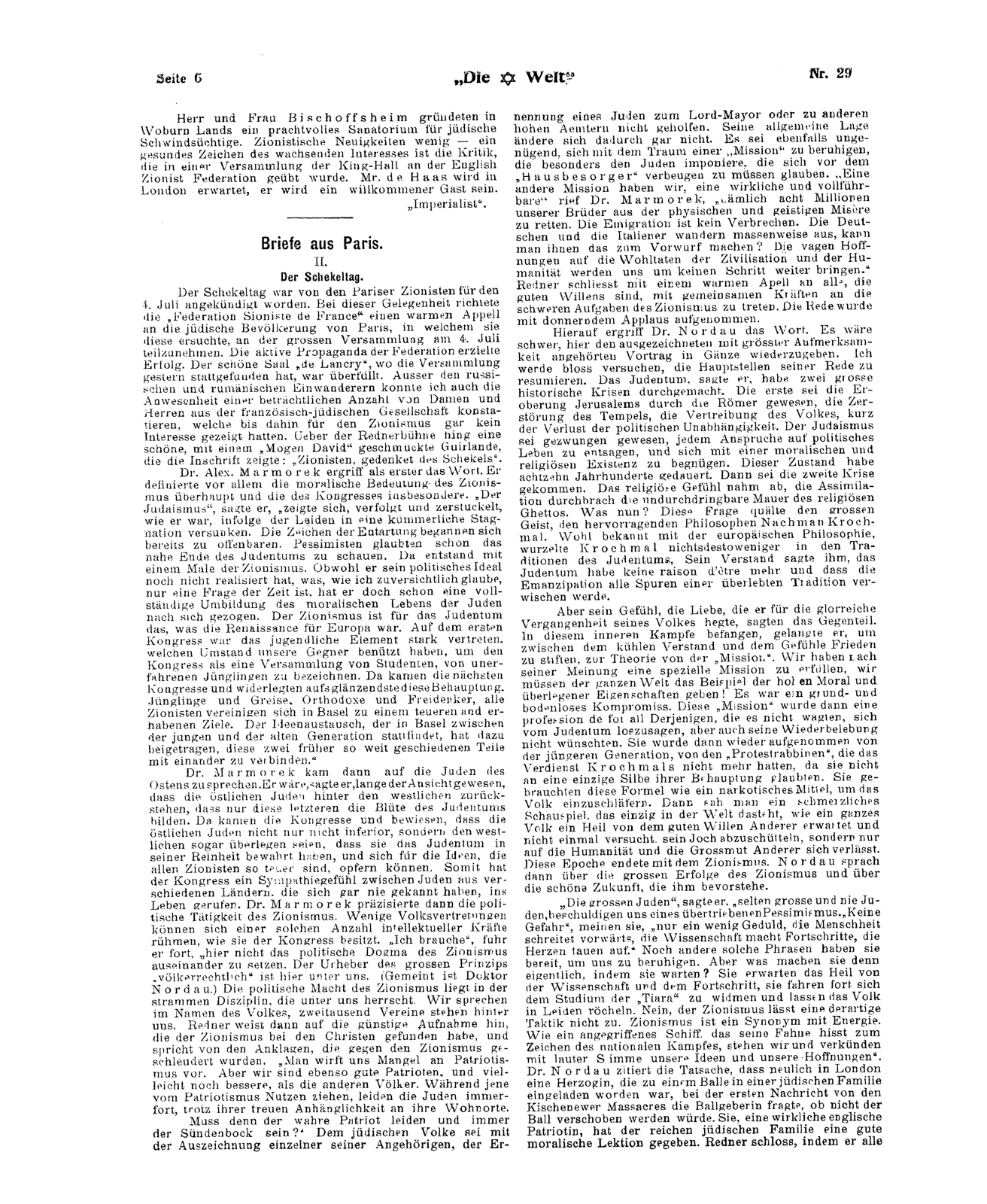
Page 6. — "Die Welt" — No. 29.
Mr. and Mrs. Bischoffsheim have founded at Woburn Lands a splendid sanatorium for Jewish consumptives. Of Zionist news there is little — a healthy sign of growing interest is the criticism levelled at the English Zionist Federation at a meeting in the King-Hall. Mr. de Haas is expected in London; he will be a welcome guest.
"Imperialist".
Letters from Paris.
II. The Shekel Day.
The Shekel Day had been announced by the Paris Zionists for the 4th of July. On this occasion the "Federation Sioniste de France" addressed a warm appeal to the Jewish population of Paris, in which it asked them to take part in the great meeting on the 4th of July. The active propaganda of the Federation met with success. The handsome hall "de Lancry", where the meeting took place yesterday, was overcrowded. Besides the Russian and Roumanian immigrants, I was also able to note the presence of a considerable number of ladies and gentlemen from French-Jewish society, who until then had shown no interest whatever in Zionism. Above the platform hung a fine garland adorned with a "Mogen David", bearing the inscription: "Zionists, remember the Shekel".
Dr. Alex. Marmorek was the first to speak. He defined, above all, the moral significance of Zionism in general and of the Congress in particular. "Judaism," he said, "persecuted and dismembered as it was, appeared, in consequence of its sufferings, sunk in a wretched stagnation. The signs of degeneration were already beginning to show themselves. Pessimists already believed they beheld the approaching end of Jewry. Then, all at once, Zionism arose. Although it has not yet realised its political ideal — which, as I confidently believe, is only a question of time — it has nevertheless already brought in its train a complete transformation of the moral life of the Jews. Zionism is for Jewry what the Renaissance was for Europe. At the first Congress the youthful element was strongly represented, a circumstance which our opponents made use of to describe the Congress as an assembly of students, of inexperienced youths. Then came the following Congresses and refuted this assertion most brilliantly. Youths and old men, Orthodox and freethinkers, all Zionists unite at Basle for one dear and exalted aim. The exchange of ideas which takes place at Basle between the young and the old generation has helped to bind together these two parts, formerly so widely sundered."
Dr. Marmorek then came to speak of the Jews of the East. He had long been of the opinion, he said, that the Eastern Jews were behind the Western, that only the latter formed the flower of Jewry. Then came the Congresses and proved that the Eastern Jews were not only not inferior, but even superior to the Western, that they had preserved Judaism in its purity, and could sacrifice themselves for the ideas so dear to all Zionists. Thus the Congress has called into being a feeling of sympathy between Jews from different countries who had never known one another at all. Dr. Marmorek then set forth precisely the political activity of Zionism. Few national assemblies can boast of such a number of intellectual forces as the Congress possesses. "I need not," he continued, "expound here the political dogma of Zionism. The author of the great principle "völkerrechtlich" is here among us. (Doctor Nordau is meant.) The political power of Zionism lies in the strict discipline that prevails among us. We speak in the name of the people; two thousand societies stand behind us. The speaker then pointed to the favourable reception Zionism had found among Christians, and spoke of the charges that had been hurled against Zionism. "We are reproached with a want of patriotism. But we are just as good patriots, and perhaps even better, than the other peoples. While they draw profit from patriotism, the Jews suffer continually, in spite of their faithful attachment to their places of abode. Must the true patriot, then, suffer and always be the scapegoat?* The Jewish people, he said, was not helped by the distinction of individual members, by the appointment of a Jew as Lord Mayor or to other high offices. Its general situation was not changed thereby in the least. It was likewise insufficient to lull oneself with the dream of a "mission", which impressed especially those Jews who believe they must bow down before the "house-porter". "Another mission we have, a real and a practicable one," cried Dr. Marmorek, "namely, to rescue eight millions of our brethren from physical and intellectual misery. Emigration is no crime. The Germans and the Italians emigrate in masses; can one reproach them with that? Vague hopes in the blessings of civilisation and humanity will not bring us a single step further." The speaker closed with a warm appeal to all men of good will to set about the heavy tasks of Zionism with united strength. The speech was received with thunderous applause.
Thereupon Dr. Nordau took the floor. It would be difficult to reproduce here in its entirety the excellent address, which was listened to with the greatest attention. I shall merely try to summarise the chief passages of his speech. Jewry, he said, had passed through two great historical crises. The first had been the conquest of Jerusalem by the Romans, the destruction of the Temple, the expulsion of the people — in short, the loss of political independence. Judaism had been compelled to renounce every claim to a political life and to content itself with a moral and religious existence. This condition had lasted eighteen centuries. Then had come the second crisis. Religious feeling declined; assimilation broke through the impenetrable wall of the religious ghetto. What now? This question tormented the great mind, the eminent philosopher Nachman Krochmal. Well acquainted with European philosophy, Krochmal was nonetheless rooted in the traditions of Judaism. His reason told him that Judaism no longer had any raison d'être and that emancipation would efface all traces of an outlived tradition.
But his feeling, the love he bore for the glorious past of his people, said the contrary. Caught in this inner struggle, he arrived, in order to make peace between cool reason and feeling, at the theory of the "mission". We have, in his opinion, a special mission to fulfil; we must give the whole world the example of lofty morality and superior qualities! It was a compromise without ground or foundation. This "mission" then became the profession de foi of all those who did not dare to break away from Judaism, but who also did not desire its revival. It was then taken up again by the younger generation, by the "protest rabbis", who no longer had Krochmal's merit, since they did not believe a single syllable of their own assertion. They used this formula like a narcotic, to lull the people to sleep. Then was seen a painful spectacle, unique in the world: how an entire people awaited its salvation from the good will of others and did not even try to shake off its yoke, but relied only on the humanity and magnanimity of others. This epoch ended with Zionism. Nordau then spoke of the great successes of Zionism and of the fair future that lay before it.
"The great Jews," he said, "seldom great and never Jews, accuse us of an exaggerated pessimism. 'No danger,' they say, 'only a little patience; mankind is advancing, science is making progress, hearts are thawing.' Still other such phrases they have ready to reassure us. But what, then, are they actually doing while they wait? They expect salvation from science and progress, they go on devoting themselves to the study of the 'Tiara', and leave the people to groan in its sufferings. No, Zionism does not admit of tactics of that kind. Zionism is a synonym for energy. Like a ship under attack that hoists its flag in token of the national struggle, we stand and proclaim with a loud voice our ideas and our hopes." Dr. Nordau cited the fact that recently in London a duchess who had been invited to a ball at the house of a Jewish family, on the first news of the Kishineff massacres asked the hostess whether the ball would not be postponed. She, a true English patriot, gave the rich Jewish family a good moral lesson. The speaker closed, in that he all