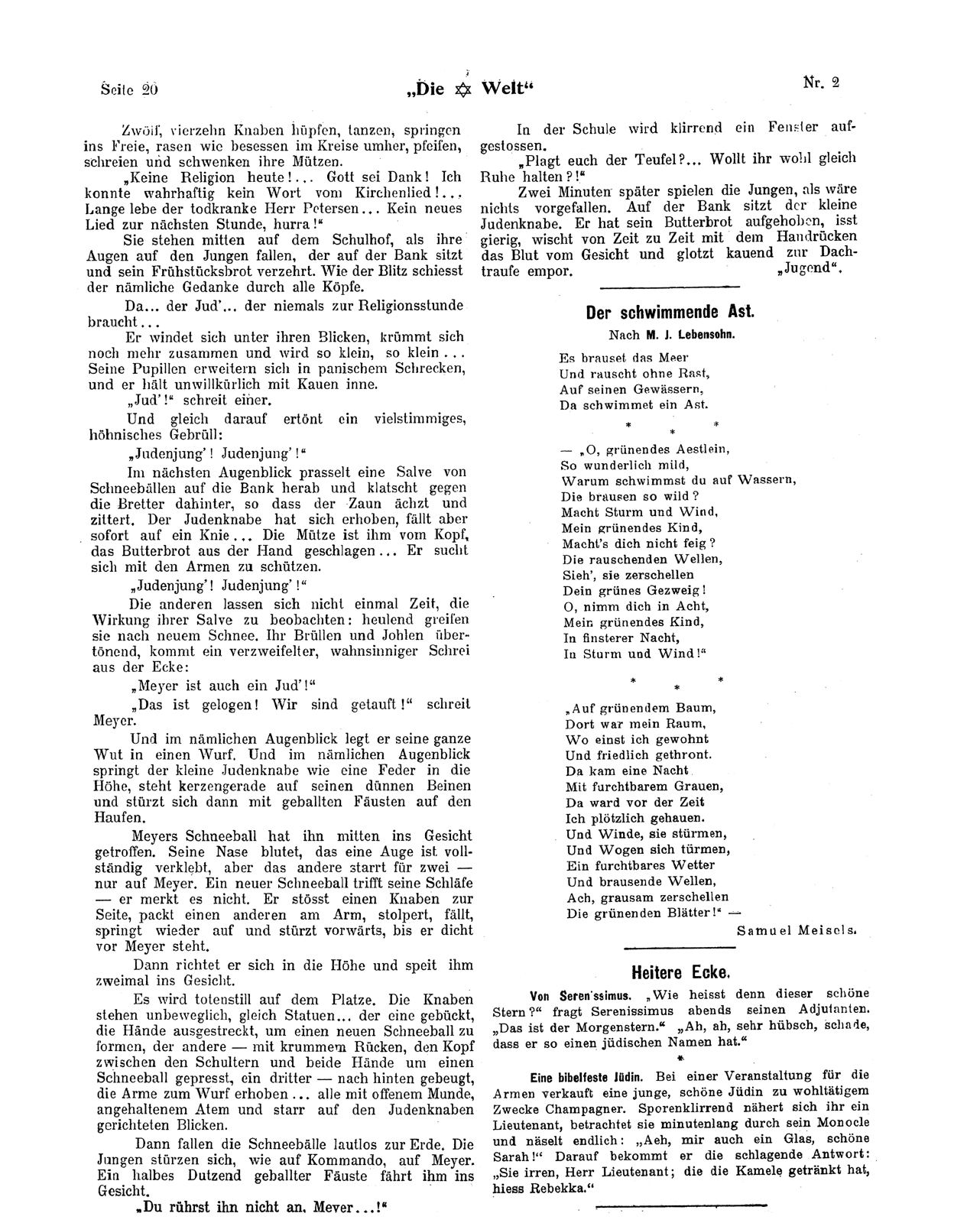
Page 20. — "Die Welt" — No. 2.
Twelve, fourteen boys hop, dance, leap out into the open, race round in a circle like things possessed, whistle, shout and wave their caps.
"No Religion to-day!... Thank God! I truly didn't know a word of the hymn!... Long live Mr. Petersen, sick unto death... No new hymn for next lesson, hurrah!"
They are standing in the middle of the schoolyard when their eyes fall on the boy who sits on the bench eating his breakfast bread. Like lightning the selfsame thought shoots through every head.
There... the Jew... who never has to go to Religion...
He writhes under their looks, hunches himself up still more and grows so small, so small... His pupils dilate in panic terror, and involuntarily he stops chewing.
"Jew!" one shouts.
And at once there rises a many-voiced, jeering roar:
"Jew-boy! Jew-boy!"
The next moment a volley of snowballs rattles down upon the bench and smacks against the boards behind, so that the fence groans and quivers. The Jewish boy has risen, but falls at once on one knee... His cap has been knocked off his head, the bread and butter out of his hand... He tries to shield himself with his arms.
"Jew-boy! Jew-boy!"
The others do not even take time to watch the effect of their volley: howling, they snatch up fresh snow. Drowning their roaring and hooting, a desperate, frenzied cry comes from the corner:
"Meyer is a Jew too!"
"That's a lie! We're baptised!" shouts Meyer.
And in that same instant he puts all his fury into one throw. And in that same instant the little Jewish boy springs up like a spring, stands bolt upright on his thin legs, and then hurls himself with clenched fists upon the crowd.
Meyer's snowball has struck him full in the face. His nose is bleeding, one eye is completely gummed shut, but the other stares for two — at Meyer alone. A fresh snowball hits his temple — he does not notice it. He shoves one boy aside, seizes another by the arm, stumbles, falls, springs up again and rushes forward until he stands right in front of Meyer.
Then he draws himself up and spits twice in his face.
A deathly stillness falls upon the yard. The boys stand motionless, like statues... one stooping, hands outstretched to shape a new snowball, another — with bent back, head between his shoulders and both hands pressed round a snowball, a third — leaning backward, arms raised to throw... all with open mouths, bated breath, and eyes fixed rigidly on the Jewish boy.
Then the snowballs drop soundlessly to the ground. The boys, as if at a word of command, fling themselves upon Meyer. Half a dozen clenched fists fly into his face.
"Don't you touch him, Meyer...!"
In the school a window is flung open with a clatter.
"Has the devil got into you?... Will you be quiet this minute?!"
Two minutes later the boys are playing as though nothing had happened. On the bench sits the little Jewish boy. He has picked up his bread and butter, eats greedily, wipes the blood from his face now and then with the back of his hand, and stares up, chewing, at the eaves.
"Jugend."
The Floating Bough.
After M. J. Lebensohn.
The sea is roaring And surges without rest; Upon its waters A bough floats abreast.
* * *
— "O little green bough, So wondrously mild, Why float'st thou on waters That roar so wild?
Do storm and wind, My green-growing child, Not make thee afraid? The thundering billows, See, how they shatter Thy green-leaved spray! O, have a care, My green-growing child, In the darksome night, In storm and wind!"
* * *
"On a green-growing tree, There my dwelling was, Where once I abode And in peace was enthroned. Then came a night Of terrible dread, And before my time I was suddenly hewn. And the winds, they are storming, And the billows are towering, A terrible tempest And roaring waves — Ah, cruelly shattered The green-growing leaves!" —
Samuel Meisels.
Merry Corner.
From Serenissimus. "What is the name of that beautiful star?" Serenissimus asks his aide-de-camp one evening. "That is the Morgenstern." "Ah, ah, very pretty; a pity it has such a Jewish name."
*
A Jewess Well Read in the Bible. At an entertainment for the poor, a young and beautiful Jewess is selling champagne for charity. With jingling spurs a lieutenant approaches her, considers her for minutes on end through his monocle, and at last drawls through his nose: "Aw, a glass for me too, fair Sarah!" Whereupon he receives the crushing reply: "You are mistaken, Lieutenant; the one who watered the camels was called Rebecca."