No. 1 — "Die Welt" — Page 3
(continued from page 2)
...ally from the land of the Nile after 430 years' sojourn, strongly mingled with Egyptian blood. Nevertheless the principle of the prohibition of marriage with alien blood remained in force at all times, and was only the more sharply expressed by Moses and his prophetic emulators in the Law of Jahveh and made, as it were, the law of laws. Moses was the ethical and ethnic regenerator of his people, and the Prophets had, as Lagarde puts it, "the instinct for the ethos and for Israel; in them there burns for the first time in history the flame of patriotism in the purest light, of that patriotism which sees in the fatherland not the time-honoured habit of a pleasant existence, but the bearer of a great task, the earthly body of an idea." (Deutsche Schriften, p. 224.) For centuries after its return from Egypt the people of Israel had enjoyed an undisturbed development in the secluded land, during which the
court with all its officials was led into exile, the young king Joakhin and his mother, besides 7000 men of war with 1000 guards, further "the first of all estates and noble families in the whole land, of the priestly order as of the others." (Ewald, Geschichte des Volkes Israel, III., 433.) The number of all those carried away on this occasion is estimated at 10,000. After the second rising against the Chaldeans, these, as the II. Book of Kings (XXIV, 14) reports, left only the lower strata of the people in the land. When the meagre remnants of these captives, released by Cyrus, returned to Judæa, no conviction "of the ethical value of the vital elements present in Israel" any longer held them together. This new community*) would have remained a miserable ruin if, as Lagarde says (loc. cit.), "Zealotism with its hydraulic pressure had not compressed the heterogeneous building-stones into a new mass. The
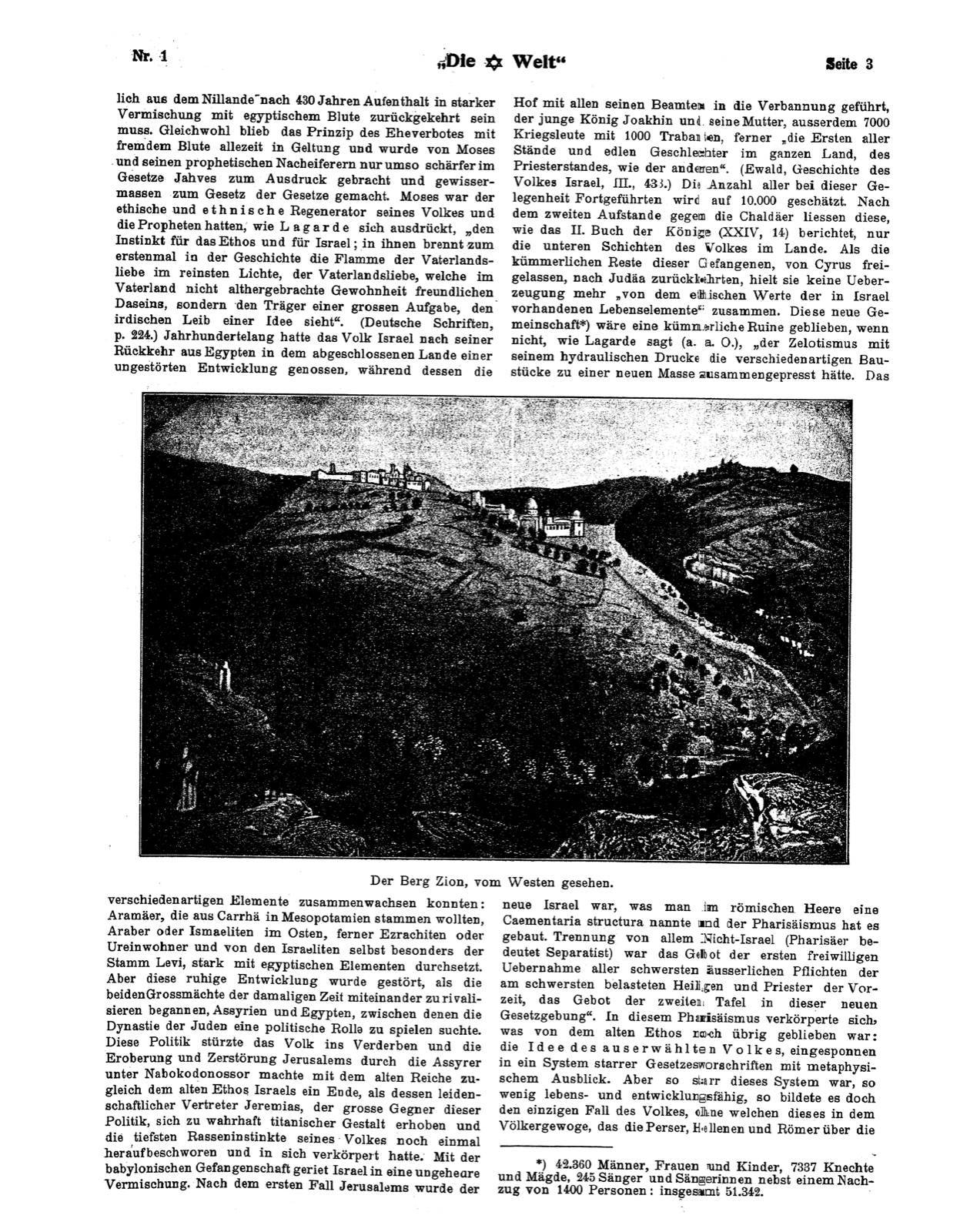
Mount Zion, seen from the West.
heterogeneous elements were able to grow together: Aramæans, who claimed to come from Carrhæ in Mesopotamia, Arabs or Ishmaelites in the East, further Ezrachites or aborigines, and of the Israelites themselves especially the tribe of Levi, strongly interspersed with Egyptian elements. But this quiet development was disturbed when the two great powers of that age, Assyria and Egypt, began to vie with one another, and between them the dynasty of the Jews sought to play a political part. This policy plunged the people into ruin, and the conquest and destruction of Jerusalem by the Assyrians under Nabokodonossor put an end, together with the old kingdom, to the old ethos of Israel, whose passionate champion, Jeremiah, the great opponent of this policy, had risen to a truly titanic stature and had once more conjured up and embodied in himself the deepest racial instincts of his people. With the Babylonian captivity Israel fell into an enormous intermingling. After the first fall of Jerusalem the
new Israel was what in the Roman army was called a caementaria structura, and Pharisaism built it. Separation from all that was not Israel (Pharisee means separatist) was the command of the first voluntary assumption of all the heaviest outward duties of the most heavily burdened saints and priests of former times, the command of the second table in this new legislation." In this Pharisaism was embodied what still remained of the old ethos: the idea of the chosen people, spun into a system of rigid legal precepts with a metaphysical outlook. But rigid as this system was, and little capable of life and development, it nevertheless formed the sole stay of the people, without which the latter, in the surge of peoples which the Persians, Hellenes and Romans over the
*) 42,360 men, women and children, 7337 men-servants and maid-servants, 245 singing men and singing women, together with a later contingent of 1400 persons: in all 51,342.