Page 21.
(continued from page 20)
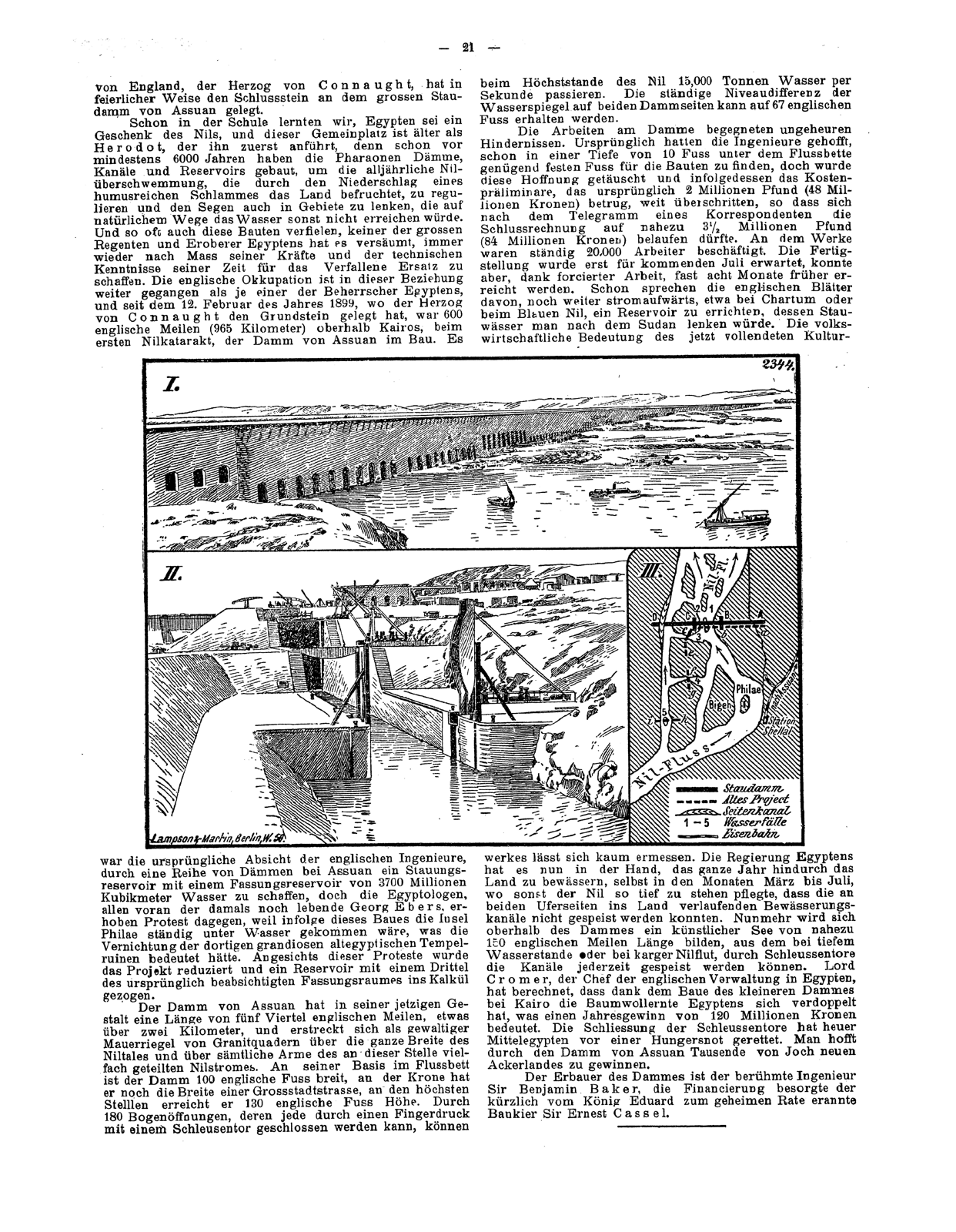
…of England, the Duke of Connaught, has with due ceremony laid the keystone of the great barrage at Assuan. Even at school we learned that Egypt is a gift of the Nile, and this commonplace is older than Herodotus, who first records it; for at least 6000 years ago the Pharaohs were already building dams, canals and reservoirs to regulate the yearly inundation of the Nile, which fertilises the land by depositing a humus-rich silt, and to direct its blessing also into regions which the water would not otherwise reach by natural means. And however often these works fell into decay, none of the great rulers and conquerors of Egypt neglected, again and again, according to the measure of his strength and the technical knowledge of his age, to replace what had decayed. The English occupation has in this respect gone further than any ruler of Egypt ever did, and since the 12th of February of the year 1899, when the Duke of Connaught laid the foundation-stone, the dam of Assuan has been under construction 600 English miles (965 kilometres) above Cairo, at the first cataract of the Nile. It at the highest level of the Nile 15,000 tons of water per second pass. The constant difference of level between the water surfaces on the two sides of the dam can be maintained at 67 English feet. The work on the dam met with enormous obstacles. The engineers had originally hoped to find sufficiently firm footing for the structure at a depth of only 10 feet below the river-bed, but this hope was disappointed, and in consequence the preliminary estimate, which originally amounted to 2 million pounds (48 million kronen), was far exceeded, so that, according to the telegram of a correspondent, the final account is likely to come to nearly 3½ million pounds (84 million kronen). Twenty thousand workmen were constantly employed on the work. Its completion was not expected until next July, but, thanks to work pressed forward at speed, it could be achieved almost eight months earlier. The English papers are already speaking of building a reservoir still further up-stream, at about Khartoum or on the Blue Nile, whose impounded waters would be led towards the Soudan. The economic significance of the now completed work of civilisa-
I.
II.
III.
Lampson&Martin, Berlin, W. 50.
2344
Philae Bigeh Nile River Assuan Station Shellal
Dam Old Project Side Canal Waterfalls Railway
was the original intention of the English engineers to create, by a series of dams at Assuan, a storage reservoir with a capacity of 3700 million cubic metres of water; but the Egyptologists, foremost among them Georg Ebers, then still living, raised a protest against it, because in consequence of this work the island of Philae would have been permanently under water, which would have meant the destruction of the magnificent ancient Egyptian temple ruins there. In view of these protests the project was reduced, and a reservoir with one third of the capacity originally intended was taken into account.
The dam of Assuan in its present form has a length of five quarters of an English mile, somewhat over two kilometres, and stretches as a mighty barrier-wall of granite blocks across the whole breadth of the Nile valley and across all the arms of the Nile, which is at this point divided into many channels. At its base in the river-bed the dam is 100 English feet broad; at the crown it still has the breadth of a street in a great city; at its highest points it reaches a height of 130 English feet. Through 180 arched openings, each of which can be closed by a sluice-gate at the pressure of a finger, can tion can scarcely be measured. The Government of Egypt now has it in its power to irrigate the land throughout the whole year, even in the months from March to July, when the Nile was otherwise wont to stand so low that the irrigation canals running inland on both banks could not be fed. Henceforth an artificial lake of nearly 150 English miles in length will form above the dam, from which, at low water or at a scanty Nile flood, the canals can be fed at any time through sluice-gates. Lord Cromer, the head of the English administration in Egypt, has calculated that, thanks to the construction of the smaller dam near Cairo, the cotton crop of Egypt has doubled, which means an annual gain of 120 million kronen. The closing of the sluice-gates this year saved Middle Egypt from a famine. It is hoped that by the dam of Assuan thousands of Joch of new arable land will be won.
The builder of the dam is the celebrated engineer Sir Benjamin Baker; the financing was undertaken by the banker Sir Ernest Cassel, lately appointed a Privy Councillor by King Edward.