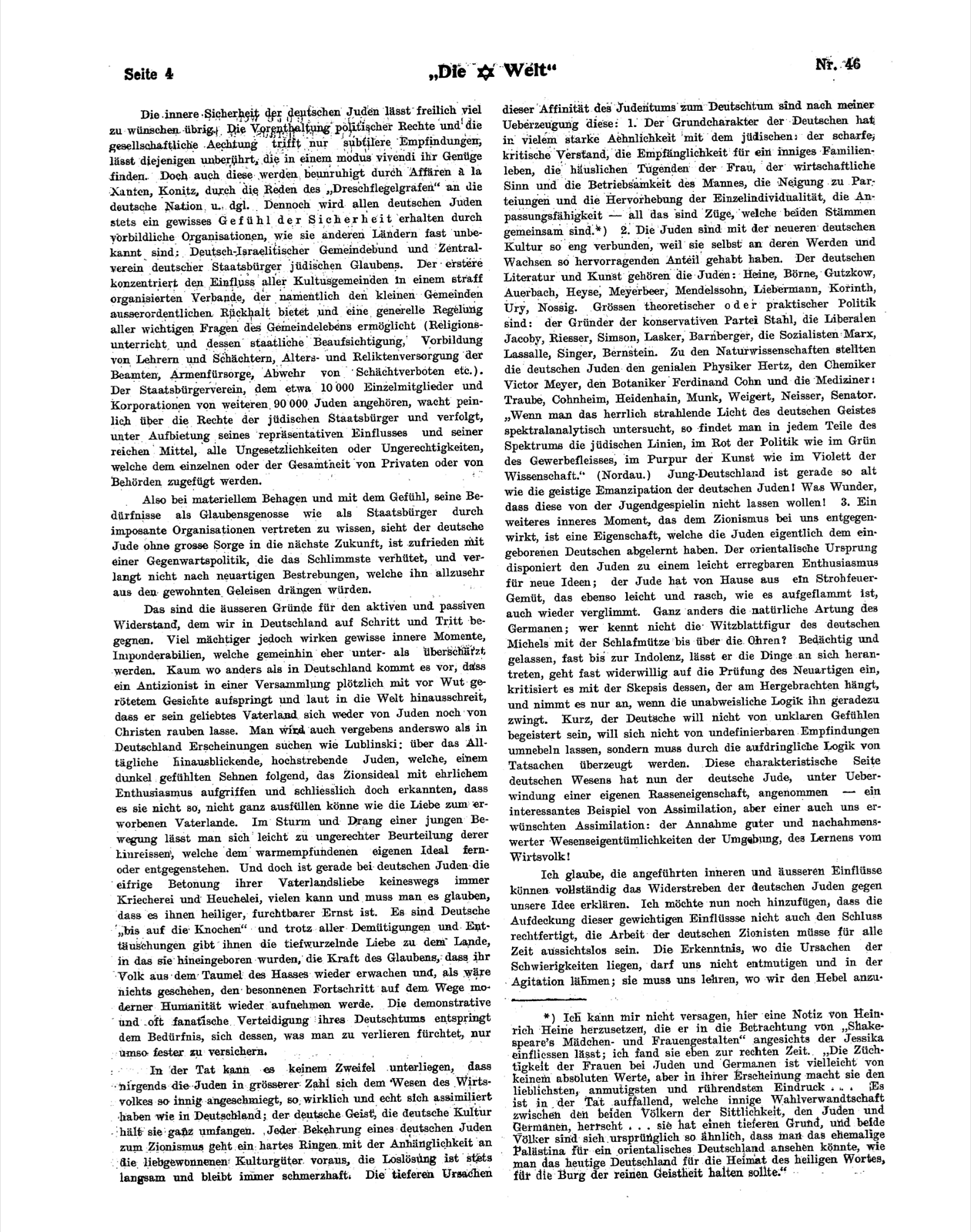
Page 4 — "Die Welt" — No. 46
The inner security of the German Jews, it is true, leaves much to be desired. The withholding of political rights and social ostracism touch only the more delicate sensibilities; they leave untouched those who find their contentment in a modus vivendi. Yet these too are disquieted by affairs à la Xanten and Konitz, by the speeches of the "Flail Count" to the German nation, and the like. Nevertheless a certain feeling of security is always preserved to all German Jews by model organisations such as are almost unknown to other countries: the German-Israelite Union of Communities and the Central Association of German Citizens of the Jewish Faith. The former concentrates the influence of all the Jewish Communities in a tightly organised federation, which affords extraordinary support especially to the small Communities and makes possible a general regulation of all the important questions of communal life (religious instruction and its supervision by the State, the training of teachers and of shochetim, provision for the old age and for the survivors of officials, poor relief, resistance to prohibitions of shechitah, etc.). The Citizens' Association, to which some 10,000 individual members and corporations of a further 90,000 Jews belong, watches scrupulously over the rights of Jewish citizens and, bringing to bear its representative influence and its ample means, prosecutes all illegalities or injustices inflicted upon the individual or upon the community by private persons or by the authorities.
Thus, in material comfort and with the feeling of knowing his needs, both as a co-religionist and as a citizen, represented by imposing organisations, the German Jew faces the near future without great anxiety, is content with a policy of the present which averts the worst, and has no desire for novel endeavours which would force him too far out of the accustomed ruts.
These are the external reasons for the active and passive resistance which we meet at every step in Germany. Far more powerfully, however, certain internal factors are at work — imponderables, which are commonly rather under- than over-estimated. Scarcely anywhere but in Germany does it happen that an anti-Zionist at a meeting suddenly leaps up, his face red with rage, and cries aloud to the world that he will let his beloved fatherland be robbed from him neither by Jews nor by Christians. One will also seek in vain elsewhere than in Germany for phenomena like Lublinski: high-aspiring Jews, looking beyond the everyday, who, following a dimly felt longing, took up the ideal of Zion with honest enthusiasm and yet in the end recognised that it could not fill them so, wholly wholly, as love for the fatherland they had acquired. In the storm and stress of a young movement one is easily carried away into unjust judgment of those who stand aloof from, or opposed to, one's own warmly felt ideal. And yet it is precisely among German Jews that the zealous emphasis upon their love of fatherland is by no means always servility and hypocrisy; of many one can and must believe that it is holy, terrible earnest with them. They are Germans "to the bone," and in spite of all humiliations and disappointments the deep-rooted love for the land into which they were born gives them the strength of the faith that their people will awaken once more from the frenzy of hatred and, as though nothing had happened, will resume its deliberate progress upon the path of modern humanity. The demonstrative and often fanatical defence of their Germanism springs from the need to assure oneself all the more firmly of that which one fears to lose.
In fact there can be no doubt that nowhere have the Jews in greater number so closely adapted themselves to the character of the host people, so really and genuinely assimilated themselves, as in Germany; the German spirit, German culture holds them wholly embraced. Every conversion of a German Jew to Zionism is preceded by a hard struggle with his attachment to the cultural treasures grown dear to him; the detachment is always slow and remains ever painful. The deeper causes of this affinity of Judaism for Germanism are, in my conviction, these: 1. The fundamental character of the Germans has in many respects a strong resemblance to the Jewish: the keen, critical understanding, the susceptibility to an intimate family life, the domestic virtues of the woman, the economic sense and the industriousness of the man, the inclination to party divisions and the emphasising of the single individuality, adaptability — all these are traits common to both races.*) 2. The Jews are so closely bound up with modern German culture because they themselves have had so eminent a share in its growth and development. To German literature and art belong the Jews: Heine, Börne, Gutzkow, Auerbach, Heyse, Meyerbeer, Mendelssohn, Liebermann, Korinth, Ury, Nossig. Great figures of theoretical or practical politics are: the founder of the Conservative party, Stahl; the Liberals Jacoby, Riesser, Simson, Lasker, Bamberger; the Socialists Marx, Lassalle, Singer, Bernstein. To the natural sciences the German Jews have contributed the brilliant physicist Hertz, the chemist Victor Meyer, the botanist Ferdinand Cohn, and the medical men: Traube, Cohnheim, Heidenhain, Munk, Weigert, Neisser, Senator. "If one examines spectroscopically the gloriously radiant light of the German spirit, one finds in every part of the spectrum the Jewish lines, in the red of politics as in the green of industry, in the purple of art as in the violet of science." (Nordau.) Young Germany is just as old as the intellectual emancipation of the German Jews! What wonder that they will not part from the playmate of their youth! 3. A further internal factor which works against Zionism among us is a quality which the Jews have in fact learned from the native German. His Oriental origin disposes the Jew to a readily excitable enthusiasm for new ideas; the Jew has by nature a temperament like a fire of straw, which dies down again as easily and as quickly as it flared up. Quite otherwise the natural disposition of the German; who does not know the comic-paper figure of the German Michel with his nightcap pulled down over his ears? Deliberate and composed, almost to the point of indolence, he lets things come to him, enters almost unwillingly upon the examination of what is new, criticises it with the scepticism of one who clings to the traditional, and accepts it only when inescapable logic positively compels him. In short, the German will not be fired by vague feelings, will not let himself be befogged by indefinable sensations, but must be convinced by the insistent logic of facts. This characteristic side of the German nature the German Jew has now adopted, overcoming a racial quality of his own — an interesting example of assimilation, but of an assimilation desirable to us as well: the adoption of good and imitable traits of character in one's surroundings, of learning from the host people!
I believe that the internal and external influences cited can fully explain the reluctance of the German Jews towards our idea. I should like to add, however, that the uncovering of these weighty influences does not also justify the conclusion that the work of the German Zionists must for all time be hopeless. The recognition of where the causes of the difficulties lie must not discourage us or paralyse us in our agitation; it must teach us where the lever is to be ap-
*) I cannot refrain from setting down here a note of Heinrich Heine's, which he lets fall in his study of "Shakespeare's Maidens and Women" on the occasion of Jessica; I came upon it just at the right time. "The chastity of women among Jews and Germans is perhaps of no absolute value, but in its manifestation it makes the loveliest, most graceful and most touching impression . . . It is in truth remarkable what an intimate elective affinity prevails between the two peoples of morality, the Jews and the Germans . . . it has a deeper ground, and both peoples were originally so alike that one might regard the Palestine of old as an Oriental Germany, just as one ought to hold the Germany of to-day for the home of the holy Word, for the stronghold of pure spirituality."