— 18 —
Where I journey, where I go, Where I sit, where I stand, There hovers before me a pallid image. Shape of terror! From hour to hour Ever paler, Hot tears come falling down, Ever richer, About the withered cheeks it twitches, Rigid out of weary eyes it peers, And a wild horror seizes me.
Do I write, upon the leaf it lives, Do I read, I see it on the book, All in vain that I seek To escape. Before me it hovers, Where I go and where I stand, Rigid and great, the pallid woe, — Till one day the grave shall close upon me And the image melt away into nothing.
*
The way is long, the day is short, The sun is sinking down already, The water roars, and the shore is far, — My ship, my ship goes down!
No wrestling avails here. The wind is whistling, The play grows motley and more motley, The sea is without end, the flood is wild, — My ship, my ship goes down!
Fare thee well, most lovely sun, fare well! Thou wilt soon shine blithely again, But I — so dreadfully roars the sea — My ship, my ship goes down! ...
Two Young Hebrews.
Feierberg and Berdyczewski.
By Dr. Marcus Ehrenpreis.
I.
They belong together, the two of them, like twin brothers. They have both the same awkwardness in their gestures, the same careworn, suffering expression in their faces, the same dream-lost, seeking longing in their eyes. They are both homeless men, who were suddenly and violently startled up out of the sweet dreams of their childhood and who, shivering and with chattering teeth, seek the new home with a thirsting soul. They are both young greybeards, early bowed by deep sorrow, early poisoned by a nameless loathing. Their books are full of unwept tears and of sighs that died away unheard. Both sought greedily the new way and the new goal. And when they were on the point of drawing nearer to one another, death drove them asunder.
Years ago I defined in this place*) what I understand by the designation "Young Hebrews." Feierberg and Berdyczewski unite in themselves all the marks of Young Hebrewdom. They are both transvaluers, ruthless shatterers of hallowed values of culture and seekers after new values, new ways, new contents of life for their people. They are both beginners; they have no forerunners, they are no grandsons. They are new in form and in content; they do not continue, but they begin.
In Feierberg and Berdyczewski — and for the present in them alone, if one leaves out of account the not yet wholly clarified poetical attempts of Bialik and Tschernichowski — our epoch, or more correctly the transitional character of our epoch, has found its literary expression. The sudden awakening, the complete rupture with ideals grown rotten, the passionate search after new ways and new goals, the shattering collision between the indestructible Semitic spirit and European culture, and lastly the ravenous hunger after the new world of beauty — all this lives in Feierberg and Berdyczewski; to all this they have lent expression in their books with youthful vehemence. They are both representative writers: out of them speaks a whole age, a generation of new Jews who have arisen and have gone forth to conquer new worlds, with the holy longing in their hearts and the young, passionate joy of life in their flaming eyes. With them the new Jews have entered into literature.
II.
Mordechai Zeb Feierberg did not, properly speaking, really live among us at all. He only flitted past, like a bird of passage out of far, far regions of the world, and in flitting past he rested a little while upon the bough of a tree, sang us a glorious, strange, far-off song — and flew on his way. That was his life, that his poetry. When he had risen, he was already going down. On the day when we were permitted to enjoy the singular beauty of this spirit, on that same day we had already to bear him to the grave — him who carried infinite riches in his soul and who had so much to give us.
Five-and-twenty years old was he when he closed for ever the eyes that had never seen the sun. Misunderstood, nay even tormented, by his fanatical family, cruelly persecuted by his small-town surroundings, deeply sickened by the narrowness of his milieu, consumed by a mortal sickness, encouraged and revered only by his few friends — so his body slowly died away, while his spirit grew and widened ever more, until in his "L'on" ("Whither?"), that testament of a seer written with his heart's blood, it reached a height before which we bow the head in reverence.
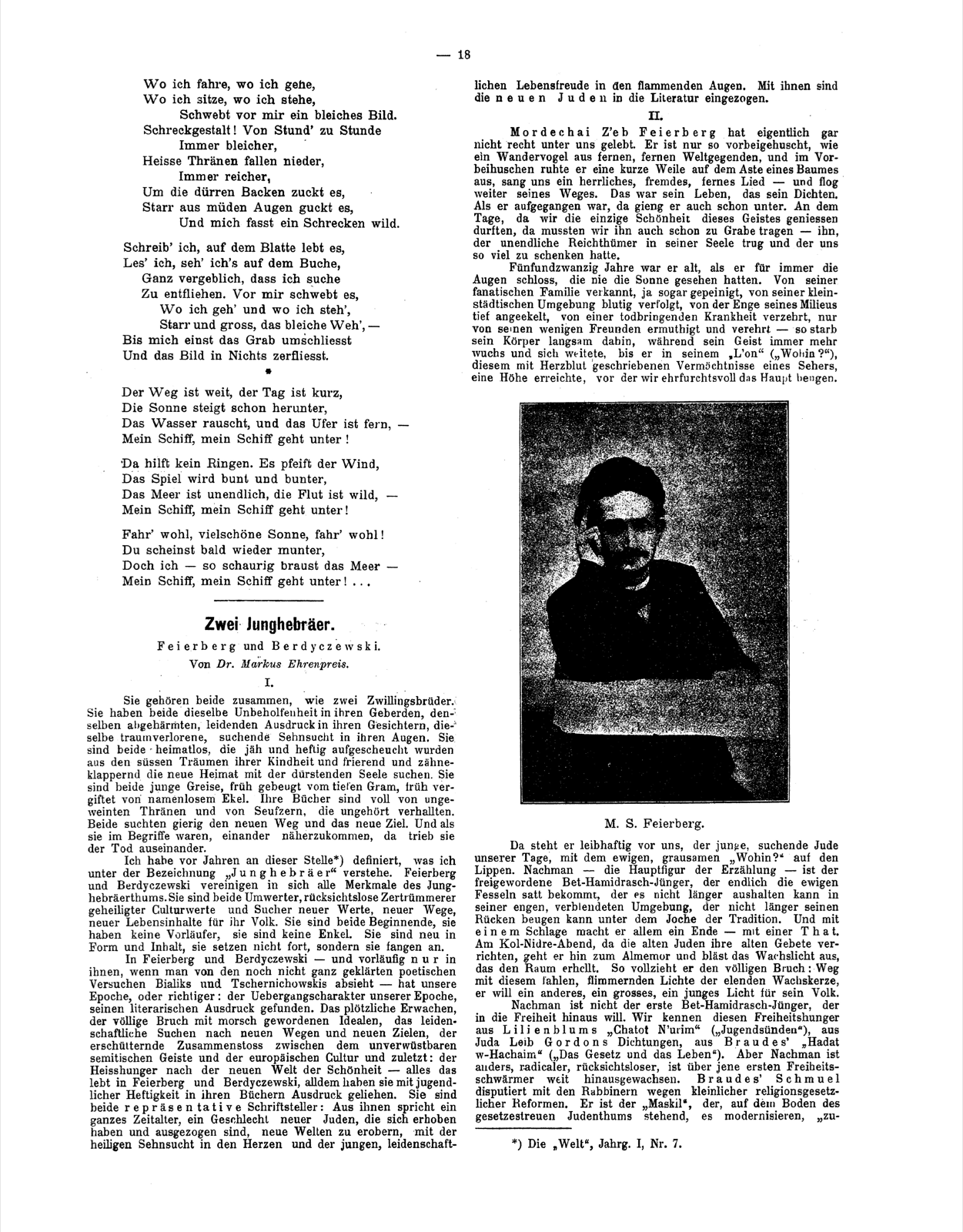
M. S. Feierberg.
There he stands bodily before us, the young, seeking Jew of our days, with the eternal, cruel "Whither?" upon his lips. Nachman — the chief figure of the tale — is the Bet-Hamidrasch disciple grown free, who has at last had enough of the everlasting fetters, who can no longer endure it in his narrow, blinded surroundings, who can no longer bow his back beneath the yoke of tradition. And at one stroke he makes an end of it all — by a deed. On the Kol-Nidre evening, when the old Jews are performing their old prayers, he goes up to the Almemor and blows out the wax light that lights the room. Thus he accomplishes the complete rupture: away with this pale, flickering light of the wretched wax candle; he will have another, a great, a young light for his people.
Nachman is not the first Bet-Hamidrasch disciple who would go forth into freedom. We know this hunger for freedom from Lilienblum's "Chatot N'urim" ("Sins of Youth"), from Juda Leib Gordon's poems, from Braudes' "Hadat w-Hachaim" ("The Law and Life"). But Nachman is other, more radical, more ruthless; he has far outgrown those first enthusiasts for freedom. Braudes' Schmuel disputes with the rabbis over petty reforms of the religious law. He is the "Maskil" who, standing upon the ground of law-abiding Jewry, would modernise it, "zu-
*) "Die Welt," Vol. I, No. 7.