— 11 —
(continued from page 10)
... immanent worth of such creations. I speak only of their recruiting force. And I have of set purpose chosen examples from the circle of cultural endeavours, because I believe that in other fields the conditions for positive achievements are not yet given. But still — every deed recruits and binds.
And now the second: in Zionist literature there are certainly to be found here and there scattered thoughts which have a convincing force. Collected and united into a firmly grounded theory they are not yet. And such a thing is very necessary. What matters is that the theory of Zionism should be so framed and so grounded that it might imprint itself as an integral constituent upon the whole world-view of a modern Jew. Deeds for the great mass and a segment of the world-view for the circles of the intelligence — these will win us the souls wholly and bind them. But when we have won them, then we shall be able to build upon them. For tough and enduring in holding fast are the Jews, as no people in the world. Then we shall be a firmly knit party, and shall at last cease to be a party — for we shall be: the people.
Old Mattisjahu was only the representative of a party. But through his deeds and those of his immediate successors, and through the doctrine which they proclaimed, and which was an idealistic world-view, there arose out of the party — the people.
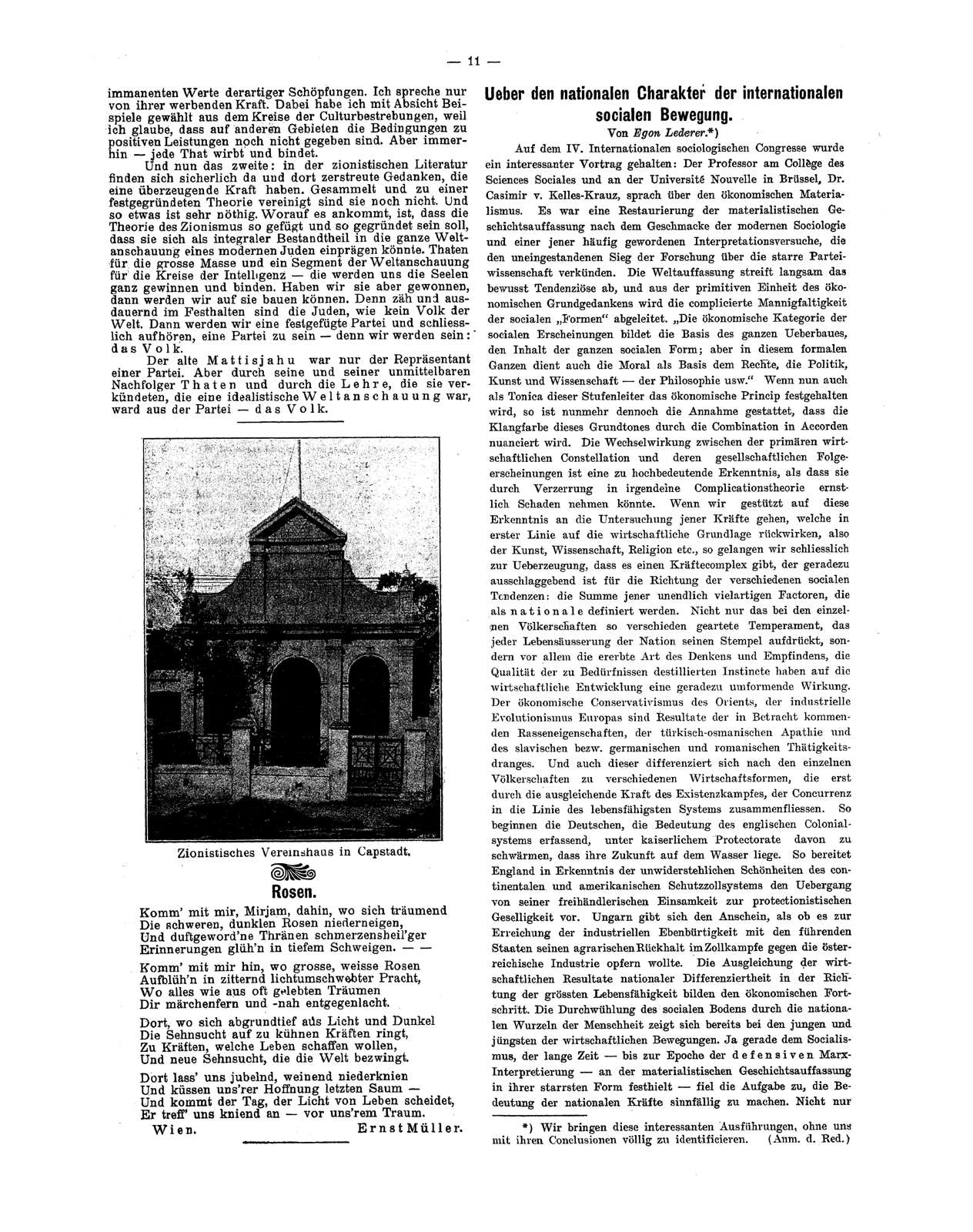
![Illustration of a building]
Zionist Club-House in Cape Town.
Roses.
Come with me, Mirjam, thither, where dreaming The heavy, dark roses bow them down, And tears turned to fragrance, of pain-hallowed Remembrances, glow in deep silence. — —
Come thither with me, where great white roses Open in trembling, light-encompassed splendour, Where all, as out of oft-lived dreams, Laughs to meet thee, fairy-far and fairy-near.
There, where abysmally deep out of light and darkness Longing wrestles upward into daring powers, Into powers that would fashion life, And a new longing that subdues the world.
There let us kneel down, exulting, weeping, And kiss the last hem of our hope — And come the day that parts the light from life, Let it find us kneeling — before our dream.
Vienna. Ernst Müller.
On the National Character of the International Social Movement.
*By Egon Lederer. )
At the IVth International Sociological Congress an interesting lecture was delivered: the professor at the Collège des Sciences Sociales and at the Université Nouvelle in Brussels, Dr. Casimir v. Kelles-Krauz, spoke upon economic materialism. It was a restoration of the materialist conception of history after the taste of modern sociology, and one of those attempts at interpretation, now grown frequent, which proclaim the unavowed victory of research over rigid party science. The conception of the world is slowly stripping off the consciously tendentious, and from the primitive unity of the fundamental economic thought there is deduced the complicated manifoldness of social "forms." "The economic category of social phenomena forms the basis of the whole superstructure, the content of the whole social form; but within this formal whole morality too serves as basis to law, and politics, art and science — to philosophy, and so forth." Now even though the economic principle be retained as the keynote of this gradation, yet the assumption is henceforth permitted that the timbre of this ground-tone is shaded by combination in chords. The reciprocal action between the primary economic constellation and its social consequences is a cognition of far too high significance to be able to take serious harm from distortion into any theory of complication whatever. If, supported upon this cognition, we proceed to the investigation of those forces which react in the first place upon the economic foundation — that is, of art, science, religion, etc. — we arrive at last at the conviction that there exists a complex of forces which is positively decisive for the direction of the various social tendencies: the sum of those infinitely multifarious factors which are defined as national. Not only the temperament, so differently constituted among the several peoples, which stamps its impress upon every utterance of the nation's life, but above all the inherited mode of thinking and of feeling, the quality of the instincts distilled into needs, have a positively transforming effect upon economic development. The economic conservatism of the Orient, the industrial evolutionism of Europe, are results of the racial properties here in question, of Turkish-Ottoman apathy and of the Slavonic, or German and Romance, urge to activity. And this urge too differentiates itself according to the several peoples into various economic forms, which only through the equalising force of the struggle for existence, of competition, flow together into the line of the most viable system. Thus the Germans, grasping the significance of the English colonial system, begin under imperial protection to rave that their future lies upon the water. Thus England, recognising the irresistible beauties of the continental and American protective-tariff system, prepares the transition from her free-trading solitude to protectionist sociability. Hungary gives herself the air of being willing, for the attainment of industrial equality with the leading states, to sacrifice her agrarian support in the tariff struggle against Austrian industry. The equalisation of the economic results of national differentiation in the direction of the greatest viability constitutes economic progress. The burrowing through of the social soil by the national roots of mankind shows itself already among the young and the youngest of the economic movements. Indeed it is precisely to socialism — which long held fast, down to the epoch of the defensive interpretation of Marx, to the materialist conception of history in its most rigid form — that the task has fallen of making the significance of the national forces palpable. Not only
*) We give these interesting expositions without wholly identifying ourselves with their conclusions. (Ed. note.)