— 5 —
(continued from page 4)
…the planters extend their plantations in the hope of better times. The development of the orange trade was chiefly to be ascribed to the rapid and direct steamship connexion with Liverpool, which was established in the year 1892. Last year was the first to show a decline in this trade. The other articles of export, in the order of their importance, are water-melons, sesame, lupins and a little maize, wool, hides, colocynth, bones and so forth. An entirely new export of vegetables was called into life last year, when Palestine supplied the world with beans, though only 520 quarters, of an estimated value of 575 pounds. The imports of the last two years have remained stationary — about 400,000 pounds. Palestine's balance of trade last year amounted to nearly 120,000 pounds. Whence comes the money that pays? Partly from the 14,500 pilgrims who come to Palestine in the course of the year, and — mark the difference — from the 3,000 tourists, chiefly Americans. As the pilgrims stand in a certain connexion with trade, it may be worth mentioning that the pilgrims consisted of 500 Germans, 550 Austrians, 650 Egyptian Copts, 1,100 Armenians, 1,500 Greeks, 6,700 Russians and 3,500 other pilgrims.
Besides their outlay for board and lodging, these pilgrims buy in the bazaars cross-shaped flowers, mother-of-pearl mementoes and olive-wood carvings. One of the largest items of the national income is backsheesh, together with the enormous sums which the Jewish inhabitants receive as alms from all parts of the world.
The chief requirement of Palestine, to judge by the imports at Jaffa, appears to lie in cotton goods, and then in coffee, sugar, rice and flour. Last year there was an enormous increase in the import of cotton goods, from 61,500 to 115,050 pounds. This would seem to be a fresh indication of an increasing population — a soap-consuming population which, clothed in cotton, pays homage to coffee.
The best proof of Palestine's advance lies in the fact that last year there were 148 more ships
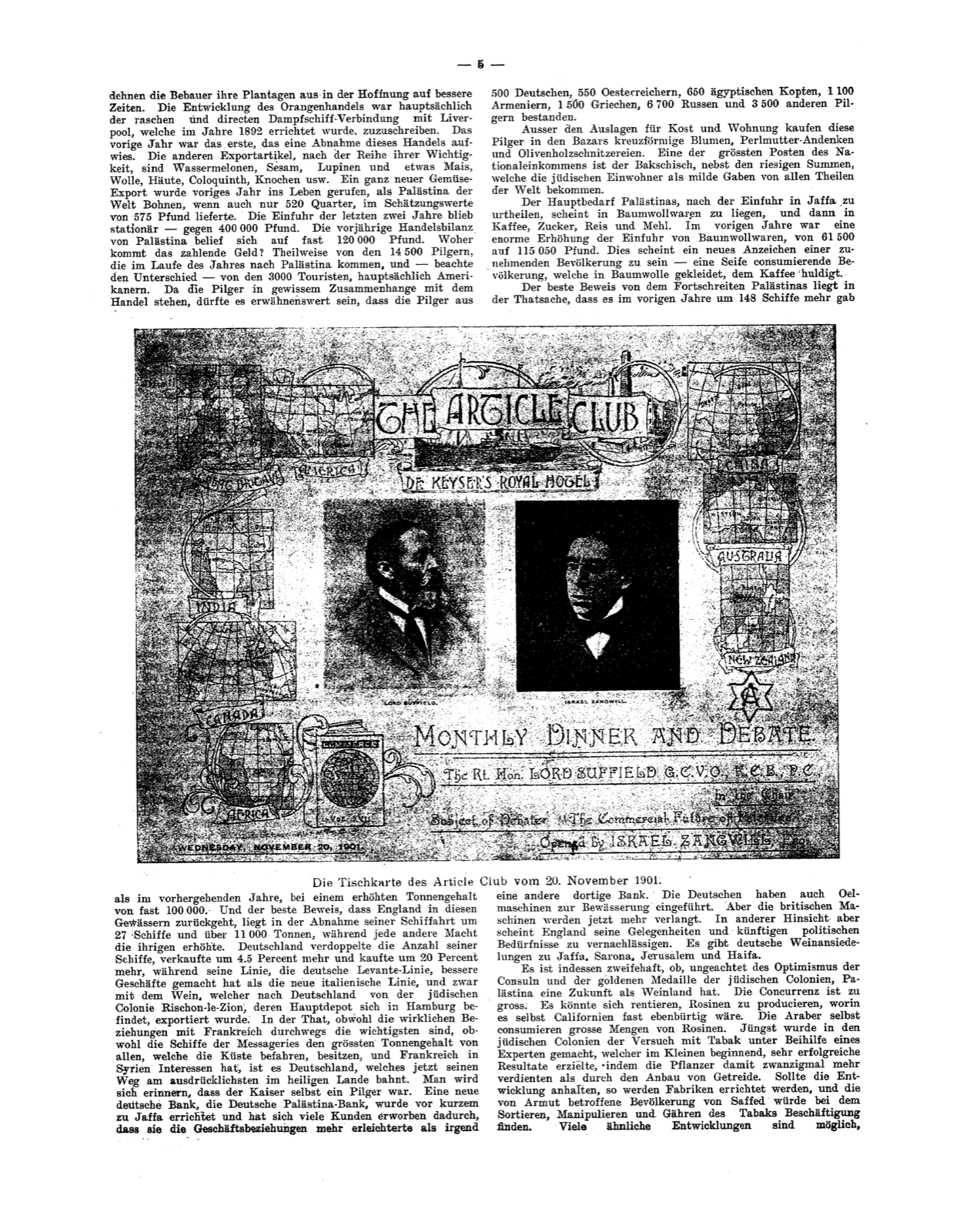
THE ARTICLE CLUB
DE KEYSER'S ROYAL HOTEL
MONTHLY DINNER AND DEBATE.
The Rt. Hon. LORD SUFFIELD, G.C.V.O., K.C.B., P.C.
Subject of Debate: "The Commercial Future of Palestine"
Opened by ISRAEL ZANGWILL, Esq.
WEDNESDAY, NOVEMBER 20, 1901.
The table-card of the Article Club of November 20th, 1901.
than in the preceding year, with an increased tonnage of nearly 100,000. And the best proof that England is falling back in these waters lies in the decrease of her shipping by 27 vessels and over 11,000 tons, while every other Power increased its own. Germany doubled the number of her ships, sold 4.5 per cent. more and bought 20 per cent. more, while her line, the German Levant Line, has done better business than the new Italian line, and that with the wine which was exported to Germany from the Jewish colony of Rischon-le-Zion, whose chief depôt is at Hamburg. Indeed, although the actual relations with France are throughout the most important, although the vessels of the Messageries possess the largest tonnage of all that ply along the coast, and France has interests in Syria, it is Germany that is now making her way most emphatically in the Holy Land. It will be remembered that the Emperor himself was a pilgrim. A new German bank, the Deutsche Palästina-Bank, was lately established at Jaffa, and has won many customers by facilitating business relations more than any other bank there. The Germans have also introduced oil-engines for irrigation. But British machines are now more in demand. In other respects, however, England seems to neglect her opportunities and her future political needs. There are German wine-settlements at Jaffa, Sarona, Jerusalem and Haifa.
It is doubtful, meanwhile, whether, notwithstanding the optimism of the consuls and the gold medal of the Jewish colonies, Palestine has a future as a wine country. The competition is too great. It might pay to produce raisins, in which it would be almost a match even for California. The Arabs themselves consume great quantities of raisins. Lately the experiment with tobacco was made in the Jewish colonies with the assistance of an expert who, beginning on a small scale, achieved very successful results, the planters earning twenty times more thereby than by the cultivation of grain. Should the development continue, factories will be erected, and the poverty-stricken population of Saffed would find employment in the sorting, handling and fermenting of the tobacco. Many similar developments are possible,