No. 19. — "Die Welt" — Page 7.
(continued from page 6)
…to create a domestic industry in the place of the more cheaply producing factory.
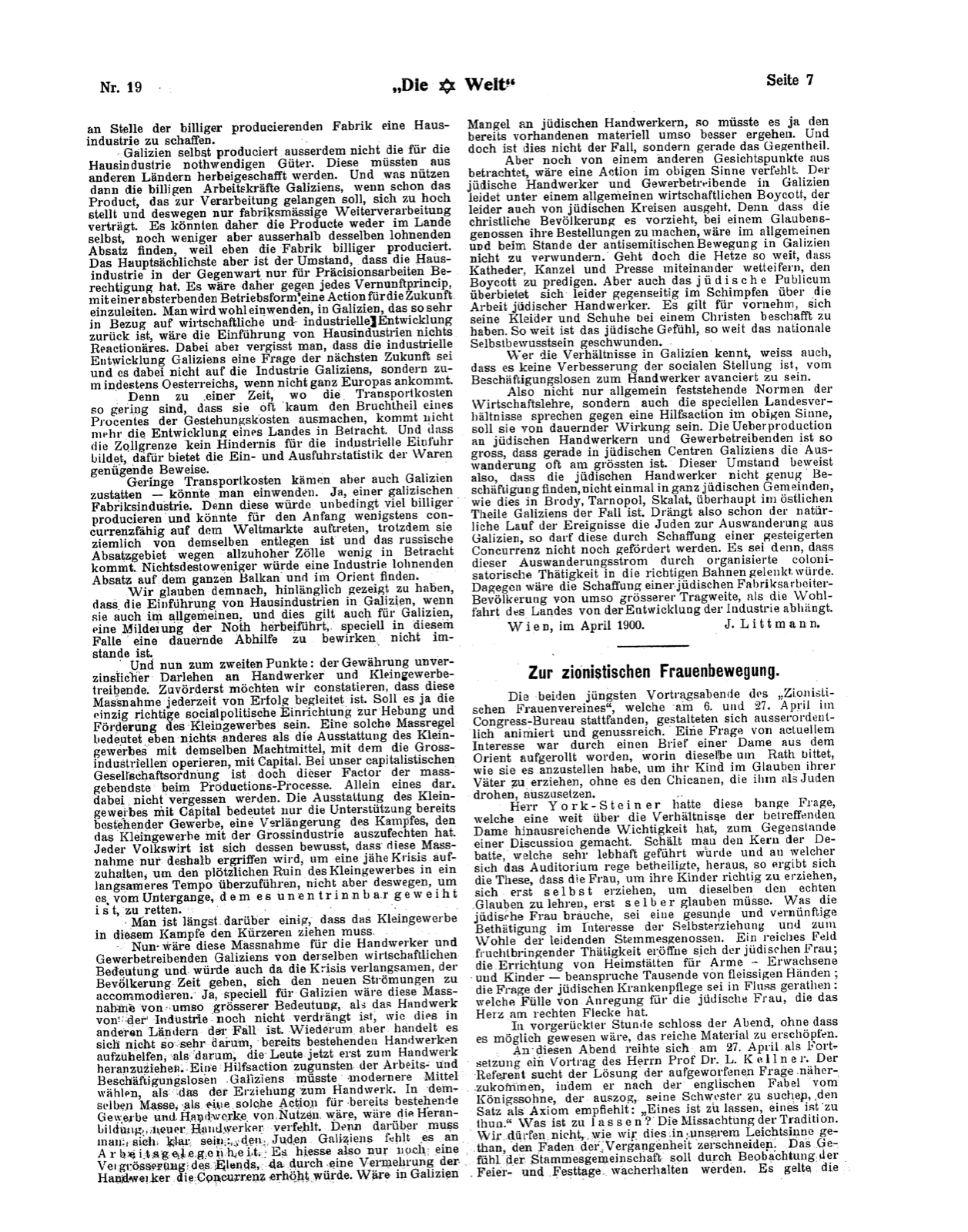
Galicia, moreover, does not itself produce the goods necessary for the domestic industry. These would have to be fetched from other lands. And of what use are then the cheap labouring hands of Galicia, if the product which is to come to be worked up already stands too high in price and therefore admits only of further working up after the manner of the factory? The products could accordingly find a remunerative sale neither in the land itself, and still less outside it, for the very reason that the factory produces more cheaply. The chief thing, however, is the circumstance that the domestic industry has at the present day a justification only for work of precision. It would therefore be against every principle of reason to inaugurate with a dying form of production an action for the future. It will doubtless be objected that in Galicia, which is so far behindhand in respect of economic and industrial development, the introduction of domestic industries would be nothing reactionary. But in so saying one forgets that the industrial development of Galicia is a question of the immediate future, and that in this matter it is not the industry of Galicia that is decisive, but at the least that of Eastern Austria, if not of all Europe.
For at a time when the costs of transport are so slight that they often hardly amount to the fraction of one per cent. of the prime cost, the development of a single land no longer comes into consideration. And that the customs frontier forms no hindrance to the industrial import, of that the statistics of the import and export of wares offer proof enough.
Slight costs of transport, however, would stand Galicia too in good stead — so it might be objected. Yes, a Galician factory industry. For this would unconditionally produce far more cheaply and could, for a beginning at least, appear as a competitor upon the world market, notwithstanding that it lies fairly remote from the same and that the Russian market comes little into consideration on account of the excessively high duties. Nevertheless an industry would find remunerative sale throughout the whole Balkans and in the Orient.
We believe accordingly that we have sufficiently shown that the introduction of domestic industries in Galicia, even though it in general — and this holds good for Galicia also — brings about a diminution of distress, is in this particular case not in a condition to effect a lasting remedy.
And now to the second point: the granting of loans free of interest to handicraftsmen and small tradesmen. First of all we would establish that this measure is at all times attended with success. It is indeed held to be the one right institution of social policy for the raising and the furtherance of the small trades. Such a measure signifies in fact nothing else than the equipping of the small trades with the same instrument of power wherewith the great industrialists operate — with capital. Under our capitalistic order of society this factor is surely the most decisive in the process of production. Only one thing must not be forgotten in the matter. The equipping of the small trades with capital signifies merely the support of already existing trades, a prolongation of the struggle which the small trade has to fight out with the great industry. Every political economist is aware that this measure is taken only in order to hold back a sudden crisis, in order to convert the sudden ruin of the small trades into a slower tempo, and not in order to save them from the destruction to which they are inescapably devoted.
Men have long been agreed that the small trade must come off the worse in this struggle.
Now this measure would be of the same economic significance for the handicraftsmen and tradesmen of Galicia, and would there too retard the crisis and give the population time to accommodate itself to the new currents. Nay, for Galicia especially this measure would be of all the greater significance, inasmuch as the handicraft has not yet been displaced by the industry, as is the case in other lands. Again, however, it is not so much a question of setting on their feet handicrafts already existing, as of drawing the people to the handicraft only now. A relief action in favour of the workless and unoccupied of Galicia would have to choose more modern means than that of the education to the handicraft. In the same measure as such an action would be of use for already existing trades and handicrafts, would the training up of new handicraftsmen be a mistake. For upon this one must be clear: what the Jews of Galicia lack is opportunity of work. It would therefore mean only a further enlargement of the misery, since by an increase in the number of handicraftsmen the competition would be heightened. Were there in Galicia a lack of Jewish handicraftsmen, those already there must needs fare all the better materially. And yet this is not the case, but precisely the contrary.
But regarded also from another point of view, an action in the above sense would be a mistake. The Jewish handicraftsman and tradesman in Galicia suffers under a general economic boycott, which unhappily proceeds from Jewish circles as well. For that the Christian population prefers to place its orders with one of its own faith would, in general and considering the state of the Antisemitic movement in Galicia, be nothing to wonder at. Indeed the agitation goes so far that professorial chair, pulpit and press vie with one another in preaching the boycott. But the Jewish public too, alas, outdoes itself in reviling the work of Jewish handicraftsmen. It passes for genteel to have procured one's clothes and shoes of a Christian. So far has the Jewish feeling, so far has the national self-consciousness, dwindled away.
Whoever knows the conditions in Galicia knows also that it is no improvement of the social position to have been promoted from the unemployed to the handicraftsman.
Thus not only generally established norms of economic science, but the special conditions of the land as well, speak against a relief action in the above sense, if it is to be of lasting effect. The overproduction of Jewish handicraftsmen and tradesmen is so great that precisely in the Jewish centres of Galicia the emigration is often greatest. This circumstance proves, then, that the Jewish handicraftsmen do not find employment enough, not even in wholly Jewish communities, as is the case in Brody, Tarnopol, Skalat, and generally in the eastern part of Galicia. If, therefore, the natural course of events already drives the Jews to emigrate from Galicia, this must not be still further promoted by the creation of a heightened competition — unless indeed this stream of emigration were guided into the right channels by organised colonising activity. On the other hand, the creation of a Jewish factory-working population would be of all the greater consequence, inasmuch as the welfare of the land depends upon the development of the industry.
Vienna, April 1900. J. Littmann.
On the Zionist Women's Movement.
The two latest lecture evenings of the "Zionist Women's Association," which took place on the 6th and the 27th of April in the Congress Bureau, proved extraordinarily animated and full of enjoyment. A question of present interest had been raised by a letter from a lady in the Orient, wherein she asks counsel how she is to set about rearing her child in the faith of its fathers without exposing it to the chicaneries which threaten it as a Jew.
Mr. York-Steiner had made this anxious question, which has an importance reaching far beyond the circumstances of the lady concerned, the subject of a discussion. If one picks out the kernel of the debate, which was conducted very briskly and in which the audience took a lively part, there results the thesis that woman, in order to rear her children aright, must first rear herself, and in order to teach them the true faith must first herself believe. What the Jewish woman needs is a sound and reasonable activity in the interest of self-education and for the good of her suffering kinsfolk. A rich field of fruitful activity opens itself to the Jewish woman: the establishment of homes for the poor — adults and children — demands thousands of diligent hands; the question of Jewish nursing of the sick has been set flowing: what a fulness of suggestion for the Jewish woman who has her heart in the right place.
At an advanced hour the evening closed, without its having been possible to exhaust the rich material.
To this evening there was joined, on the 27th of April, as a continuation, a lecture by Prof. Dr. L. Kellner. The lecturer seeks to come nearer to the solution of the question raised by commending, after the English fable of the king's son who went forth to seek his sister, the sentence as an axiom: "One thing is to be left undone, one thing is to be done." What is to be left undone? The disregard of tradition. We may not, as we have done in our levity, cut through the thread of the past. The feeling of the community of race shall be kept awake by the observance of the holy days and festivals. It was needful that the