No. 3 — "Die Welt" — Page 13.
But to carry off the proletarian Jews from the revolutionary cause means to carry off from that cause the most energetic, the most intelligent and the most conscientious elements." It would therefore be dreadful if the Jewish proletarians were provided with a better position and a possibility of existence; for the party would suffer thereby. Th. Z.
Doctor Arthur Kahn (Bonn): "Ein Judentag." Our fellow-Zionist has supported in the most excellent manner, by his brochure, the agitation of the German Zionists for the holding of a Jewish State. We believe we cannot recommend the work better than by reproducing the following appraisal from the "Israel. Rundschau": "At the right moment," it says there, "there came the splendid Bonn brochure of Dr. Arthur Kahn, 'Ein Judentag'
(to be obtained through the bookshop of Jean Trapp, Bonn, price 25 Pf.), whose enthusiastic, honest language ought to find everywhere in the Jewish people the echo it deserves. We will keep ourselves far from extravagances; our position is too grave and too gloomy for us to have time or mind for mutual incense-burning; but this must be said, that never in more concise form, in a more courageous, more matter-of-fact manner, have the injuries from which we suffer been set forth, and that never has the way to betterment been pointed out with a more loving confidence in the sound kernel of the Jewish people than in Kahn's little work, of which a Stuhlweissenburg newspaper wrote on the 3rd inst.: 'Whether the "Judentag" will answer expectations and scatter the darkness we do not know; but of this we hold ourselves convinced,
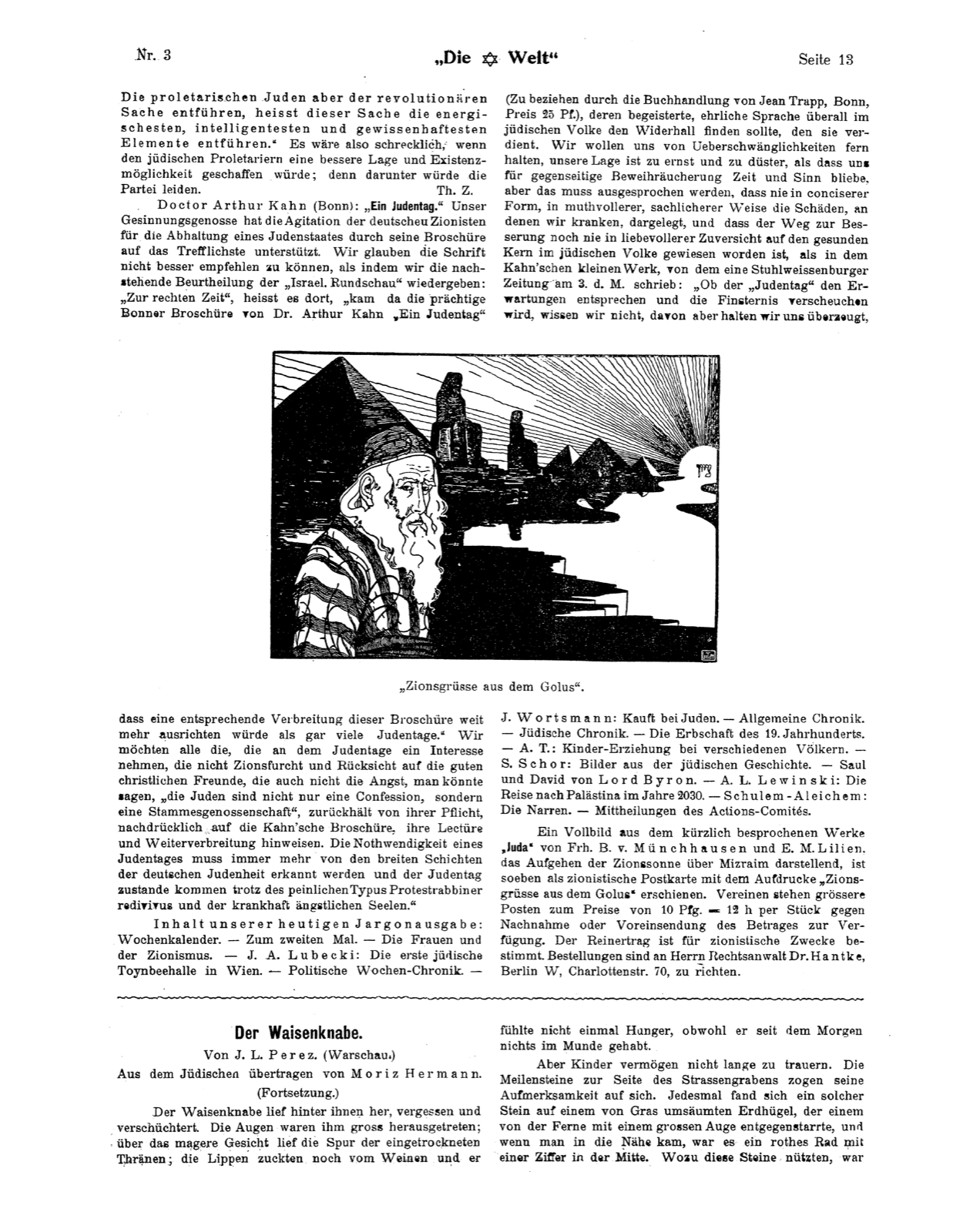
"Zion's Greetings from the Golus."
that a proper circulation of this brochure would accomplish far more than a great many Judentage.'" We would point emphatically to Kahn's brochure, to the reading and the further circulation of it, for all those who take an interest in the Judentag, all those whom no fear of Zion, no regard for their good Christian friends, and no anxiety lest it be said, "the Jews are not merely a confession, but a fellowship of tribe," holds back from their duty. The necessity of a Judentag must be recognised more and more by the broad strata of German Jewry, and the Judentag must come about, in spite of the painful type of the Protestrabbiner redivivus and of the morbidly timid souls."
Contents of our present Jargon edition: Weekly Calendar. — For the Second Time. — Women and Zionism. — J. A. Lubecki: The First Jewish Toynbee Hall in Vienna. — Political Weekly Chronicle. — J. Wortsmann: Buy from Jews. — General Chronicle. — Jewish Chronicle. — The Inheritance of the 19th Century. — A. T.: The Rearing of Children among Various Peoples. — S. Schor: Pictures from Jewish History. — Saul and David, by Lord Byron. — A. L. Lewinski: The Journey to Palestine in the Year 2030. — Schulem-Aleichem: The Fools. — Communications of the Actions Committee.
A full-page plate from the lately noticed work "Juda," by Baron B. v. Münchhausen and E. M. Lilien, representing the rising of the sun of Zion over Mizraim, has just appeared as a Zionist picture postcard with the imprint "Zion's Greetings from the Golus." Larger parcels are at the disposal of societies at the price of 10 Pfg. = 12 h the piece, against cash on delivery or on remittance of the amount in advance. The net proceeds are destined for Zionist purposes. Orders are to be addressed to Herr Rechtsanwalt Dr. Hantke, Berlin W, Charlottenstr. 70.
The Orphan Boy.
By J. L. Perez. (Warsaw.) Translated from the Jewish by Moriz Hermann. (Continued.)
The orphan boy ran along behind them, forgotten and cowed. His eyes had started far out of his head; over the thin face ran the trace of dried tears; the lips still twitched with weeping, and he
felt no hunger at all, although since the morning he had had nothing in his mouth.
But children are not able to mourn for long. The milestones at the side of the road-ditch drew his attention to them. Each such stone was found upon a mound of earth fringed with grass, which from afar stared towards one with a great eye, and when one came near it was a red wheel with a figure in the middle. To what use these stones were put, was