Page 4. — "Die ✡ Welt" — No. 29.
"The Roumanian," a witty Roumanian statesman once said, "is born a scholarship-holder, lives as an official, and dies a pensioner." And in truth one may divide the Roumanian people into two great categories: the agricultural country population and the officialdom in the towns. In spite of all the efforts of the Government, in spite of all the costly trade schools, it has still not been possible to rear a Roumanian artisan class, and many a one who has passed through the trade school with good success hangs his handicraft upon the nail in order rather to fill some small official post. Whoever understands the noble art of writing and reading even after a fashion has no other wish than to turn his crow's-feet to account as an official. He seeks and finds a protector who procures him a little office. To be sure, the salaries of the small officials are wretched enough, and they need perhaps three times as much for their menus plaisirs alone. But that is their least care. What, then, are the Jews there for? One presses the soul out of their bodies, one makes them sweat blood; and the thrifty, who know that behind them others stand greedily waiting to reach the manger at a change of Government, amass fortunes. The exploitation has been brought into a regular system, and every circumstance is made use of to squeeze money out of the Jews. Nay, the officers of public security even play the part of patrons of art for the sake of the dear profit. If a troupe of strolling players, circus-riders or rope-dancers comes to a town, then the officials of public security undertake — against fat percentages, of course — the distribution of the entrance tickets, and it goes without saying that these are forced upon none but the Jews. Which of these will venture to refuse one of the dreaded ones the acceptance of a ticket, and so call down upon himself vengeful chicaneries, or even the bull's pizzle, that persuasive instrument customary in the country? And so many a poor Jew must sighing give up his last franc and go hungry with wife and children, in order to have in the evening the unwished-for pleasure of watching the capers of a mountebank.
The Roumanians proudly call themselves the Belgians of the East. Do they understand thereby the industrious and enlightened Belgian people, or those Belgian outcasts who on the Congo repeat the atrocities of the Spanish conquistadores? Let them answer this question for themselves.
Yet let us be just: the guilt does not lie with the Roumanian people. The Roumanians are on the whole a good-natured, tolerant race of men, and perhaps no people is so little disposed to antisemitism as precisely the Roumanian. The guilt lies with those circles which formally drill the masses into antisemitism, which in a mad fury of destruction fling the firebrand of hatred into the peace of the towns and incite citizen against citizen. The guilt lies with those political place-hunters of all parties, and in particular of the Conservative party, who make the Jewish question a political lever and thereby assume the theatrical pose of saviours of the fatherland. The guilt lies with the governing circles of all parties, who believe they must outbid one another in emulation with anti-Jewish laws. The guilt, finally, for the despairing exodus of the Roumanian Jews is borne by the dishonest place-hunting of Filipescu, the incapacity of Kantakuzene, and the tactless, antisemitic fanaticism of Istrati.
But of this more particularly in a further letter.
Chinese Jews.
Travellers have repeatedly brought to Europe more or less trustworthy accounts of ancient Jewish communities in China, but what we heard was too obscure and blurred to awaken any particular interest in these possible "splinters of the Jewish people." Now it stands otherwise. English and French sinologists have established from Chinese sources all manner of incontestable facts touching the history of our kinsmen; other investigators have deciphered the inscriptions of the former synagogues of Kai-fung-fu; and in the most recent time the English-Jewish community of Shanghai has come into immediate touch with the remnants of the Chinese Jews. Marcus Adler has, in an exceedingly instructive lecture, carefully sifted the scattered material, and now these Chinese kinsmen of ours have been brought as near to us as our brethren in Russia or California.
The first authentic reports of Chinese Jews we owe to the Jesuits: Father Ricci obtained knowledge of the existence of Jewish communities in Kai-fung-fu, the former capital of Honan, and in Hang-tschau-fu as well as in other Chinese cities; the synagogue in Kai-fung-fu possessed a scroll of the Law which was more than five hundred years old. Ricci and his successor, Julius Aléxi, visited this synagogue at the beginning of the seventeenth century, and a hundred years later Jesuits again came to Kai-fung-fu, who reported Jewish settlements in Ning-po and Ning-Rea and described the synagogue quite exactly, nay, even published translations of the inscriptions found upon the walls and the gravestones.
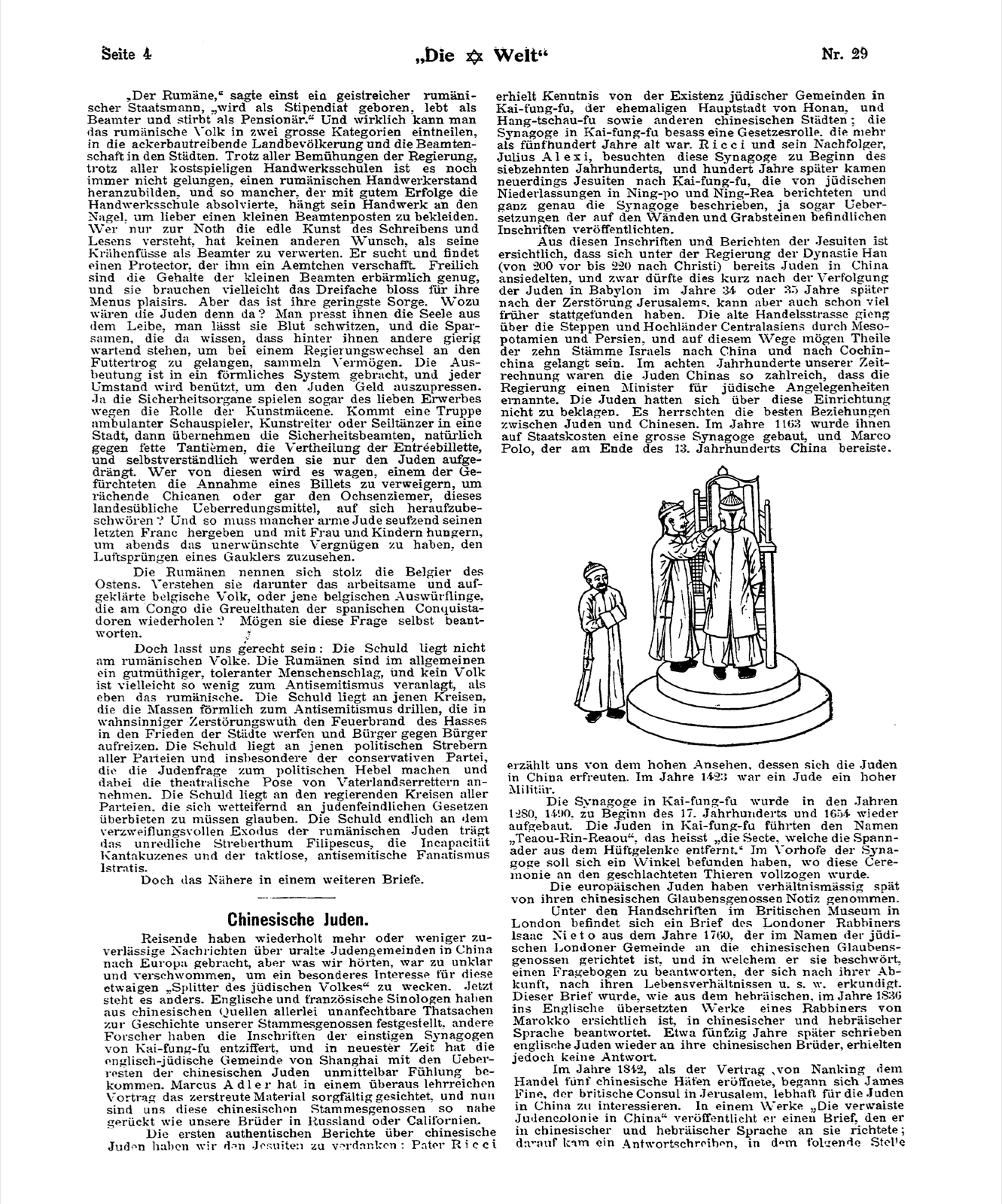
From these inscriptions and reports of the Jesuits it is evident that Jews were already settling in China under the government of the Han dynasty (from 200 before to 220 after Christ), and this may have taken place shortly after the persecution of the Jews in Babylon in the year 34, or 35 years later, after the destruction of Jerusalem, but may also have occurred much earlier. The old trade route went over the steppes and highlands of Central Asia through Mesopotamia and Persia, and by this way portions of the ten tribes of Israel may have made their way to China and to Cochin-China. In the eighth century of our era the Jews of China were so numerous that the Government appointed a Minister for Jewish Affairs. The Jews had no cause to complain of this arrangement. The best relations prevailed between Jews and Chinese. In the year 1163 a great synagogue was built for them at the cost of the State, and Marco Polo, who travelled through China at the end of the thirteenth century, tells us of the high esteem which the Jews enjoyed in China. In the year 1423 a Jew was a high military officer.
The synagogue in Kai-fung-fu was rebuilt in the years 1280 and 1490, at the beginning of the seventeenth century, and in 1654. The Jews in Kai-fung-fu bore the name "Teaou-Rin-Reaou," that is to say, "the sect which removes the sinew from the hip-joint." In the forecourt of the synagogue there is said to have been a corner where this ceremony was performed upon the slaughtered animals.
The European Jews took notice of their Chinese co-religionists comparatively late.
Among the manuscripts in the British Museum in London there is a letter of the London Rabbi Isaac Nieto, of the year 1760, addressed in the name of the Jewish community of London to their Chinese co-religionists, in which he conjures them to answer a set of questions inquiring after their descent, their conditions of life, and so forth. This letter was, as appears from the Hebrew work of a Rabbi of Morocco translated into English in the year 1836, answered in the Chinese and Hebrew tongues. Some fifty years later English Jews again wrote to their Chinese brethren, but received no answer.
In the year 1842, when the Treaty of Nanking opened five Chinese ports to trade, James Fine, the British Consul in Jerusalem, began to take a lively interest in the Jews in China. In a work, "The Orphaned Jewish Colony in China," he publishes a letter which he addressed to them in the Chinese and Hebrew tongues; whereupon there came a letter in reply, in which the following passage