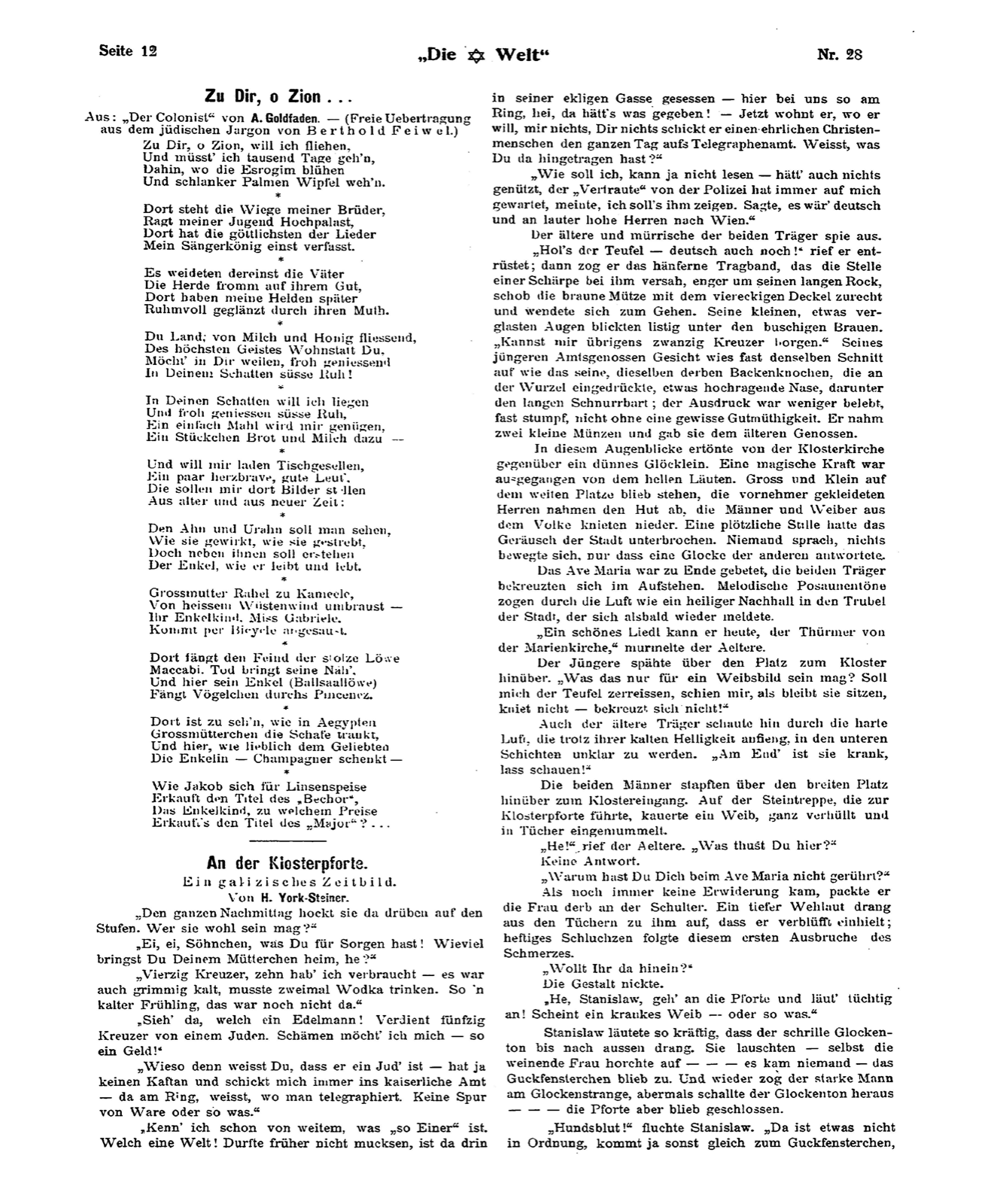
Page 12. — "Die Welt" — No. 28.
To Thee, O Zion . . .
From: "Der Colonist" by A. Goldfaden. — (Free rendering from the Jewish Jargon by Berthold Feiwel.)
To Thee, O Zion, will I flee, And must I journey a thousand days, Thither, where the Esrogim blossom And the tops of slender palms are stirred.
*
There stands the cradle of my brethren, There towers the high palace of my youth, There the divinest of all songs Was once composed by my singer-king.
*
There once the fathers pastured The flock in piety upon their land, There in later days my heroes Shone gloriously through their valour.
*
Thou land; flowing with milk and honey, Thou dwelling-place of the highest Spirit, Fain would I tarry in Thee, gladly enjoying In Thy shadow sweet repose!
*
In Thy shadows will I lie And gladly enjoy sweet repose, A simple meal will suffice me, A little piece of bread and milk therewith —
*
And I will bid me table-companions, A few stout-hearted, worthy folk, Who there shall set me pictures forth Out of the old and out of the newer time:
*
The sire and the forefather shall be seen, How they wrought, how they strove, Yet beside them shall arise The grandson, in his very flesh and life.
*
Grandmother Rachel upon camel-back, Roared about by the hot desert wind — Her grandchild, Miss Gabriele, Comes whirring up per bicycle.
*
There the proud lion Maccabi Takes the foe. His nearness brings death, And here his grandson (a ballroom lion) Catches little birds through his pince-nez.
*
There is to be seen how in Egypt The little grandmother waters the sheep, And here, how sweetly to her beloved The granddaughter — pours out champagne —
*
As Jacob for a mess of lentils Bought himself the title of "Bechor", The grandchild — at what price Does it buy the title of "Major"? . . .
At the Porter's Gate.
A Galician picture of the times. By H. York-Steiner.
"The whole afternoon she has been squatting over yonder upon the steps. Who can she be?"
"Eh, eh, sonny, what cares you have! How much are you bringing home to your mother, hey?"
"Forty kreuzer; ten I have spent — it was bitterly cold too, I had to drink vodka twice. Such a cold spring, the like was never yet."
"Look at that, what a nobleman! Earns fifty kreuzer from a Jew. I should be ashamed of myself — money like that!"
"How then do you know that he is a Jew — he has no caftan and is always sending me to the imperial office — there on the Ring, you know, where one telegraphs. Not a trace of wares or anything of the sort."
"I know from afar what 'one of that sort' is. What a world! In former days he dared not utter a sound, he sat in there in his loathsome lane — here with us on the Ring, ho, there would have been a to-do! — Now he lives where he pleases, and without so much as a by-your-leave he sends an honest Christian the whole day long to the telegraph office. Do you know what it was you carried there?"
"How should I, since I cannot read — and it would have been of no use either; the 'confidant' of the police was always waiting for me and thought I should show it to him. He said it was German and to nothing but high gentlemen in Vienna."
The elder and the more surly of the two porters spat out.
"The devil take it — German into the bargain!" he cried indignantly; then he drew the hempen carrying-strap, which served him in the place of a sash, tighter about his long coat, set straight the brown cap with the square top and turned to go. His small, somewhat glassy eyes looked out cunningly from beneath the bushy brows. "You might, by the way, lend me twenty kreuzer." His younger colleague's face showed almost the same cut as his own, the same coarse cheek-bones, the nose pressed in at the root and somewhat prominent, beneath it the long moustache; the expression was less animated, almost dull, not without a certain good-nature. He took two small coins and gave them to the elder comrade.
At this moment there sounded from the cloister church opposite a thin little bell. A magic power had gone forth from the clear ringing. Great and small upon the wide square stood still, the more genteelly dressed gentlemen took off their hats, the men and women of the common people knelt down. A sudden stillness had broken in upon the noise of the town. Nobody spoke, nothing moved, save that one bell answered another.
The Ave Maria had been prayed to its end; the two porters crossed themselves as they rose. Melodious notes of trombones drew through the air like a holy echo into the bustle of the town, which presently made itself heard again.
"A fine little tune he knows to-day, the tower-warder of the Marienkirche," murmured the elder.
The younger peered across the square towards the cloister. "What sort of a female can that be? May the devil tear me asunder, it seemed to me she stays sitting, does not kneel — does not cross herself!"
The elder porter too looked over through the harsh air, which, in spite of its cold brightness, was beginning to grow dim in the lower strata. "Maybe she is ill; let us go and see!"
The two men tramped across the broad square over to the cloister entrance. Upon the stone steps that led up to the cloister gate there crouched a woman, wholly veiled and muffled up in cloths.
"Hey!" cried the elder. "What are you doing here?"
No answer.
"Why did you not stir at the Ave Maria?"
As still no reply came, he seized the woman roughly by the shoulder. A deep sound of pain rose to him out of the cloths, so that he stopped short in bewilderment; violent sobbing followed upon this first outbreak of the grief.
"Do you want to get in there?"
The figure nodded.
"Here, Stanislaw, go to the gate and ring stoutly! Seems to be a sick woman — or something of the sort."
Stanislaw rang so vigorously that the shrill sound of the bell penetrated to the outside. They listened — even the weeping woman gave ear — — — nobody came — the little peep-window stayed shut. And again the strong man pulled at the bell-rope, again the sound of the bell rang out — — — but the gate remained closed.
"Dog's blood!" swore Stanislaw. "There is something not in order here, otherwise someone comes at once to the little peep-window,