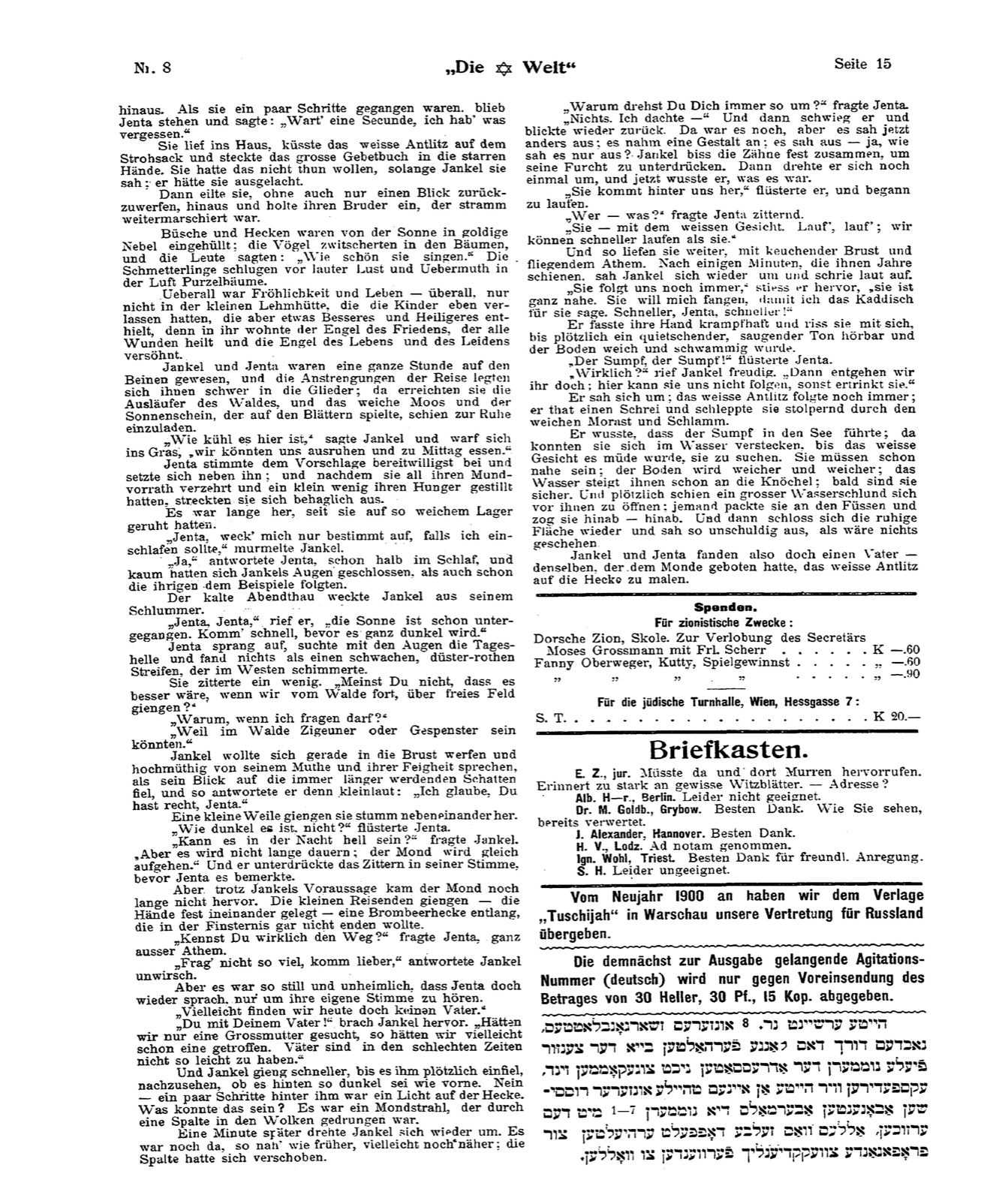
No. 8. — "Die Welt" — Page 15.
(continued from page 14)
…stepped out. When they had gone a few paces, Jenta stopped and said: "Wait a second, I have forgotten something."
She ran into the house, kissed the white face upon the straw sack and put the great prayer-book into the stiffened hands. She had not wished to do it so long as Jankel could see her; he would have laughed at her.
Then she hurried out without so much as casting a single glance behind her, and overtook her brother, who had marched stoutly on.
Bushes and hedges were wrapped by the sun in golden mists; the birds twittered in the trees, and the people said: "How sweetly they sing." The butterflies, out of sheer delight and wantonness, turned somersaults in the air.
Everywhere there was gladness and life — everywhere save in the little mud hut which the children had just left, but which held something better and holier, for in it dwelt the angel of peace, who heals all wounds and reconciles the angels of life and of suffering.
Jankel and Jenta had been on their feet a whole hour, and the exertions of the journey lay heavy in their limbs; then they reached the outskirts of the wood, and the soft moss and the sunshine that played upon the leaves seemed to invite them to rest.
"How cool it is here," said Jankel, and threw himself into the grass, "we might rest and take our dinner."
Jenta agreed to the proposal most readily and sat down beside him; and after they had consumed their whole store of provisions and stilled their hunger a very little, they stretched themselves out in comfort.
It was long since they had rested upon so soft a couch.
"Jenta, be sure to wake me if I should fall asleep," murmured Jankel.
"Yes," answered Jenta, already half asleep, and scarcely had Jankel's eyes closed when hers too followed the example.
The cold evening dew woke Jankel out of his slumber.
"Jenta, Jenta," he cried, "the sun has already gone down. Come quickly, before it grows quite dark."
Jenta sprang up, sought the light of day with her eyes and found nothing but a faint, dull-red streak that glimmered in the west.
She trembled a little. "Don't you think it would be better if we went away from the wood, across the open field?"
"Why, if I may ask?"
"Because there might be gipsies or ghosts in the wood."
Jankel was just about to throw out his chest and speak loftily of his courage and her cowardice, when his glance fell upon the ever-lengthening shadows, and so he answered meekly: "I think you are right, Jenta."
For a little while they walked on side by side in silence.
"How dark it is, isn't it?" whispered Jenta.
"Can it be light at night?" asked Jankel. "But it will not last long; the moon will rise directly." And he suppressed the trembling in his voice before Jenta noticed it.
But in spite of Jankel's prediction the moon was long in coming forth. The little travellers went — their hands laid fast in one another — along a bramble hedge which in the darkness would not come to an end at all.
"Do you really know the way?" asked Jenta, quite out of breath.
"Don't ask so many questions, come along rather," answered Jankel testily.
But it was so still and uncanny that Jenta yet spoke again, only to hear her own voice.
"Perhaps we shall not find a father to-day after all."
"You and your father!" burst out Jankel. "If we had only looked for a grandmother, we might perhaps have met with one by now. Fathers are not so easy to come by in these bad times."
And Jankel went faster, until it suddenly occurred to him to look whether it was as dark behind as in front. No — a few paces behind him there was a light upon the hedge. What could that be? It was a moonbeam that had pierced through a rift in the clouds.
A minute later Jankel turned round again. It was still there, as near as before, perhaps nearer still; the rift had shifted.
"Why do you keep turning round so?" asked Jenta.
"Nothing. I thought —" And then he was silent and looked back again. It was still there, but it looked different now; it was taking a shape; it looked — yes, what did it look like? Jankel set his teeth hard, to keep down his fear. Then he turned round once more, and now he knew who it was.
"She is coming after us," he whispered, and began to run.
"Who — what?" asked Jenta, trembling.
"She — with the white face. Run, run; we can run faster than she."
And so they ran on, with panting breasts and flying breath. After some minutes, which seemed to them years, Jankel looked round again and cried aloud.
"She is following us still," he gasped, "she is quite near. She wants to catch me, that I may say the Kaddish for her. Faster, Jenta, faster!"
He seized her hand convulsively and dragged her along with him, until suddenly a squelching, sucking sound became audible and the ground grew soft and spongy.
"The marsh, the marsh!" whispered Jenta.
"Really?" cried Jankel joyfully. "Then we shall escape her after all; here she cannot follow us, or she will drown."
He looked round; the white face was following still; he uttered a scream and dragged her stumbling through the soft mire and slime.
He knew that the marsh led into the lake; there they could hide themselves in the water until the white face grew weary of seeking them. They must be near now; the ground grows softer and softer; the water is already rising to their ankles; soon they are safe. And suddenly a great gulf of water seemed to open before them; someone seized them by the feet and drew them down — down. And then the still surface closed again and looked as innocent as though nothing had happened.
So Jankel and Jenta found a father after all — the same who had bidden the moon paint the white face upon the hedge.
Contributions.
For Zionist purposes:
- Dorsche Zion, Skole. On the betrothal of the secretary Moses Grossmann to Miss Scherr — K —.60
- Fanny Oberweger, Kutty, winnings at a game — „ —.60
- „ — „ — „ — „ — „ —.90
For the Jewish Gymnasium, Vienna, Hessgasse 7:
- S. T. — K 20.—
Letter-Box.
E. Z., jur. Would be bound to call forth grumbling here and there. Recalls certain comic papers too strongly. — Address? Alb. H—r., Berlin. Unfortunately not suitable. Dr. M. Goldb., Grybow. Best thanks. As you see, already made use of. J. Alexander, Hanover. Best thanks. H. V., Lodz. Taken ad notam. Ign. Wohl, Trieste. Best thanks for the kind suggestion. S. H. Unfortunately unsuitable.
From New Year 1900 onward we have made over our representation for Russia to the publishing house "Tuschijah" in Warsaw.
The agitation number (in German) shortly to be issued will be supplied only against previous remittance of the amount of 30 Heller, 30 Pf., 15 Kop.
To-day No. 8 of our journal appears. Since, owing to the whole procedure at the censorship, many numbers have not reached the addressees, we to-day dispatch to a portion of our Russian subscribers the numbers 1–7 once again, with the request that they will be pleased to employ for purposes of propaganda everything which they have received twice over.