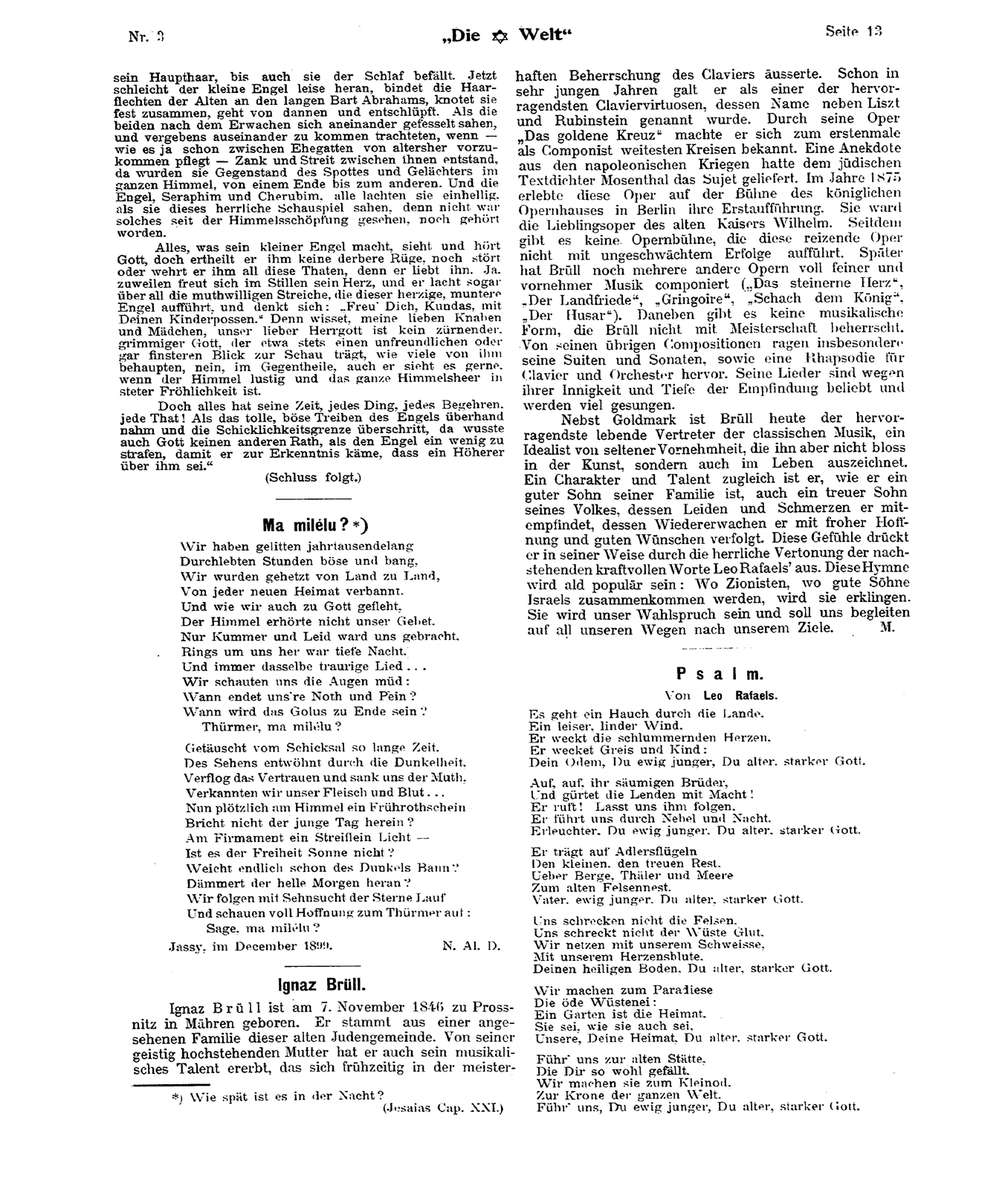
No. 3. — "Die ✡ Welt" — Page 13.
(continued from page 12)
…his head of hair, until she too is overcome by sleep. Now the little angel creeps softly up, binds the old woman's braids to Abraham's long beard, knots them fast together, goes his way and slips off. When the two of them, upon waking, saw themselves fettered to one another and strove in vain to come apart, and when — as has ever been wont to happen between married folk from of old — quarrel and strife arose between them, they became the object of mockery and laughter throughout all heaven, from one end to the other. And the angels, seraphim and cherubim, all of them laughed with one accord when they beheld this glorious spectacle, for the like had not been seen nor heard since the creation of heaven.
God sees and hears everything his little angel does, yet he administers him no rougher rebuke, nor does he hinder or forbid him any of these deeds, for he loves him, Yes, at times his heart rejoices in secret, and he even laughs at all the wanton pranks this dear, merry angel plays, and thinks to himself: "Rejoice, Kundas, in thy childish tomfoolery." For know, my dear boys and girls, our dear Lord God is no wrathful, grim God, who forever wears an unfriendly or even a gloomy look, as many assert of him; no, on the contrary, he too is glad when heaven is merry and the whole heavenly host is in constant cheerfulness.
But everything has its time, every thing, every desire, every deed! When the mad, wicked doings of the angel got the upper hand and overstepped the bounds of seemliness, then even God knew no other counsel than to punish the angel a little, that he might come to the knowledge that a Higher One was above him."
(Conclusion follows.)
Ma milélu? *)
We have suffered for thousands of years, Lived through hours evil and full of dread, We were hunted from land to land, Banished from every new home. And however we besought God, Heaven did not hear our prayer. Only sorrow and suffering were brought us, Round about us was deep night. And ever the same mournful song . . . We wearied our eyes with watching: When shall our need and anguish end? When shall the Golus be at an end? Watchman, ma milélu?
Deceived by fate so long a time, Weaned from sight by the darkness, Our confidence fled away and our courage sank, We misjudged our own flesh and blood . . . Now of a sudden a gleam of dawn in the sky — Is the young day not breaking in? On the firmament a little streak of light — Is it not the sun of freedom? Does the spell of darkness yield at last? Does the bright morning draw on? With longing we follow the course of the stars And look up full of hope to the watchman: Say, ma milélu?
Jassy, December 1899. N. Al. D.
Ignaz Brüll.
Ignaz Brüll was born on the 7th of November 1846 at Prossnitz in Moravia. He comes of a respected family of that ancient Jewish community. From his intellectually eminent mother he inherited also his musical talent, which showed itself early in a masterly command of the pianoforte. Already in very early years he passed for one of the most eminent pianoforte virtuosi, whose name was named beside those of Liszt and Rubinstein. By his opera "Das goldene Kreuz" he first made himself known as a composer to the widest circles. An anecdote from the Napoleonic wars had furnished the Jewish librettist Mosenthal with the subject. In the year 1875 this opera had its first performance upon the stage of the Royal Opera House in Berlin. It became the favourite opera of the old Emperor William. Since then there is no operatic stage that does not perform this charming opera with undiminished success. Later Brüll composed several other operas full of fine and distinguished music ("Das steinerne Herz", "Der Landfriede", "Gringoire", "Schach dem König", "Der Husar"). Besides this there is no musical form which Brüll does not command with mastery. Among his remaining compositions there stand out in particular his suites and sonatas, as well as a Rhapsody for pianoforte and orchestra. His songs are beloved for their inwardness and depth of feeling, and are much sung.
Next to Goldmark, Brüll is to-day the most eminent living representative of classical music, an idealist of a rare distinction, which marks him, however, not merely in art but in life as well. A character and a talent at once, he is, even as he is a good son of his family, also a faithful son of his people, whose sufferings and sorrows he feels with them, whose re-awakening he follows with glad hope and good wishes. These feelings he expresses in his own manner through the glorious musical setting of the following powerful words of Leo Rafaels. This hymn will soon be popular: wherever Zionists, wherever good sons of Israel shall come together, it will resound. It will be our watchword, and shall accompany us upon all our ways towards our goal. M.
Psalm.
By Leo Rafaels.
There goes a breath through the lands. A soft, a gentle wind. It wakes the slumbering hearts. It wakes the greybeard and the child: Thy breath, thou ever young, thou old, strong God.
Up, up, ye laggard brethren, And gird your loins with might! He calls! Let us follow him. He leads us through mist and night. Illuminator, thou ever young, thou old, strong God.
He bears upon eagles' wings The little, the faithful remnant. Over mountains, valleys and seas To the ancient rocky nest. Father, ever young, thou old, strong God.
The rocks affright us not, The desert's glow affrights us not, We water with our sweat, With our heart's blood, Thy holy soil, thou old, strong God.
We make into a paradise The desolate wilderness: A garden is the homeland, Be it as it may, Our, thy homeland, thou old, strong God.
Lead us to the ancient place, That pleaseth thee so well. We make of it a jewel, The crown of all the world. Lead us, thou ever young, thou old, strong God.
*) How late is it in the night? (Isaiah, Chap. XXI.)