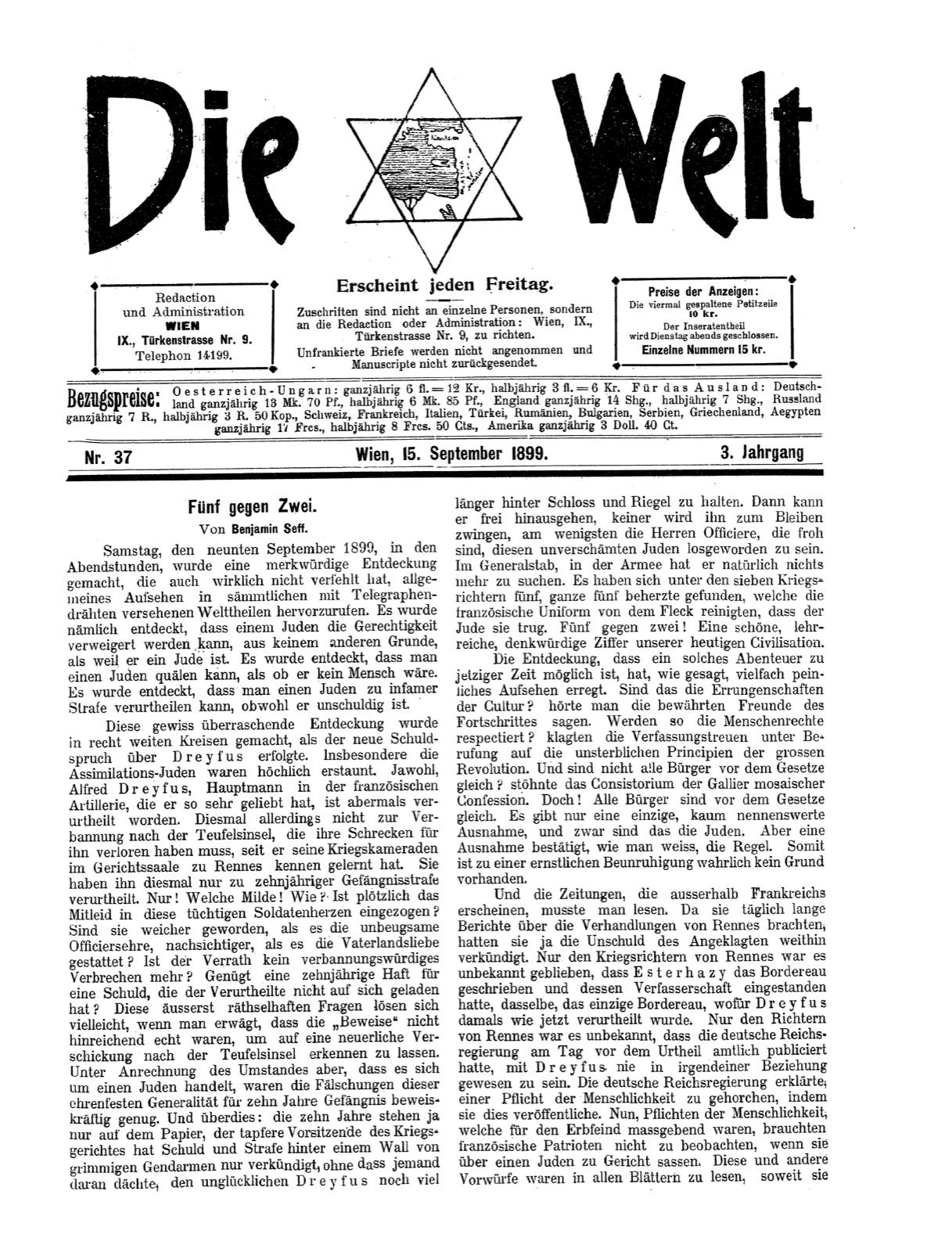
Die Welt
Appears every Friday.
Editorial Office and Administration: VIENNA, IX., Türkenstrasse No. 9. Telephone 14199. Communications are to be addressed not to individual persons, but to the Editorial Office or the Administration: Vienna, IX., Türkenstrasse No. 9. Unstamped letters are not accepted, and manuscripts are not returned. Advertising rates: the four-column petit line 10 kr. The advertisement section closes Tuesday evening. Single numbers 15 kr.
Subscription rates: Austria-Hungary: yearly 6 fl. = 12 Kr., half-yearly 3 fl. = 6 Kr. For abroad: Germany yearly 13 Mk. 70 Pf., half-yearly 6 Mk. 85 Pf.; England yearly 14 Shg., half-yearly 7 Shg.; Russia yearly 7 R., half-yearly 3 R. 50 Kop.; Switzerland, France, Italy, Turkey, Roumania, Bulgaria, Servia, Greece, Egypt yearly 17 Frcs., half-yearly 8 Frcs. 50 Cts.; America yearly 3 Doll. 40 Ct.
No. 37 | Vienna, 15 September 1899. | Third Year
Five against Two.
By Benjamin Seff.
On Saturday, the ninth of September 1899, in the evening hours, a remarkable discovery was made, which has indeed by no means failed to excite general attention in all those quarters of the world provided with telegraph wires. It was discovered, namely, that justice may be refused to a Jew for no other reason than that he is a Jew. It was discovered that one may torment a Jew as though he were not a human being. It was discovered that a Jew may be condemned to an infamous punishment although he is innocent.
This assuredly surprising discovery was made in very wide circles when the new verdict of guilty was pronounced upon Dreyfus. The assimilation Jews in particular were exceedingly astonished. Yes indeed, Alfred Dreyfus, captain in the French artillery which he loved so dearly, has once more been condemned. This time, to be sure, not to banishment to Devil's Island, which must have lost its terrors for him since he came to know his comrades-in-arms in the court-room at Rennes. This time they have sentenced him only to ten years' imprisonment. Only! What clemency! How? Has compassion suddenly entered into these stout soldierly hearts? Have they grown softer than inflexible officers' honour, more indulgent than love of the fatherland permits? Is treason no longer a crime deserving of banishment? Does a ten years' confinement suffice for a guilt which the condemned man never took upon himself? These extremely puzzling questions perhaps resolve themselves when one considers that the "proofs" were not sufficiently genuine to warrant a fresh deportation to Devil's Island. But taking into account the circumstance that a Jew was concerned, the forgeries of these honour-firm generals were of proof enough for ten years in gaol. And besides: the ten years stand only upon paper; the valiant president of the court-martial has but proclaimed guilt and punishment from behind a rampart of grim gendarmes, without anyone thinking of keeping the unhappy Dreyfus much longer under lock and key. Then he may walk out free; no one will compel him to stay, least of all the gentlemen officers, who are glad to have got rid of this impudent Jew. On the general staff, in the army, he has of course no further business. Among the seven military judges there were found five, five whole stout-hearted men, who cleansed the French uniform of the stain that a Jew had worn it. Five against two! A fine, instructive, memorable figure of our present-day civilisation.
The discovery that such an adventure is possible at the present time has, as we have said, aroused painful astonishment in many quarters. Are these the achievements of culture? one heard the tried friends of progress say. Are the rights of man respected in this fashion? lamented the loyal constitutionalists, invoking the immortal principles of the great Revolution. And are not all citizens equal before the law? groaned the Consistory of the Gauls of the Mosaic confession. Indeed they are! All citizens are equal before the law. There is but one single exception, scarcely worth naming, and that is the Jews. But an exception, as everyone knows, proves the rule. There is therefore truly no ground for any serious disquiet.
And the newspapers appearing outside France — those one ought to have read. Since they brought daily long reports of the proceedings at Rennes, they had indeed proclaimed the innocence of the accused far and wide. Only to the military judges of Rennes had it remained unknown that Esterhazy had written the bordereau and had confessed its authorship, the same, the only bordereau for which Dreyfus was condemned then as now. Only to the judges of Rennes was it unknown that the German Imperial Government had officially published, on the day before the verdict, that it had never stood in any relation whatsoever with Dreyfus. The German Imperial Government declared that in publishing this it was obeying a duty of humanity. Now, duties of humanity which were binding upon the hereditary enemy needed not be observed by French patriots when they sat in judgment upon a Jew. These and other reproaches were to be read in all the papers, in so far as they