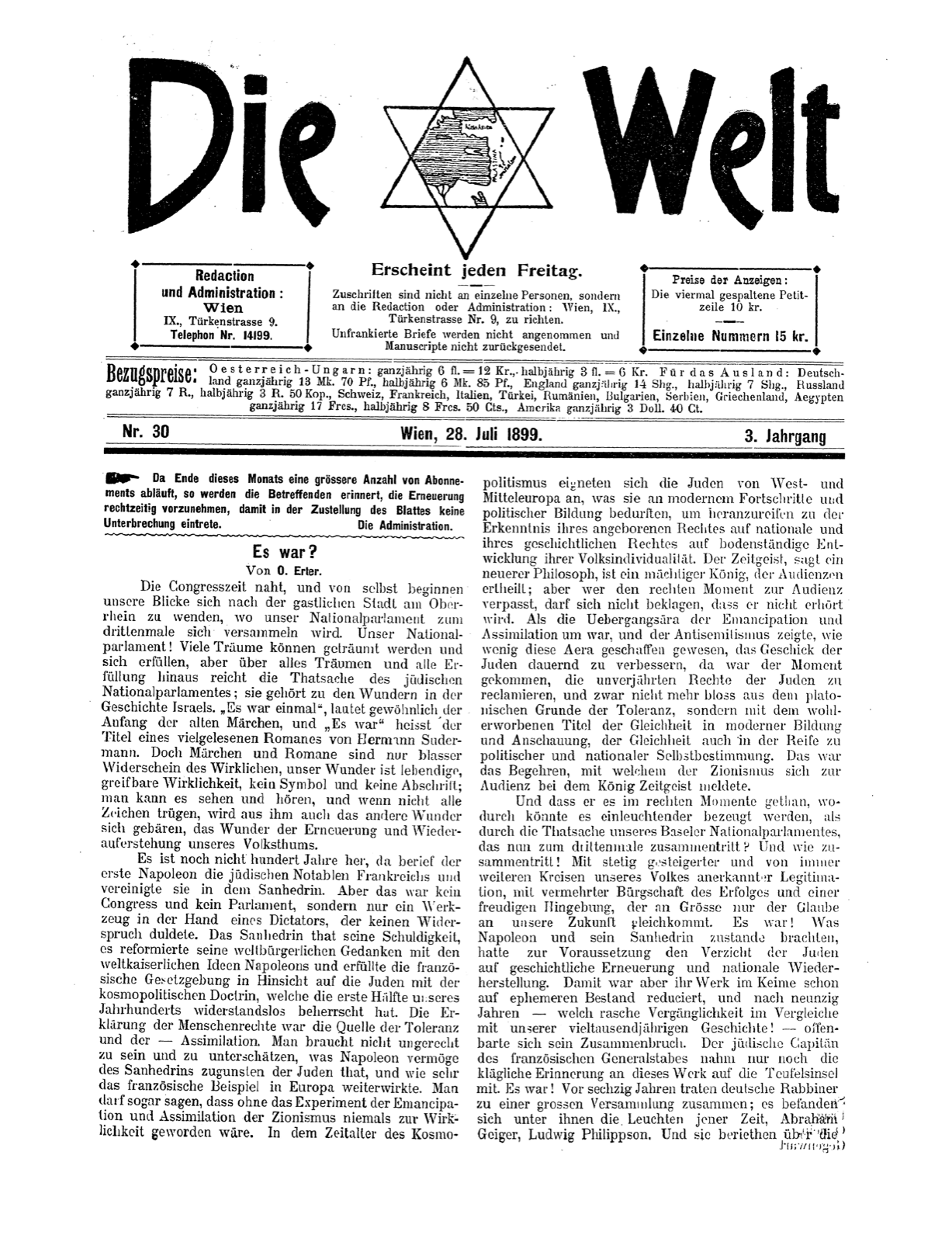
Die Welt
Appears every Friday.
Editorial Office and Administration: Vienna IX., Türkenstrasse 9. Telephone No. 14199. — Communications are to be addressed not to individual persons, but to the Editorial Office or the Administration: Vienna, IX., Türkenstrasse No. 9. Unfranked letters will not be accepted, and manuscripts will not be returned. — Advertising Rates: the four-column petit line, 10 kr. — Single numbers 15 kr.
Subscription Prices: Austria-Hungary: yearly 6 fl. = 12 Kr., half-yearly 3 fl. = 6 Kr. For abroad: Germany yearly 13 Mk. 70 Pf., half-yearly 6 Mk. 85 Pf.; England yearly 14 Shg., half-yearly 7 Shg.; Russia yearly 7 R., half-yearly 3 R. 50 Kop.; Switzerland, France, Italy, Turkey, Roumania, Bulgaria, Servia, Greece, Egypt yearly 17 Frcs., half-yearly 8 Frcs. 50 Cts.; America yearly 3 Doll. 40 Ct.
No. 30 / Vienna, 28 July 1899. / Vol. III.
As a considerable number of subscriptions expire at the end of this month, those concerned are reminded to effect the renewal in good time, so that no interruption may occur in the delivery of the paper.
The Administration.
It Was?
By O. Erter.
The time of the Congress draws near, and of themselves our eyes begin to turn towards the hospitable city on the Upper Rhine, where our national parliament will assemble for the third time. Our national parliament! Many dreams may be dreamed and may be fulfilled, but beyond all dreaming and all fulfilment reaches the fact of the Jewish national parliament; it belongs among the wonders in the history of Israel. "Once upon a time" is the usual beginning of the old fairy-tales, and "It Was" is the title of a much-read novel by Hermann Sudermann. But fairy-tales and novels are only the pale reflection of the real; our wonder is living, palpable reality, no symbol and no copy; it can be seen and heard, and if all signs do not deceive, out of it that other wonder also will be born, the wonder of the renewal and the resurrection of our nationhood.
It is not yet a hundred years since the first Napoleon summoned the Jewish notables of France and united them in the Sanhedrin. But that was no congress and no parliament, but only a tool in the hand of a dictator who brooked no contradiction. The Sanhedrin did its duty; it reformed its cosmopolitan thoughts with the world-imperial ideas of Napoleon, and filled French legislation in respect of the Jews with that cosmopolitan doctrine which ruled the first half of our century without resistance. The Declaration of the Rights of Man was the source of toleration and of — assimilation. One need not be unjust and undervalue what Napoleon did by means of the Sanhedrin in favour of the Jews, and how greatly the French example worked on throughout Europe. One may even say that without the experiment of emancipation and assimilation Zionism would never have become a reality. In the age of cosmopolitanism the Jews of Western and Central Europe made their own whatever they needed of modern progress and political culture in order to ripen towards the recognition of their inborn right to a national, and of their historical right to a native-soil, development of their national individuality. The spirit of the age, says a more recent philosopher, is a mighty king who grants audiences; but he who misses the right moment for his audience must not complain that he is not heard. When the transitional era of emancipation and assimilation was over, and antisemitism showed how little that era had been fitted to better the lot of the Jews permanently, then the moment had come to reclaim the unforfeited rights of the Jews — and no longer merely upon the platonic ground of toleration, but with the well-earned title of equality in modern culture and outlook, of equality also in ripeness for political and national self-determination. That was the petition with which Zionism presented itself for audience before King Zeitgeist.
And that it did so at the right moment — by what could it be more convincingly attested than by the fact of our Basle national parliament, which now assembles for the third time? And how it assembles! With a legitimation steadily heightened and acknowledged by ever wider circles of our people, with an increased warrant of success, and with a joyful devotion equalled in greatness only by our faith in our future. It was! What Napoleon and his Sanhedrin brought to pass had for its premise the renunciation by the Jews of historical renewal and national restoration. Thereby, however, their work was in the very germ reduced to an ephemeral existence, and after ninety years — what swift transience compared with our history of many thousands of years! — its collapse revealed itself. The Jewish captain of the French general staff carried with him to Devil's Island nothing more than the pitiable memory of that work. It was! Sixty years ago German rabbis came together in a great assembly; among them were the luminaries of that time, Abraham Geiger, Ludwig Philippson. And they took counsel concerning the