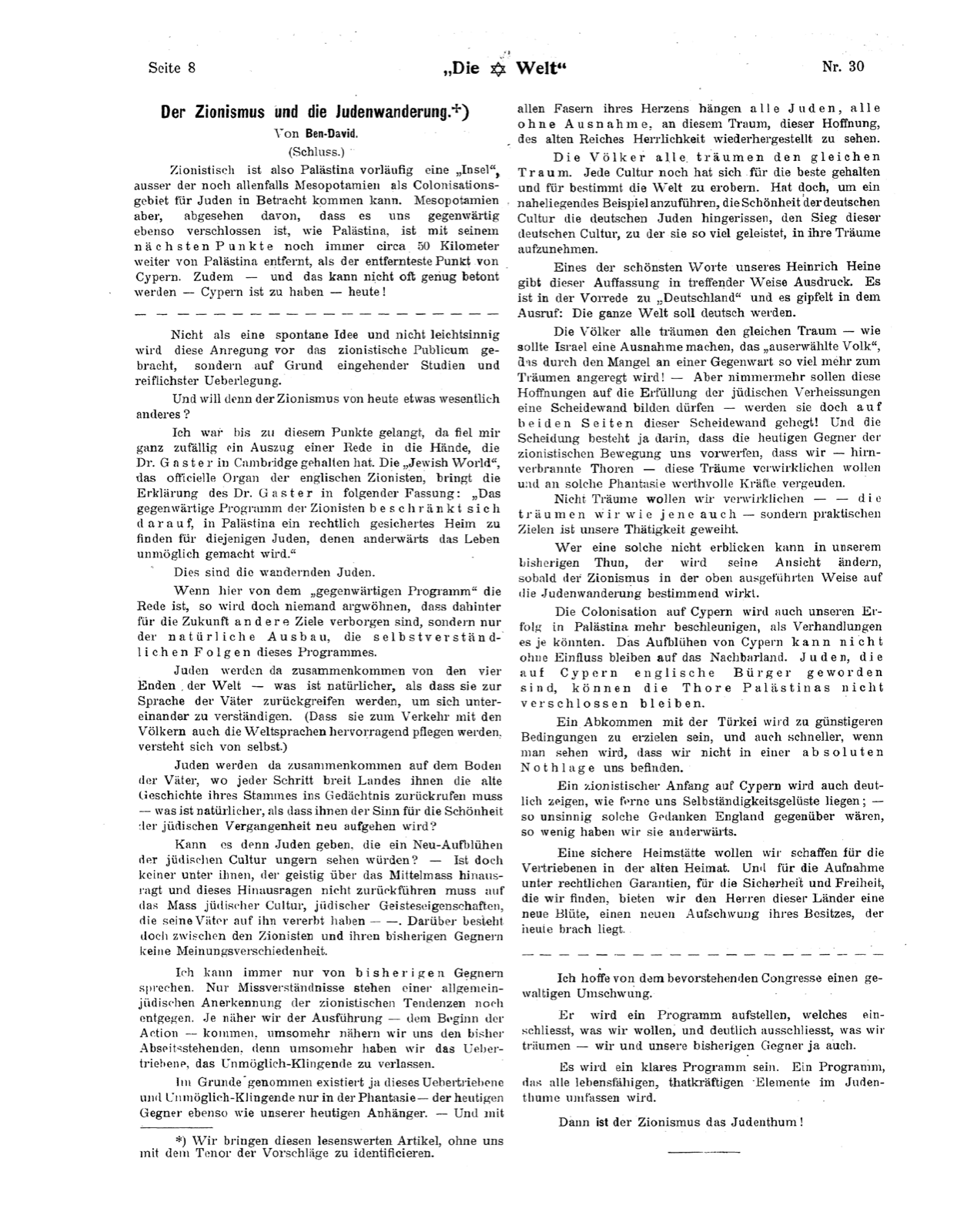
Page 8. — "Die Welt" — No. 30.
Zionism and the Jewish Migration.*)
By Ben-David.
(Conclusion.)
Zionistically speaking, then, Palestine is for the present an "island", besides which at most Mesopotamia can come into consideration as a region of colonisation for Jews. Mesopotamia, however — apart from the fact that it is at present just as closed to us as Palestine — is at its nearest point still about 50 kilometres farther distant from Palestine than the remotest point of Cyprus. Moreover — and this cannot be emphasised often enough — Cyprus is to be had — to-day!
It is not as a spontaneous notion, and not lightly, that this suggestion is brought before the Zionist public, but upon the ground of thorough studies and the maturest reflection.
And does the Zionism of to-day want anything essentially different?
I had got as far as this point when quite by chance there fell into my hands an extract from an address which Dr. Gaster delivered at Cambridge. The "Jewish World", the official organ of the English Zionists, gives Dr. Gaster's declaration in the following form: "The present programme of the Zionists confines itself to finding in Palestine a legally secured home for those Jews for whom life is made impossible elsewhere."
These are the migrating Jews.
When mention is here made of the "present programme", surely no one will suspect that other aims for the future lie concealed behind it, but only the natural development, the self-evident consequences of this programme.
Jews will come together there from the four ends of the world — what is more natural than that they will fall back upon the language of the fathers in order to make themselves understood among one another. (That for intercourse with the nations they will also cultivate the world-languages in an eminent degree goes without saying.)
Jews will come together there upon the soil of the fathers, where every foot's breadth of land must call back into their memory the ancient history of their race — what is more natural than that the sense for the beauty of the Jewish past will dawn upon them anew?
Can there be Jews, then, who would be loth to see a fresh flowering of Jewish culture? — There is surely not one among them who rises intellectually above the average and who must not trace that eminence back to the measure of Jewish culture, of Jewish qualities of mind, which his fathers have bequeathed to him —. Upon this point there exists no difference of opinion between the Zionists and their hitherto opponents.
I can always speak only of hitherto opponents. Nothing but misunderstandings still stands in the way of a general Jewish recognition of the Zionist tendencies. The nearer we come to the execution — to the beginning of the action — the nearer we come to those who have hitherto stood aside; for so much the more must we abandon the exaggerated, the impossible-sounding.
At bottom this exaggerated and impossible-sounding element exists only in the imagination — of the opponents of to-day just as much as of our adherents of to-day. — And with every fibre of their hearts all Jews, all without exception, cling to this dream, this hope, of seeing the glory of the ancient kingdom restored.
All the peoples dream the same dream. Every culture yet has held itself to be the best and destined to conquer the world. To adduce an obvious example: the beauty of German culture has so carried away the German Jews that they have taken up into their dreams the victory of that German culture to which they have contributed so much.
One of the finest sayings of our Heinrich Heine gives apt expression to this conception. It stands in the preface to "Deutschland", and it culminates in the exclamation: The whole world shall become German.
All the peoples dream the same dream — how should Israel form an exception, the "chosen people", which by the want of a present is so much the more incited to dreaming! — But nevermore may these hopes for the fulfilment of the Jewish promises be permitted to form a partition-wall — they are, after all, cherished upon both sides of that wall! And the division consists precisely in this, that the present-day opponents of the Zionist movement reproach us with wishing — hare-brained fools that we are — to realise these dreams, and with squandering valuable energies upon such a fantasy.
It is not dreams that we wish to realise — those we dream as the others do — but our activity is consecrated to practical aims.
Whoever cannot descry such an activity in what we have hitherto done will change his view as soon as Zionism, in the manner set forth above, comes to exert a determining influence upon the Jewish migration.
The colonisation of Cyprus will also hasten our success in Palestine more than negotiations could ever do. The flourishing of Cyprus cannot remain without influence upon the neighbouring land. To Jews who have become English citizens in Cyprus the gates of Palestine cannot remain closed.
An agreement with Turkey will be obtainable upon more favourable conditions, and more quickly too, when it is seen that we do not find ourselves in a position of absolute distress.
A Zionist beginning in Cyprus will also show plainly how far from us lie any cravings after independence; — senseless as such thoughts would be as against England, just as little do we harbour them elsewhere.
A secure homestead we wish to create for those driven out, in the old homeland. And for the reception under legal guarantees, for the security and freedom which we find, we offer the lords of these lands a new flowering, a new upsurge of their possession, which to-day lies fallow.
I hope from the coming Congress a mighty turn of affairs.
It will set up a programme which includes what we want and plainly excludes what we dream — we, and our hitherto opponents as well.
It will be a clear programme. A programme which will comprehend all the vital, energetic elements in Jewry.
Then Zionism is Jewry!
*) We print this article, which is well worth reading, without identifying ourselves with the tenor of its proposals.