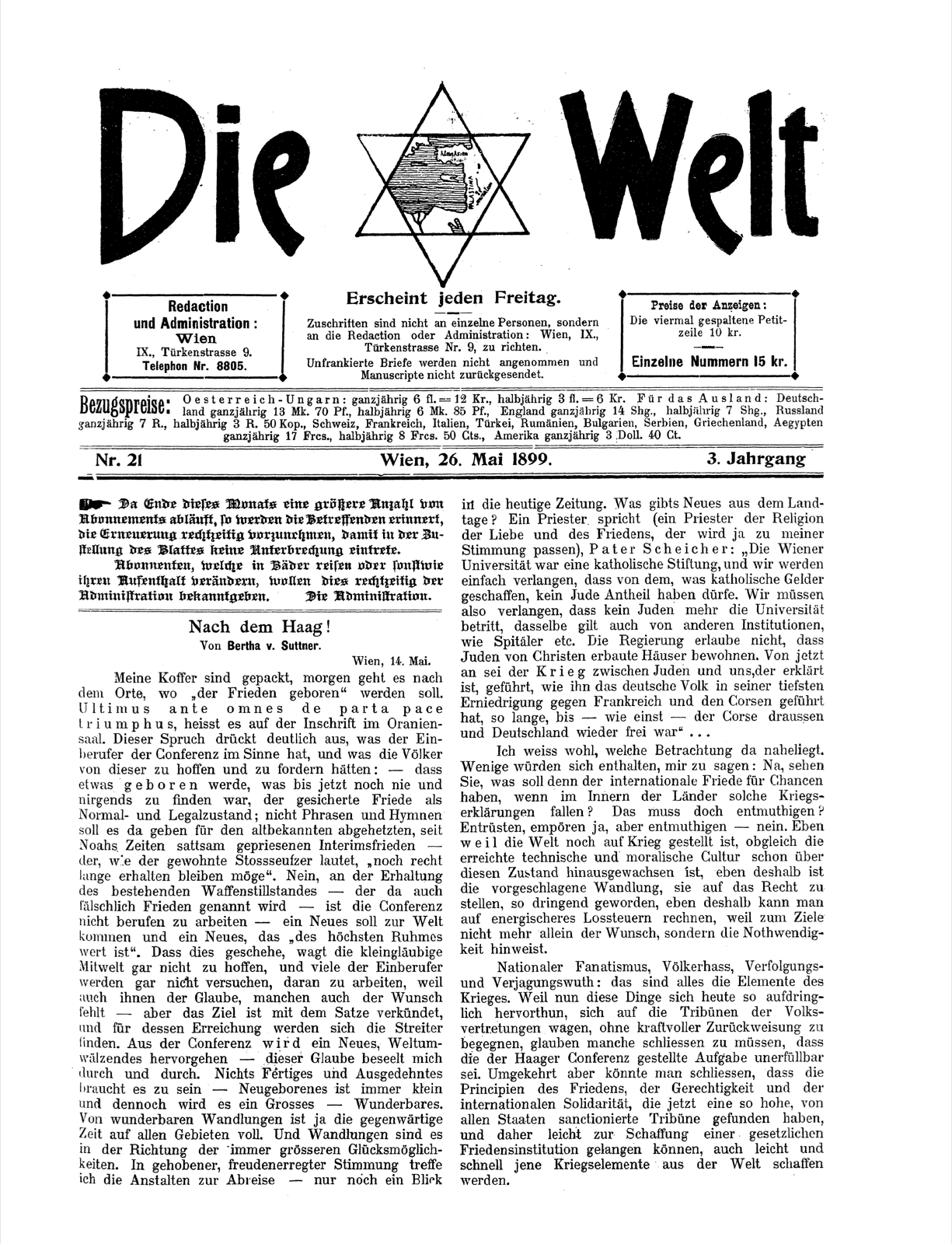
Die Welt
Editorial Office and Administration: Vienna IX., Türkenstrasse 9. Telephone No. 8805.
Published every Friday.
Communications are to be addressed, not to individual persons, but to the Editorial Office or the Administration: Vienna, IX., Türkenstrasse No. 9.
Unstamped letters are not accepted, and manuscripts are not returned.
Advertising rates: The four-column petit line 10 kr. Single numbers 15 kr.
Subscription rates: Austria-Hungary: yearly 6 fl. = 12 Kr., half-yearly 3 fl. = 6 Kr. For abroad: Germany yearly 13 Mk. 70 Pf., half-yearly 6 Mk. 85 Pf., England yearly 14 shg., half-yearly 7 shg., Russia yearly 7 R., half-yearly 3 R. 50 Kop., Switzerland, France, Italy, Turkey, Roumania, Bulgaria, Servia, Greece, Egypt yearly 17 frcs., half-yearly 8 frcs. 50 cts., America yearly 3 doll. 40 ct.
No. 21 | Vienna, 26 May 1899. | Third Year
☞ As a considerable number of subscriptions expire at the end of this month, those concerned are reminded to effect their renewal in good time, so that no interruption may occur in the delivery of the paper.
Subscribers who are travelling to the baths, or who otherwise change their place of residence, are requested to notify the Administration thereof in good time. The Administration.
To The Hague!
By Bertha v. Suttner.
Vienna, 14 May.
My trunks are packed; to-morrow I set out for the place where "peace is to be born." Ultimus ante omnes de parta pace triumphus — so runs the inscription in the Orange Hall. This motto expresses clearly what the convener of the Conference has in mind, and what the nations would have to hope and to demand of it: — that something be born which hitherto was nowhere and never to be found, assured peace as the normal and legal condition; there are to be no phrases and hymns there for the old familiar, harried interim peace, praised to satiety since Noah's days — which, as the customary sigh has it, "may yet long be preserved to us." No, it is not to the preservation of the existing armistice — which is likewise falsely called peace — that the Conference is called to labour; a new thing is to come into the world, and a new thing that "is worthy of the highest renown." That this should come to pass our contemporaries of little faith do not even venture to hope, and many of the conveners will not so much as attempt to work for it, because they too lack the faith, and some the wish as well — but the goal is proclaimed in that sentence, and champions for its attainment will be found. Out of the Conference something new, something world-transforming will proceed — this faith animates me through and through. It need be nothing finished and full-grown — the new-born is always small, and yet it will become a great thing — a wonderful thing. The present age is indeed full of wonderful transformations in every field. And they are transformations in the direction of ever greater possibilities of happiness. In an elevated and joyfully excited mood I make my preparations for departure — only one more glance at to-day's newspaper. What news is there from the Diet? A priest is speaking (a priest of the religion of love and of peace; he will surely suit my mood), Father Scheicher: "The University of Vienna was a Catholic foundation, and we shall simply demand that of what Catholic money created no Jew may have any share. We must therefore demand that no Jew shall any longer set foot in the University; the same holds of other institutions as well, such as hospitals, etc. Let the Government not permit Jews to inhabit houses built by Christians. From now on let the war between the Jews and us, which has been declared, be waged as the German people waged it in its deepest humiliation against France and the Corsican, so long until — as once before — the Corsican was out and Germany free again"...
I know well what reflection here suggests itself. Few would refrain from saying to me: Well, you see, what chances is international peace to have, when such declarations of war are uttered within the countries themselves? Surely that must discourage one? Indignation, revolt — yes; discouragement — no. Precisely because the world is still set upon war, although the technical and moral culture already attained has outgrown that condition, precisely therefore has the proposed transformation, to set it upon right, become so urgent; precisely therefore may one count upon a more energetic steering towards the goal, because it is no longer desire alone, but necessity, that points the way thither.
National fanaticism, hatred between peoples, the rage of persecution and of expulsion: these are all of them the elements of war. Because these things now thrust themselves forward so obtrusively, and venture upon the tribunes of the popular assemblies without meeting any vigorous rebuff, some believe they must conclude that the task set before the Hague Conference is incapable of fulfilment. Conversely, however, one might conclude that the principles of peace, of justice and of international solidarity, which have now found so lofty a tribune, sanctioned by all the States, and can therefore easily attain to the creation of a legal institution of peace, will also easily and swiftly rid the world of those elements of war.