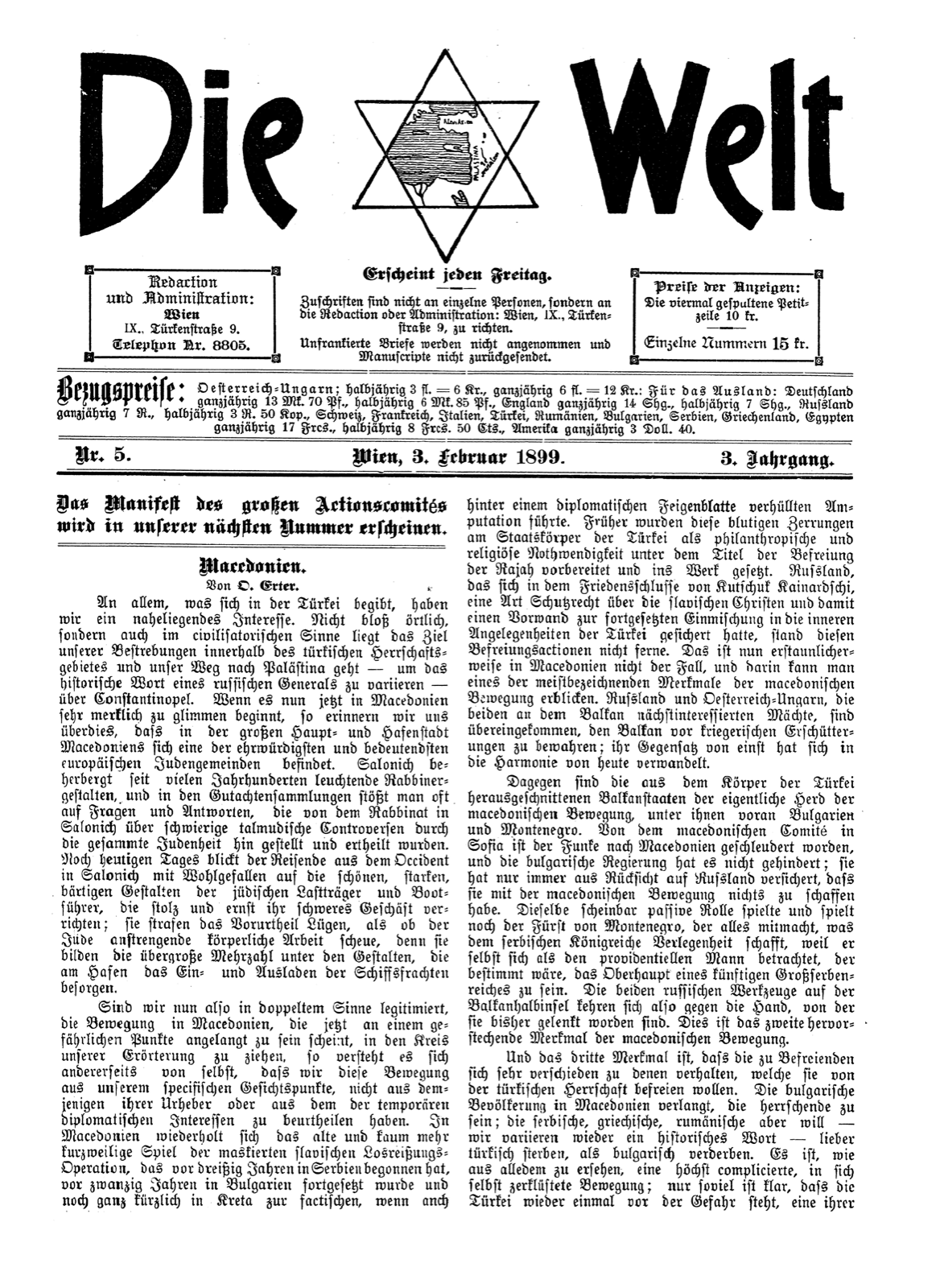
Die Welt
Editorial Office and Administration: Vienna IX., Türkenstraße 9. Telephone No. 8805. Appears every Friday. Communications are to be addressed not to individual persons, but to the Editorial Office or the Administration: Vienna, IX., Türkenstraße 9. Unstamped letters are not accepted, and manuscripts are not returned. Advertising rates: the four-column petit line 10 kr. Single numbers 15 kr.
Subscription rates: Austria-Hungary; half-yearly 3 fl. = 6 Kr., yearly 6 fl. = 12 Kr.: For abroad: Germany yearly 13 Mk. 70 Pf., half-yearly 6 Mk. 85 Pf., England yearly 14 Shg., half-yearly 7 Shg., Russia yearly 7 R., half-yearly 3 R. 50 Kop., Switzerland, France, Italy, Turkey, Roumania, Bulgaria, Servia, Greece, Egypt yearly 17 Frcs., half-yearly 8 Frcs. 50 Cts., America yearly 3 Doll. 40.
No. 5. | Vienna, 3 February 1899. | Vol. 3.
The Manifesto of the Greater Actions Committee will appear in our next number.
Macedonia.
By O. Erter.
In all that comes to pass in Turkey we have an immediate interest. Not merely in a local, but also in a civilising sense, the goal of our endeavours lies within the Turkish dominions, and our road to Palestine runs — to vary the historic word of a Russian general — by way of Constantinople. If, then, things are now beginning very perceptibly to smoulder in Macedonia, we further remember that in the great capital and seaport of Macedonia there is one of the most venerable and most considerable Jewish communities of Europe. For many centuries Salonica has harboured shining figures among the rabbis, and in the collections of responsa one often comes upon questions and answers that were put to, and given by, the rabbinate of Salonica upon difficult Talmudic controversies throughout the whole of Jewry. Even at the present day the traveller from the Occident looks in Salonica with pleasure upon the handsome, strong, bearded figures of the Jewish porters and boatmen, who perform their heavy business proudly and gravely; they give the lie to the prejudice that the Jew shuns strenuous bodily labour, for they form the overwhelming majority among the figures who attend at the harbour to the lading and unlading of the ships' cargoes.
If we are thus in a double sense entitled to draw the movement in Macedonia — which now appears to have reached a dangerous point — into the circle of our discussion, it is on the other hand self-evident that we have to judge this movement from our own specific point of view, and not from that of its authors or from that of the temporary diplomatic interests. In Macedonia there is repeating itself the old and hardly any longer diverting game of the masked Slavonic operation of severance, which began thirty years ago in Servia, was continued twenty years ago in Bulgaria, and quite recently in Crete led to an amputation that was actual, though veiled behind a diplomatic fig-leaf. Formerly these bloody wrenchings at the body politic of Turkey were prepared and set on foot as a philanthropic and religious necessity, under the title of the liberation of the Rajah. Russia, which in the peace of Kutchuk Kainardji had secured to itself a kind of right of protection over the Slavonic Christians, and therewith a pretext for continued interference in the internal affairs of Turkey, did not stand far from these acts of liberation. That, astonishingly enough, is not the case in Macedonia, and therein one may discern one of the most characteristic marks of the Macedonian movement. Russia and Austria-Hungary, the two Powers most nearly interested in the Balkans, have agreed to preserve the Balkans from warlike convulsions; their antagonism of former days has been transformed into the harmony of to-day.
The Balkan States cut out of the body of Turkey, on the other hand, are the real hearth of the Macedonian movement, and foremost among them Bulgaria and Montenegro. From the Macedonian Committee in Sofia the spark has been flung into Macedonia, and the Bulgarian Government has not hindered it; it has only ever, out of regard for Russia, given assurances that it has nothing to do with the Macedonian movement. The same apparently passive part was played, and is still played, by the Prince of Montenegro, who joins in everything that creates embarrassment for the Servian kingdom, because he regards himself as the providential man destined to be the head of a future Greater Servian Empire. The two Russian instruments in the Balkan peninsula thus turn against the hand by which they have hitherto been guided. This is the second salient mark of the Macedonian movement.
And the third mark is that those who are to be liberated stand in very different relations towards those who wish to liberate them from Turkish rule. The Bulgarian population in Macedonia demands to be the ruling one; the Servian, the Greek, the Roumanian, however, would rather — we again vary a historic word — die Turkish than perish Bulgarian. It is, as may be seen from all this, a highly complicated movement, riven within itself; only so much is clear, that Turkey once more stands before the danger of one of her