Page 4. — “Die Welt” — No. 36.
(continued from page 3)
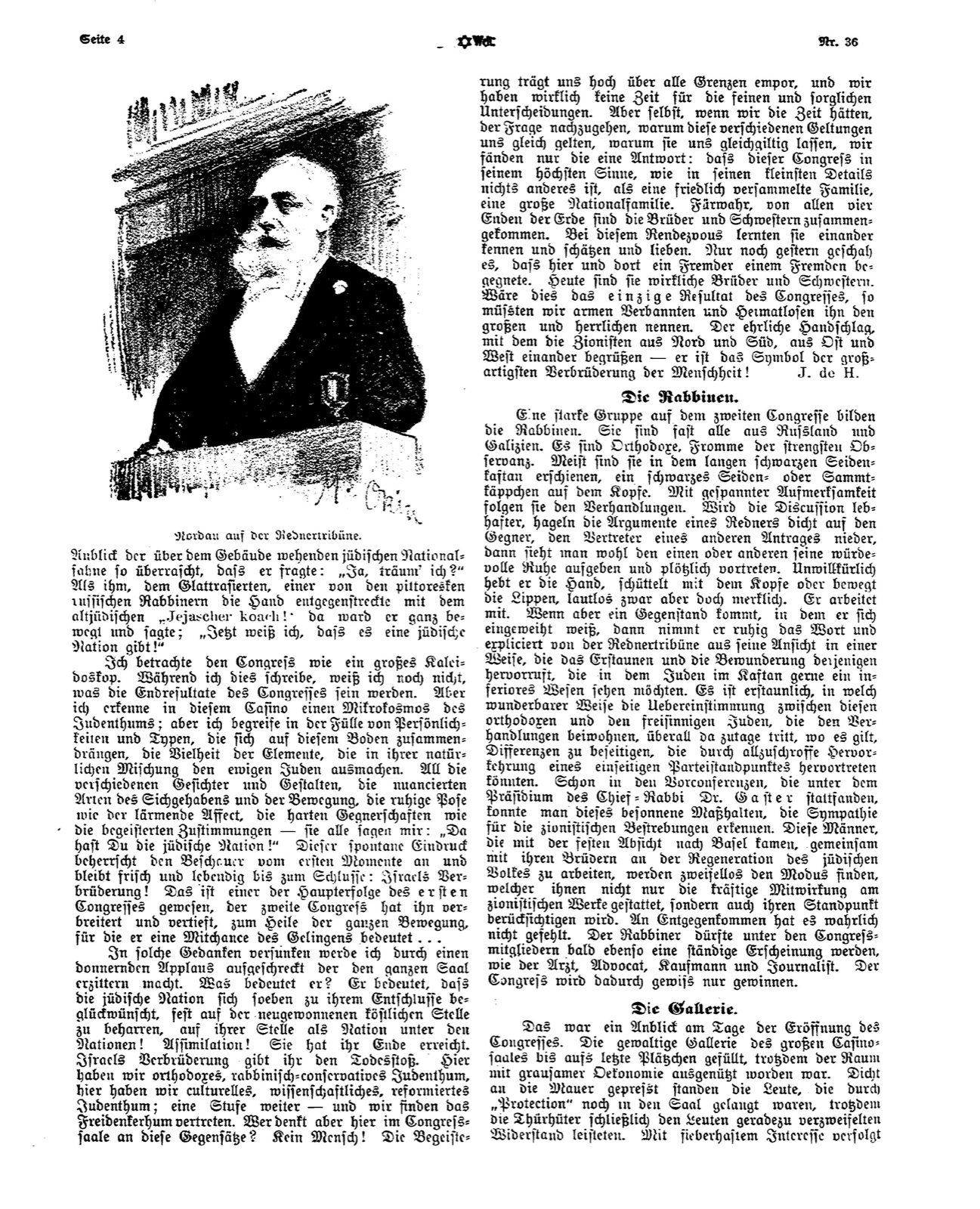
Nordau on the speaker's platform.
…sight of the Jewish national flag waving above the building so surprised that he asked: “Why, am I dreaming?” When one of the picturesque Russian rabbis stretched out his hand to him, the clean-shaven man, with the old Jewish “Jaschascher koach!” he was quite moved and said: “Now I know that there is a Jewish nation!”
I regard the Congress as a great kaleidoscope. While I write this, I do not yet know what the final results of the Congress will be. But I recognise in this Casino a microcosm of Jewry; but I comprehend, in the abundance of personalities and types that throng together upon this ground, the multiplicity of the elements which in their natural mixture make up the eternal Jew. All the various faces and figures, the nuanced manners of bearing and of movement, the quiet pose as well as the clamorous emotion, the hard antagonisms as well as the enthusiastic assents — they all say to me: “Here you have the Jewish nation!” This spontaneous impression governs the beholder from the first moment and remains fresh and living to the close: Israel's fraternisation! That has been one of the chief successes of the first Congress; the second Congress has broadened and deepened it, to the welfare of the whole movement, for which it signifies a contributing chance of success…
Sunk in such thoughts, I am startled by a thundering applause which makes the whole hall tremble. What does it mean? It means that the Jewish nation is at this very moment congratulating itself upon its resolve to stand fast upon the newly won and precious place, upon its place as a nation among the nations! Assimilation! It has reached its end. Israel's fraternisation gives it the death-blow. Here we have orthodox, rabbinically conservative Jewry; here we have cultural, scientific, reformed Jewry; a step further — and we find free-thought represented. But who here in the Congress hall thinks of these oppositions? Not a soul! Enthusiasm bears us high aloft above all boundaries, and we have really no time for the fine and careful distinctions. But even if we had the time to pursue the question why these differing valuations count with us alike, why they leave us indifferent, we should find but the one answer: that this Congress, in its highest sense as in its smallest details, is nothing else than a family peacefully assembled, one great national family. In truth, from all four ends of the earth the brothers and sisters have come together. At this rendezvous they came to know and to esteem and to love one another. Only yesterday it happened that here and there a stranger met a stranger. To-day they are real brothers and sisters. Were this the only result of the Congress, we poor exiles and homeless ones would have to call it the great and glorious one. The honest handclasp with which the Zionists from north and south, from east and west greet one another — it is the symbol of the grandest fraternisation of mankind!
J. de H.
The Rabbis.
A strong group at the second Congress is formed by the rabbis. They are almost all from Russia and Galicia. They are orthodox, pious men of the strictest observance. For the most part they have appeared in the long black silk caftan, a little black silk or velvet cap upon the head. With tense attention they follow the deliberations. If the discussion grows livelier, if the arguments of a speaker hail thick upon his adversary, the champion of some other motion, then one may indeed see this or that one of them give up his dignified repose and suddenly step forward. Involuntarily he raises his hand, shakes his head or moves his lips, soundlessly indeed, yet perceptibly. He is working with the rest. But when a subject comes up in which he knows himself initiated, then he quietly takes the word and expounds his view from the speaker's platform in a manner that calls forth the astonishment and the admiration of those who would gladly see in the Jew in the caftan an inferior being. It is astonishing in what wonderful fashion the agreement between these orthodox and the liberal-minded Jews who are present at the deliberations comes to light wherever it is a question of removing differences that might arise from too sharp an insistence upon a one-sided party standpoint. Already in the preliminary conferences, which were held under the presidency of Chief-Rabbi Dr. Gaster, this considerate moderation, this sympathy for the Zionist endeavours, could be recognised. These men, who came to Basle with the firm intention of working together with their brethren at the regeneration of the Jewish people, will doubtless find the mode which will not only permit them a vigorous co-operation in the Zionist work, but will also take account of their standpoint. In goodwill there has truly been no lack. The rabbi is likely soon to become as constant a figure among the members of the Congress as the physician, the advocate, the merchant and the journalist. The Congress will assuredly only gain thereby.
The Gallery.
That was a sight on the day of the opening of the Congress. The vast gallery of the great Casino hall filled to the very last little place, although the space had been turned to account with cruel economy. Pressed close against the wall stood the people who had still made their way into the hall by “protection,” although the doorkeepers were at last offering the people a downright desperate resistance. With feverish interest follows