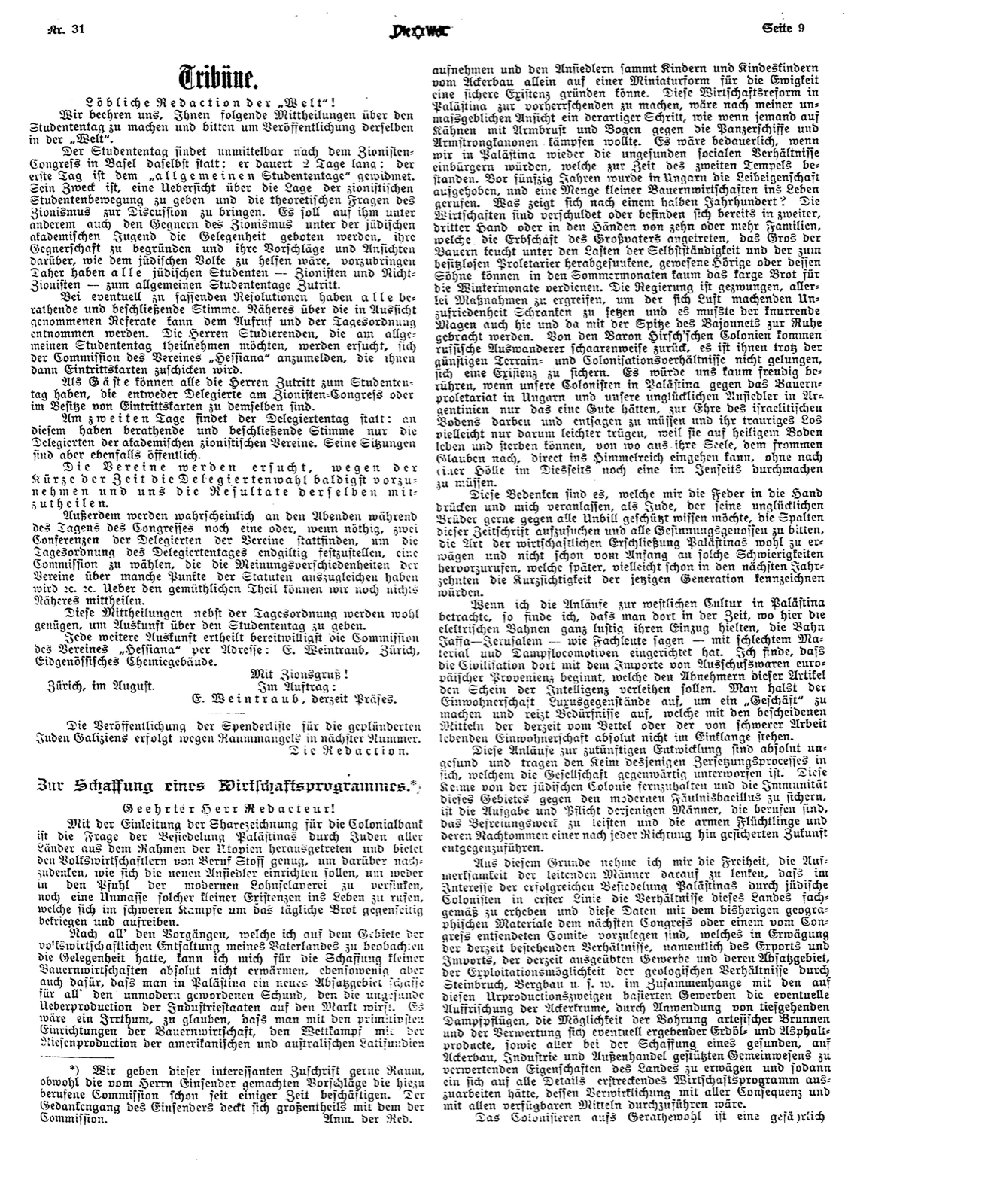
No. 31. — “Die Welt” — Page 9.
Tribune.
Esteemed Editors of the “Welt”!
We have the honour to make you the following communications concerning the Students' Day, and beg for their publication in the “Welt”.
The Students' Day will take place immediately after the Zionist Congress at Basle, in that same city; it lasts two days: the first day is devoted to the “General Students' Day”. Its purpose is to give a survey of the position of the Zionist student movement and to bring the theoretical questions of Zionism under discussion. Among other things, the opponents of Zionism among the Jewish academic youth are also to be afforded the opportunity there of stating the grounds of their opposition and of bringing forward their proposals and views as to how the Jewish people might be helped. Hence all Jewish students — Zionists and non-Zionists — have admission to the General Students' Day.
In the event of resolutions coming to be adopted, all have a consultative and a deciding vote. Further particulars concerning the papers proposed may be gathered from the summons and the order of the day. Those gentlemen students who desire to take part in the General Students' Day are requested to give notice to the commission of the society “Hassiana”, which will then send them cards of admission.
As guests, all those gentlemen may have admission to the Students' Day who are either delegates to the Zionist Congress or in possession of cards of admission to the same.
On the second day the Delegates' Day takes place; at this only the delegates of the academic Zionist societies have a consultative and a deciding vote. Its sittings are, however, likewise public.
The societies are requested, in view of the shortness of the time, to proceed with the election of delegates as soon as possible and to communicate the results thereof to us.
Besides this, there will probably take place, on the evenings during the sittings of the Congress, one or, if necessary, two conferences of the delegates of the societies, in order to settle definitively the order of the day of the Delegates' Day, to elect a commission which will have to adjust the differences of opinion among the societies upon sundry points of the statutes, &c. &c. Concerning the social part we can as yet communicate nothing more precise.
These communications, together with the order of the day, will doubtless suffice to give information about the Students' Day.
Any further information is most willingly furnished by the commission of the society “Hassiana”, at the address: E. Weintraub, Zurich, Eidgenössisches Chemiegebäude.
With Zion's greeting! By order: E. Weintraub, at present President. Zurich, in August.
The publication of the list of donors for the plundered Jews of Galicia will, for want of space, follow in the next number. The Editors.
Towards the Creation of an Economic Programme.*)
Esteemed Mr. Editor!
With the opening of the share subscription for the Colonial Bank, the question of the settlement of Palestine by Jews of all lands has stepped out of the frame of the Utopias and offers to political economists by profession matter enough for reflection as to how the new settlers are to establish themselves, so as neither to sink into the mire of modern wage-slavery nor to call into being a vast mass of those small livelihoods which, in the hard struggle for daily bread, war upon and wear out one another.
After all the occurrences which I have had opportunity to observe in the field of the economic unfolding of my native land, I can absolutely not warm to the creation of small peasant holdings, and just as little to the notion that in Palestine a new market should be created for all the trash that has gone out of fashion and that the unsound over-production of the industrial states throws upon the market. It would be an error to believe that with the most primitive appointments of peasant husbandry one could take up the contest with the giant production of the American and Australian latifundia
*) We gladly give room to this interesting communication, although the proposals made by the sender have already for some time been occupying the commission called to the task. The train of thought of the sender coincides in great part with that of the commission. Ed. note.
and could found for the settlers, together with their children and their children's children, from agriculture alone upon a miniature holding, a secure existence for all eternity. To make this economic reform the predominant one in Palestine would, in my unauthoritative opinion, be such a step as if someone were minded to fight in skiffs, with crossbow and bow, against ironclads and Armstrong guns. It would be deplorable if we were to naturalise in Palestine once more the unsound social conditions which subsisted in the time of the Second Temple. Fifty years ago serfdom was abolished in Hungary, and a multitude of small peasant holdings called into being. What shows itself after half a century? The holdings are encumbered with debt, or are already in second or third hands, or in the hands of ten or more families that have entered upon the grandfather's inheritance; the bulk of the peasants pants beneath the burdens of independence, and the former bondman, sunk to a propertyless proletarian, or his sons can scarcely earn in the summer months the scanty bread for the winter months. The Government is compelled to adopt all manner of measures in order to set bounds to the discontent that is finding vent, and here and there the growling stomach has had to be brought to quiet with the point of the bayonet. From the Baron Hirsch colonies Russian emigrants are returning in troops; in spite of the favourable conditions of terrain and of colonisation they have not succeeded in securing themselves an existence. It would scarcely touch us with joy if our colonists in Palestine, as against the peasant proletariat in Hungary and our unhappy settlers in Argentina, had only this one good thing: that they must want and renounce to the honour of Israelitish soil, and would bear their sad lot the more lightly perhaps only because they can live and die upon holy ground, whence their soul, according to the pious belief, can enter directly into the kingdom of heaven, without having to pass through yet another hell in the beyond after one in this world.
It is these misgivings that press the pen into my hand and move me, as a Jew who would gladly see his unhappy brethren protected against all wrong, to seek out the columns of this journal and to beg all who are of the same mind to weigh well the manner of the economic opening-up of Palestine and not from the very beginning to call forth such difficulties as would later, perhaps already in the coming decades, mark the short-sightedness of the present generation.
When I consider the first attempts at Western culture in Palestine, I find that there, at the time when here the electric railways were making their entry quite merrily, the Jaffa—Jerusalem line was — as experts say — fitted out with bad material and with steam locomotives. I find that civilisation begins there with the importation of reject wares of European provenance, which are to lend to the purchasers of these articles the appearance of intelligence. Articles of luxury are foisted upon the inhabitants in order to make a “business”, and needs are excited which stand absolutely out of accord with the modest means of an inhabitant population living at present by beggary or by heavy labour.
These first attempts towards the future development are absolutely unsound and bear within them the germ of that process of decomposition to which society is at present subject. To keep these germs away from the Jewish colony and to secure the immunity of this territory against the modern bacillus of putrefaction is the task and the duty of those men who are called to accomplish the work of liberation and to lead the poor fugitives and their descendants towards a future secured in every direction.
For this reason I take the liberty of directing the attention of the leading men to this: that in the interest of the successful settlement of Palestine by Jewish colonists the conditions of this country are in the first place to be ascertained in a proper manner, and that these data, together with the geographical material hitherto existing, are to be laid before the next Congress or before a committee deputed by the Congress, which, in consideration of the conditions at present existing — namely of the export and import, of the trades at present carried on and their market, of the possibility of exploiting the geological conditions by quarrying, mining and so forth in connection with the trades based upon these branches of primary production — would have to weigh the possible freshening of the arable soil by the employment of deep-going steam ploughs, the possibility of boring artesian wells and of turning to account any petroleum and asphalt products that might result, as well as all the properties of the country to be turned to account in the creation of a sound commonwealth resting upon agriculture, industry and foreign trade, and would then have to work out an economic programme extending to all details, the realisation of which would be to be carried through with all consistency and with all available means.
Colonising at haphazard is a dangerous