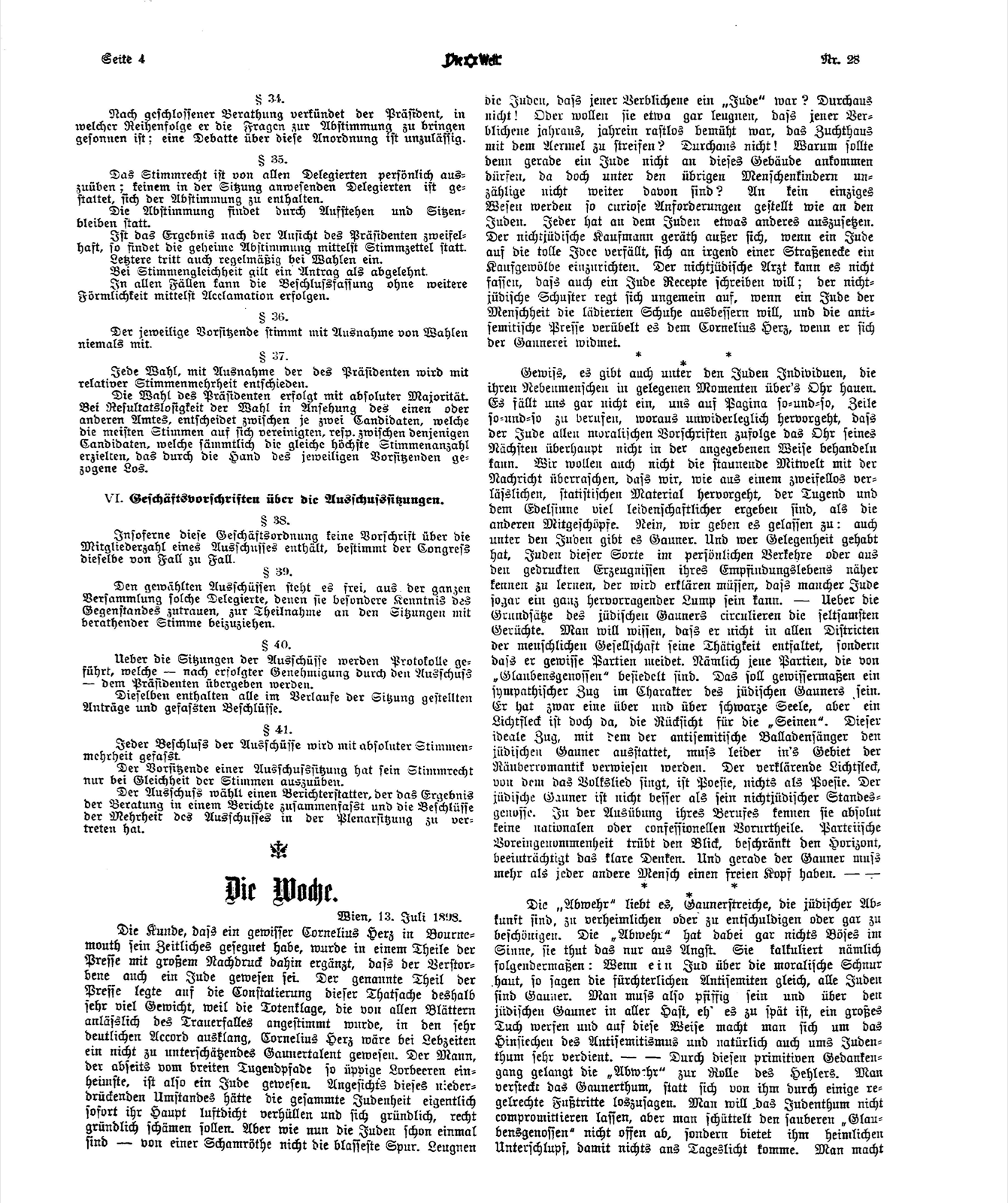
Page 4 — "Die Welt" — No. 28
§ 34.
After the deliberation is closed, the President announces in what order he intends to put the questions to the vote; a debate upon this arrangement is not admissible.
§ 35.
The right to vote is to be exercised by all delegates in person; no delegate present in the sitting is permitted to abstain from voting.
The voting takes place by rising and by remaining seated.
If in the President's opinion the result is doubtful, then secret voting by means of ballot-papers takes place.
The latter also occurs regularly in elections.
In the case of an equality of votes a motion is deemed rejected.
In all cases the resolution may be passed without further formality by acclamation.
§ 36.
The chairman for the time being never votes with the rest, save in elections.
§ 37.
Every election, with the exception of that of the President, is decided by a relative majority of votes.
The election of the President takes place by absolute majority. If the election proves without result in respect of one office or another, the decision between any two candidates who have united the most votes upon themselves, or between those candidates who have all attained the same highest number of votes, is made by the lot drawn by the hand of the chairman for the time being.
VI. Rules of Business concerning the Committee Sittings.
§ 38.
In so far as these Rules of Procedure contain no provision as to the number of members of a committee, the Congress determines the same from case to case.
§ 39.
The elected committees are at liberty to call in from the whole assembly, for participation in the sittings with a consultative voice, such delegates as they credit with a special knowledge of the subject.
§ 40.
Of the sittings of the committees minutes are kept, which — after approval has been given by the committee — are handed over to the President.
The same contain all the motions made and resolutions passed in the course of the sitting.
§ 41.
Every resolution of the committees is passed by an absolute majority of votes.
The chairman of a committee sitting is to exercise his right to vote only in the case of an equality of votes.
The committee elects a reporter, who sums up the result of the deliberation in a report and has to represent the resolutions of the majority of the committee in the plenary sitting.
The Week.
Vienna, 13 July 1898.
The tidings that a certain Cornelius Herz had departed this life at Bournemouth were supplemented in a part of the press, with great emphasis, by the addition that the deceased had also been a Jew. The said part of the press laid so very much weight upon the establishing of this fact because the lament for the dead which was struck up by all the papers on the occasion of the bereavement died away in the very distinct chord that Cornelius Herz had in his lifetime been a talent for roguery not to be underrated. The man who, off the broad path of virtue, garnered so luxuriant a crop of laurels was therefore a Jew. In view of this depressing circumstance the whole of Jewry ought properly to have veiled its head airtight on the instant and to have been ashamed, thoroughly, right thoroughly ashamed. But such as the Jews are — of a blush of shame not the palest trace. Do the Jews deny that the departed one was a "Jew"? By no means! Or would they perhaps even deny that the departed one was, year in, year out, restlessly at pains to brush the penitentiary with his sleeve? By no means! Why, then, should a Jew of all people not be permitted to come up against this building, seeing that among the rest of the children of men countless numbers are no further off from it? Upon no single creature are such curious demands made as upon the Jew. Everyone has something different to find fault with in the Jew. The non-Jewish merchant is beside himself when a Jew hits upon the mad notion of setting up a shop for himself at some street corner. The non-Jewish physician cannot grasp it that a Jew too should wish to write prescriptions; the non-Jewish cobbler is uncommonly agitated when a Jew wishes to mend mankind's damaged shoes; and the anti-Semitic press takes it ill of Cornelius Herz that he devotes himself to roguery.
* * *
Certainly, there are among the Jews too individuals who at convenient moments smite their fellow-men over the ear. It does not occur to us at all to invoke page such-and-such, line such-and-such, from which it appears irrefutably that the Jew, according to all moral precepts, cannot treat his neighbour's ear in the manner indicated at all. Neither do we wish to surprise the astonished world with the news that we, as appears from doubtless reliable statistical material, are far more passionately devoted to virtue and to nobility of mind than the other fellow-creatures. No, we calmly admit it: among the Jews too there are rogues. And whoever has had occasion to become more closely acquainted with Jews of this sort in personal intercourse or from the printed products of their emotional life will have to declare that many a Jew can even be a quite eminent scoundrel. — Concerning the principles of the Jewish rogue the strangest rumours circulate. It is claimed to be known that he does not unfold his activity in all the districts of human society, but that he avoids certain quarters. Namely those quarters which are settled by "co-religionists." This is supposed to be, in a manner of speaking, an engaging trait in the character of the Jewish rogue. His soul, it is true, is black through and through, but a spot of light is nevertheless there: the consideration for "his own." This ideal trait, with which the anti-Semitic ballad-singer equips the Jewish rogue, must unhappily be relegated to the domain of robber-romance. The transfiguring spot of light of which the folk-song sings is poetry, nothing but poetry. The Jewish rogue is no better than his non-Jewish fellow of the same station. In the exercise of their calling they know absolutely no national or confessional prejudices. Partisan bias clouds the vision, narrows the horizon, impairs clear thinking. And precisely the rogue must have a free head more than any other man. — —
* * *
The "Abwehr" loves to conceal, or to excuse, or even to gloss over rogueries which are of Jewish origin. The "Abwehr" has nothing evil in mind in this, it does so only out of fear. It calculates, namely, as follows: If o n e Jew kicks over the moral traces, the terrible anti-Semites say at once that all Jews are rogues. One must therefore be crafty and throw, in all haste, before it is too late, a great cloth over the Jewish rogue, and in this way one renders great service to the wasting away of anti-Semitism and, naturally, to Jewry as well. — — Through this primitive train of thought the "Abwehr" arrives at the part of the receiver of stolen goods. One hides away the roguery instead of disowning it by a few proper kicks. One does not wish to let Jewry be compromised, but one does not openly shake off the precious "co-religionist"; one offers him instead a secret shelter, so that nothing may come to the light of day. One makes