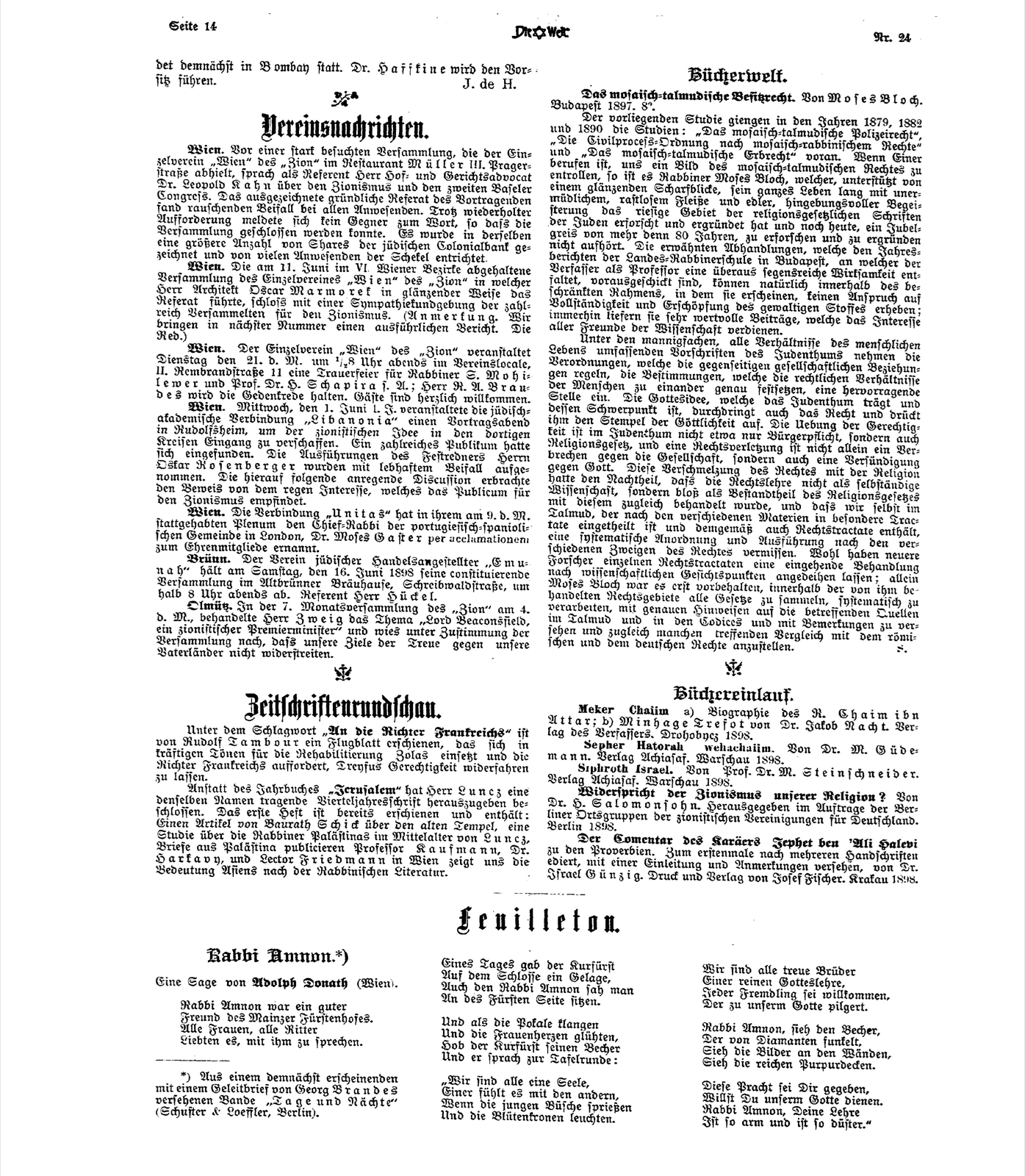
Page 14. — "Die Welt" — No. 24.
(continued from page 13)
…vened shortly in Bombay. Dr. Haffkine will preside. J. de H.
News of the Societies.
Vienna. Before a strongly attended meeting, which the local society "Vienna" of the "Zion" held at the Restaurant Müller (II., Pragerstrasse), the Court and Judicial Advocate Mr. Dr. Leopold Kahn spoke as reporter upon Zionism and the second Basle Congress. The speaker's excellent and thorough address met with resounding applause from all those present. In spite of repeated invitation no opponent asked for the floor, so that the meeting could be closed. At the same meeting a considerable number of shares in the Jewish Colonial Bank were subscribed, and the shekel was paid by many of those present.
Vienna. The meeting of the local society "Vienna" of the "Zion" held on the 11th of June in the VI. Vienna district, at which the architect Mr. Oscar Marmorek conducted the address in brilliant fashion, closed with a demonstration of sympathy for Zionism on the part of the numerous assembly. (Note. We shall give a detailed report in the next number. The Ed.)
Vienna. The local society "Vienna" of the "Zion" will hold on Tuesday, the 21st inst., at half-past 7 in the evening, in the society's rooms, II., Rembrandtstrasse 11, a memorial service for Rabbi S. Mohilewer and Prof. Dr. H. Schapira, of blessed memory; Mr. R. A. Braudes will deliver the commemorative address. Guests are cordially welcome.
Vienna. On Wednesday, the 1st of June of this year, the Jewish academic society "Libanonia" arranged a lecture evening at Rudolfsheim, in order to procure an entrance for the Zionist idea in the circles there. A numerous public had assembled. The observations of the speaker of the evening, Mr. Oskar Rosenberger, were received with lively applause. The stimulating discussion which followed furnished the proof of the keen interest which the public feels for Zionism.
Vienna. The society "Unitas" has, at its plenary meeting held on the 9th inst., appointed the Chief-Rabbi of the Portuguese-Spanish congregation in London, Dr. Moses Gaster, an honorary member per acclamationem.
Bruenn. The society of Jewish commercial employees "Emunah" holds its constituent meeting on Saturday, the 16th of June 1898, at the Altbrünner Bräuhaus, Schreibwaldstrasse, at half-past 7 in the evening. Reporter, Mr. Hückel.
Olmütz. At the 7th monthly meeting of the "Zion" on the 4th inst., Mr. Zweig treated the theme "Lord Beaconsfield, a Zionist Prime Minister," and demonstrated, with the assent of the meeting, that our aims do not conflict with fidelity towards our native lands.
Review of Periodicals.
Under the catchword "To the Judges of France" a leaflet by Rudolf Tambour has appeared, which pleads in vigorous tones for the rehabilitation of Zola and calls upon the judges of France to let justice be done to Dreyfus.
In place of the year-book "Jerusalem" Mr. Luncz has resolved to publish a quarterly bearing the same name. The first number has already appeared and contains: an article by Baurath Schick upon the ancient Temple, a study upon the rabbis of Palestine in the Middle Ages by Luncz; letters from Palestine are published by Professor Kaufmann and Dr. Harkavy, and Lecturer Friedmann in Vienna shows us the significance of Asia according to rabbinical literature.
Book World.
The Mosaic-Talmudic Law of Property. By Moses Bloch. Budapest 1897. 8°.
The present study was preceded, in the years 1879, 1882 and 1890, by the studies: "The Mosaic-Talmudic Law of Police," "The Code of Civil Procedure according to Mosaic-Rabbinic Law," and "The Mosaic-Talmudic Law of Inheritance." If any man is called to unroll for us a picture of Mosaic-Talmudic law, it is Rabbi Moses Bloch, who, supported by a brilliant acuteness of vision, has all his life long, with untiring, restless diligence and noble, devoted enthusiasm, explored and fathomed the vast domain of the religious-legal writings of the Jews, and who to this day, a venerable jubilarian of more than 80 years, does not cease to explore and to fathom. The treatises mentioned, which are prefixed to the annual reports of the National Rabbinical Seminary at Budapest, at which the author as professor unfolds an exceedingly beneficent activity, cannot of course, within the restricted frame in which they appear, lay any claim to completeness or to the exhaustion of the mighty material; they furnish nevertheless very valuable contributions, which deserve the interest of all friends of learning.
Among the manifold precepts of Judaism, which embrace all the relations of human life, a prominent place is taken by those ordinances which regulate the mutual relations of society, the provisions which exactly determine the legal relations of men to one another. The idea of God, which Judaism bears and which is its centre of gravity, penetrates the law also and stamps upon it the impress of divinity. The exercise of justice is in Judaism not merely a civic duty, but also religious law, and a violation of right is not only a crime against society, but also a sin against God. This fusion of law with religion had the disadvantage that the doctrine of law was treated not as an independent science, but merely as a component part of the religious law and together with it, and that even in the Talmud, which is divided according to the various subjects into separate tractates and accordingly contains legal tractates also, we miss a systematic arrangement and elaboration according to the various branches of the law. Recent scholars have indeed accorded a thorough treatment to individual legal tractates from scientific points of view; but it was reserved for Moses Bloch first to collect, within the fields of law treated by him, all the laws, to work them up systematically, to furnish them with exact references to the sources in question in the Talmud and in the codices and with observations, and at the same time to institute many an apt comparison with Roman and with German law. S.
Books Received.
Meker Chajim a) Biography of R. Chaim ibn Attar; b) Minhage Trefot, by Dr. Jakob Nacht. Published by the author. Drohobycz 1898.
Sepher Hatorah wehachaiim. By Dr. M. Güdemann. Achiasaf, publishers. Warsaw 1898.
Siphroth Israel. By Prof. Dr. M. Steinschneider. Achiasaf, publishers. Warsaw 1898.
Does Zionism Contradict our Religion? By Dr. H. Salomonsohn. Published by order of the Berlin local groups of the Zionist Federations for Germany. Berlin 1898.
The Commentary of the Karaite Jephet ben 'Ali Halevi upon the Proverbs. Edited for the first time from several manuscripts, and furnished with an introduction and notes, by Dr. Israel Günzig. Printed and published by Josef Fischer. Cracow 1898.
Feuilleton.
Rabbi Amnon.*)
A legend by Adolph Donath (Vienna).
Rabbi Amnon was a good
Friend of the princely court of Mainz.
All the ladies, all the knights
Loved to hold converse with him.
One day the Elector gave
A banquet at the castle;
Rabbi Amnon too was seen
Sitting at the prince's side.
And when the goblets rang
And the hearts of the women glowed,
The Elector raised his beaker
And he spoke to the company at table:
"We are all one soul,
Each feels it with the others,
When the young bushes sprout
And the crowns of blossom shine.
We are all faithful brothers
Of one pure doctrine of God;
Let every stranger be welcome
Who makes pilgrimage to our God.
Rabbi Amnon, see the beaker
That sparkles with diamonds,
See the pictures on the walls,
See the rich purple coverings.
This splendour shall be given thee,
Wilt thou serve our God.
Rabbi Amnon, thy doctrine
Is so poor and is so gloomy."
*) From a volume "Tage und Nächte" shortly to appear, furnished with an introductory letter by Georg Brandes (Schuster & Loeffler, Berlin).