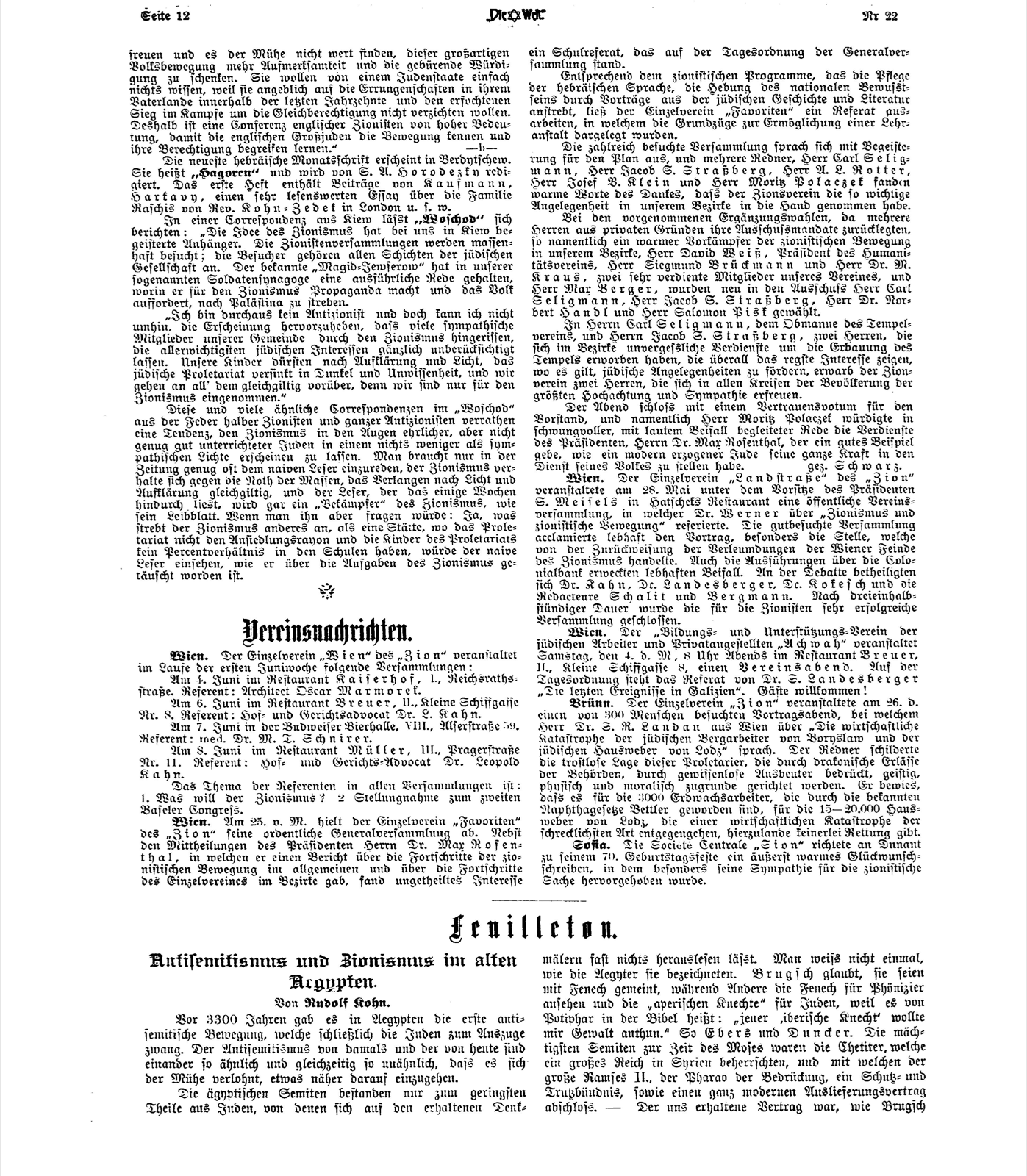
Page 12 — "Die Welt" — No. 22
(continued from page 11)
…joice and do not find it worth the trouble to bestow upon this grand popular movement more attention and the appreciation which is its due. They will simply hear nothing of a Jewish State, because they allegedly do not wish to renounce the achievements gained in their fatherland within the last decades and the victory won in the struggle for equality of rights. Therefore a conference of English Zionists is of high significance, in order that the English great Jews may come to know the movement and learn to comprehend its justification." —h—
The newest Hebrew monthly appears at Berdytschew. It is called "Hagoren" and is edited by S. A. Horodezky. The first number contains contributions by Kaufmann, Harkavy, a very readable essay upon the family of Rashi by the Rev. Kohn-Zedek in London, etc.
In a correspondence from Kieff the "Woschod" has the following reported to it: "The idea of Zionism has enthusiastic adherents among us in Kieff. The Zionist meetings are attended in masses; those who attend belong to all strata of Jewish society. The well-known 'Magid-Jewserow' has delivered a detailed address in our so-called Soldiers' Synagogue, in which he makes propaganda for Zionism and calls upon the people to strive towards Palestine.
"I am by no means an anti-Zionist, and yet I cannot refrain from bringing forward the phenomenon that many sympathetic members of our community, carried away by Zionism, leave the very weightiest Jewish interests wholly out of consideration. Our children thirst for enlightenment and light, the Jewish proletariat sinks into darkness and ignorance, and we pass by all this indifferently, for we are taken up only with Zionism."
These and many similar correspondences in the "Woschod" from the pen of half-Zionists and of whole anti-Zionists betray a tendency to make Zionism appear, in the eyes of honest but not sufficiently well-informed Jews, in a light that is anything but sympathetic. One need only persuade the naive reader often enough in the newspaper that Zionism behaves indifferently towards the distress of the masses and the craving for light and enlightenment, and the reader who reads this for some weeks together becomes even a "combatant" of Zionism, like his favourite paper. But were one to ask him: Well, what else does Zionism strive after than a place where the proletariat has no Pale of Settlement and the children of the proletariat no percentage quota in the schools — the naive reader would perceive how he has been deceived concerning the tasks of Zionism.
Society News.
Vienna. The individual society "Vienna" of the "Zion" arranges in the course of the first week of June the following meetings:
On the 4th of June at the Restaurant Kaiserhof, I., Reichsratstraße. Speaker: Architect Oscar Marmorek.
On the 6th of June at the Restaurant Breuer, II., Kleine Schiffgasse No. 8. Speaker: Court and Judicial Advocate Dr. L. Kahn.
On the 7th of June at the Budweiser Bierhalle, VIII., Alserstraße 59. Speaker: Dr. med. M. T. Schnirer.
On the 8th of June at the Restaurant Müller, III., Pragerstraße No. 11. Speaker: Court and Judicial Advocate Dr. Leopold Kahn.
The theme of the speakers at all the meetings is:
- What does Zionism want?
- Position to be taken towards the second Basle Congress.
Vienna. On the 25th of last month the individual society "Favoriten" of the "Zion" held its ordinary general meeting. Besides the communications of the president, Dr. Max Rosenthal, in which he gave a report upon the progress of the Zionist movement in general and upon the progress of the individual society in the district, undivided interest was found by a school report which stood upon the agenda of the general meeting.
In accordance with the Zionist programme, which strives after the cultivation of the Hebrew language and the raising of the national consciousness through lectures upon Jewish history and literature, the individual society "Favoriten" had a report drawn up in which the outlines for making possible an educational institution were set forth.
The numerously attended meeting declared itself with enthusiasm for the plan, and several speakers, Mr. Carl Seligmann, Mr. Jacob S. Straßberg, Mr. A. L. Rotter, Mr. Josef B. Klein and Mr. Moritz Polaczek, found warm words of thanks that the Zion Society had taken in hand this so important matter in our district.
At the supplementary elections undertaken, since several gentlemen laid down their committee mandates for private reasons, and notably a warm champion of the Zionist movement in our district, Mr. David Weiß, president of the Humanity Society, Mr. Siegmund Brückmann and Mr. Dr. M. Kraus, two very deserving members of our society, and Mr. Max Berger, there were newly elected to the committee Mr. Carl Seligmann, Mr. Jacob S. Straßberg, Mr. Dr. Norbert Handl and Mr. Salomon Fisk.
In Mr. Carl Seligmann, the chairman of the Temple Society, and Mr. Jacob S. Straßberg, two gentlemen who have earned unforgettable merit in the district for the building of the Temple, and who show everywhere the liveliest interest where Jewish affairs are to be furthered, the Zion Society has gained two gentlemen who enjoy the greatest respect and sympathy in all circles of the population.
The evening closed with a vote of confidence in the board, and Mr. Moritz Polaczek in particular, in a spirited speech accompanied by loud applause, appreciated the merits of the president, Dr. Max Rosenthal, who gives a good example how a modernly educated Jew should place his whole strength in the service of his people. signed Schwarz.
Vienna. The individual society "Landstraße" of the "Zion" arranged on the 28th of May, under the presidency of the president S. Meisels, a public meeting of the society at Hatschek's Restaurant, at which Dr. Werner reported upon "Zionism and the Zionist Movement". The well-attended meeting briskly acclaimed the lecture, especially the passage which dealt with the repudiation of the calumnies of the Vienna enemies of Zionism. The expositions concerning the Colonial Bank likewise awakened lively applause. In the debate there took part Dr. Kahn, Dr. Landesberger, Dr. Kokesch and the editors Schalit and Bergmann. After a duration of three hours and a half the meeting, very successful for the Zionists, was closed.
Vienna. The "Educational and Benevolent Society of Jewish Workmen and Private Employees 'Achwah'" arranges on Saturday, the 4th inst., at 8 o'clock in the evening, at the Restaurant Breuer, II., Kleine Schiffgasse 8, an evening of the society. Upon the agenda stands the report of Dr. S. Landesberger, "The Latest Events in Galicia". Guests welcome!
Bruenn. The individual society "Zion" arranged on the 26th inst. a lecture evening attended by 300 persons, at which Dr. S. R. Landau of Vienna spoke upon "The Economic Catastrophe of the Jewish Mine Workers of Boryslaw and of the Jewish Home Weavers of Lodz". The speaker depicted the desolate situation of these proletarians, who, oppressed by draconian decrees of the authorities and by unscrupulous exploiters, are being ruined mentally, physically and morally. He proved that for the 3000 earth-wax workers who have become beggars through the well-known naphtha laws, and for the 15,000-20,000 home weavers of Lodz, who are going to meet an economic catastrophe of the most frightful kind, there is in this country no rescue of any sort.
Sofia. The Societé Centrale "Sion" addressed to Dunant, upon the celebration of his 70th birthday, an exceedingly warm letter of congratulation, in which his sympathy for the Zionist cause was especially brought forward.
Feuilleton.
Antisemitism and Zionism in Ancient Egypt.
By Rudolf Kohn.
3300 years ago there existed in Egypt the first anti-Semitic movement, which finally compelled the Jews to the Exodus. The anti-Semitism of that day and that of to-day are so like one another and at the same time so unlike, that it is worth the trouble to enter somewhat more closely upon it.
The Egyptian Semites consisted only in the smallest part of Jews, of whom almost nothing can be gathered from the monuments that have been preserved. It is not even known how the Egyptians designated them. Brugsch believes they are meant by the Fenech, while others take the Fenech for Phoenicians and the "aperian servants" for Jews, because it is said of Potiphar in the Bible: "that iberian servant" would have done me violence." So Ebers and Duncker. The mightiest Semites in the time of Moses were the Chetites, who ruled a great empire in Syria, and with whom the great Ramses II., the Pharaoh of the oppression, concluded an alliance of defence and offence, as well as a quite modern treaty of extradition. — The treaty preserved to us was, as Brugsch