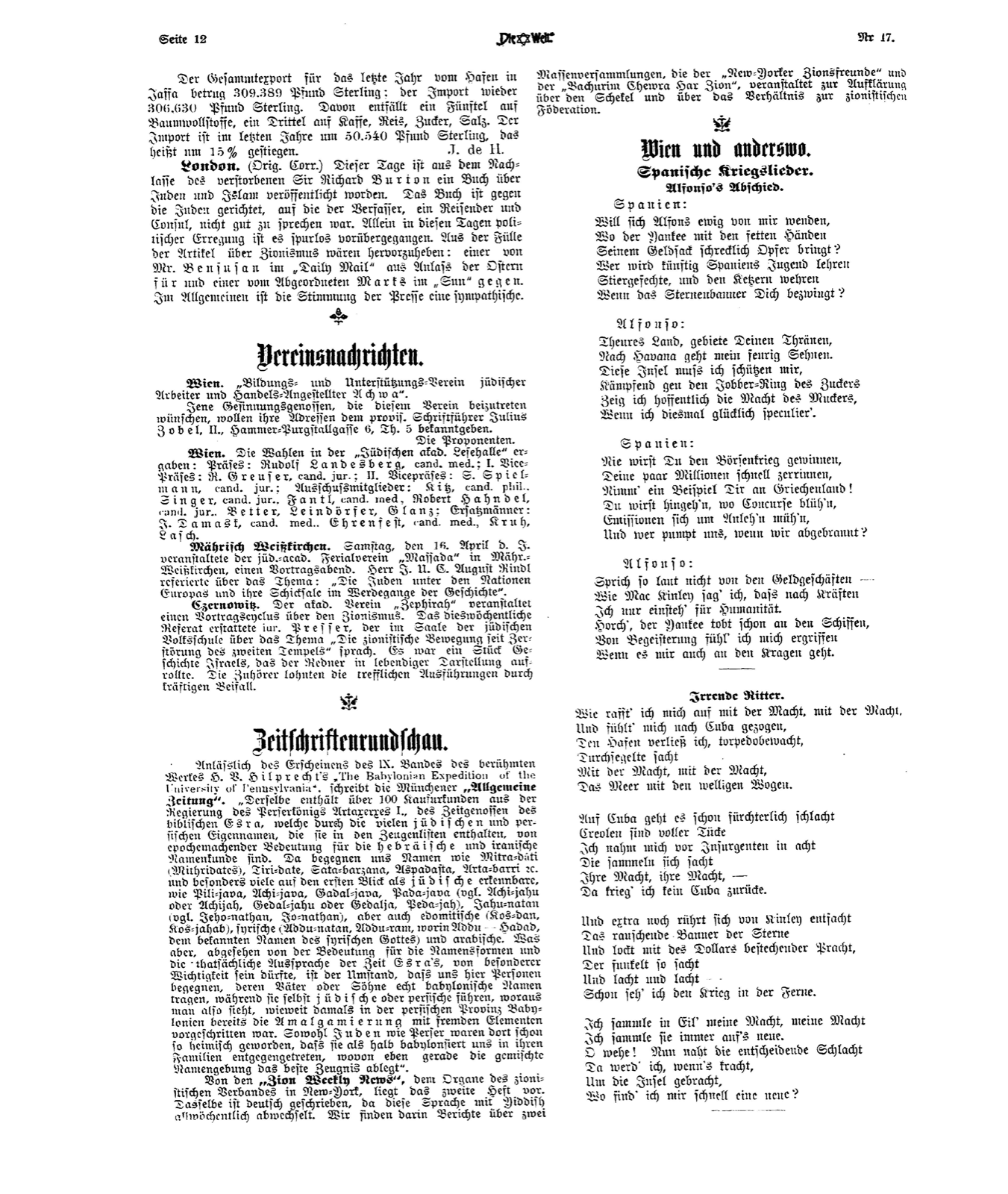
Page 12. — "Die Welt" — No. 17.
The total export for the last year from the harbour of Jaffa amounted to 309,389 pounds sterling; the import again to 306,630 pounds sterling. Of this a fifth falls to cotton stuffs, a third to coffee, rice, sugar, salt. The import has risen in the last year by 50,540 pounds sterling, that is by 15%. J. de H.
London. (Orig. Corr.) These last days there has been published from the remains of the late Sir Richard Burton a book upon Jews and Islam. The book is directed against the Jews, of whom the author, a traveller and consul, was not disposed to speak well. Only, in these days of political agitation, it has passed by without leaving a trace. Out of the abundance of articles upon Zionism the following are to be signalised: one by Mr. Bensusan in the "Daily Mail", on the occasion of Easter, in favour, and one by the member Marks in the "Sun", against. In general the temper of the press is a sympathetic one.
Society News.
Vienna. "Educational and Benevolent Society of Jewish Workmen and Commercial Employés Achwah". Those of like mind who desire to join this society are requested to make their addresses known to the provisional secretary Julius Zobel, II., Hammer-Purgstallgasse 6, Th. 5. The Promoters.
Vienna. The elections in the "Jewish Academic Reading Hall" resulted as follows: President: Rudolf Landesberg, cand. med.; First Vice-President: R. Greuser, cand. jur.; Second Vice-President: S. Spielmann, cand. jur.; members of committee: Kiß, cand. phil., Singer, cand. jur., Fandl, cand. med., Robert Hahndel, cand. jur., Vetter, Leindörfer, Glanz; substitutes: J. Damask, cand. med., Ehrenfest, cand. med., Kruh, Lasch.
Mährisch Weißkirchen. On Saturday, the 16th of April of this year, the Jewish academic vacation society "Massada" in Mähr.-Weißkirchen arranged a lecture evening. Herr J. U. C. August Kindl read a paper upon the theme: "The Jews among the Nations of Europe and their Destinies in the Course of History".
Czernowitz. The academic society "Zephirah" is arranging a cycle of lectures upon Zionism. This week's paper was delivered by iur. Presser, who spoke in the hall of the Jewish elementary school upon the theme "The Zionist Movement since the Destruction of the Second Temple". It was a piece of the history of Israel that the speaker unrolled in lively presentation. The hearers rewarded the excellent exposition with hearty applause.
Review of the Periodicals.
On the occasion of the appearance of the IXth volume of the famous work of H. V. Hilprecht, "The Babylonian Expedition of the University of Pennsylvania", the Munich "Allgemeine Zeitung" writes. "It contains over 100 deeds of purchase from the reign of the Persian king Artaxerxes I., the contemporary of the biblical Ezra, which, through the many Jewish and Persian proper names that they contain in their lists of witnesses, are of epoch-making importance for Hebrew and Iranian onomatology. There we meet with names such as Mitra-dâti (Mithridates), Tiridate, Sata-barzana, Aspadasta, Arta-barri &c., and especially many recognisable at first glance as Jewish, such as Pili-java, Achi-java, Gadal-java, Pada-java (cf. Achi-jahu or Achijah, Gedal-jahu or Gedalja, Peda-jah), Jahu-natan (cf. Jeho-nathan, Jo-nathan), but also Edomite ones (Koš-dan, Koš-jahab), Syrian (Abdu-natan, Abdu-ram, in which Abdu = Hadad, the well-known name of the Syrian god) and Arabic. But what, apart from the significance for the forms of the names and the actual pronunciation of Ezra's time, may be of especial importance, is the circumstance that we here meet with persons whose fathers or sons bear genuine Babylonian names while they themselves carry Jewish or Persian ones, from which it may accordingly be seen how far at that time the amalgamation with foreign elements had already advanced in the Persian province of Babylonia. Both Jews and Persians had already become so much at home there that they confront us in their families as half Babylonianised, of which the mixed giving of names bears precisely the best testimony".
Of the "Zion Weekly News", the organ of the Zionist association in New-York, the second number lies before us. It is written in German, since this language alternates weekly with Yiddish. We find in it reports of two mass meetings, those of the "New-Yorker Zionsfreunde" and of the "Bachurim Chewra Har Zion", arranged for enlightenment concerning the shekel and concerning the relation to the Zionist Federation.
Vienna and Elsewhere.
Spanish War Songs.
Alfonso's Farewell.
Spain: Will Alfons turn from me for ever, Now that the Yankee with his fat hands Brings frightful sacrifice to his money-bag? Who shall hereafter teach the youth of Spain Bull-fighting, and hold the heretics at bay, If the Star-Spangled Banner vanquish thee?
Alfonso: Beloved land, command thy tears to cease, To Havana goes my ardent longing. This island I must guard for mine, Fighting against the jobbers' ring of sugar I hope to show the might of the canting bigot, If this time I speculate with fortune.
Spain: Never wilt thou win the war of the Bourse, Thy few millions will swiftly melt away, Take Greece for an example to thyself! Thou wilt go where bankruptcies flourish, Where issues labour after loans, And who will lend to us when we are burnt out?
Alfonso: Speak not so loud of the money business — Like Mac Kinley I press it hard, that with all my powers I stand for humanity alone. Hark, the Yankee is already raging at the ships, With enthusiasm I feel myself seized Even though it go to my own neck.
Knights Errant.
How I roused myself up with the might, with the might, And felt myself drawn towards Cuba, The harbour I left, torpedo-guarded, And sailed softly With the might, with the might, The sea with its billowing waves.
In Cuba things already go frightfully ill, The Creoles are full of guile, I kept myself on guard against insurgents, They gather softly Their might, their might, — And so I get no Cuba back again.
And besides, kindled by Kinley, there stirs The rustling banner of the stars, And it lures with the dollar's corrupting splendour, Which glitters so softly And laughs and laughs — Already I see the war in the distance.
In haste I gather my might, my might, I gather it ever anew. O woe! Now the decisive battle draws near, And there, when the crash comes, I shall be robbed of the island, Where shall I quickly find myself a new one?