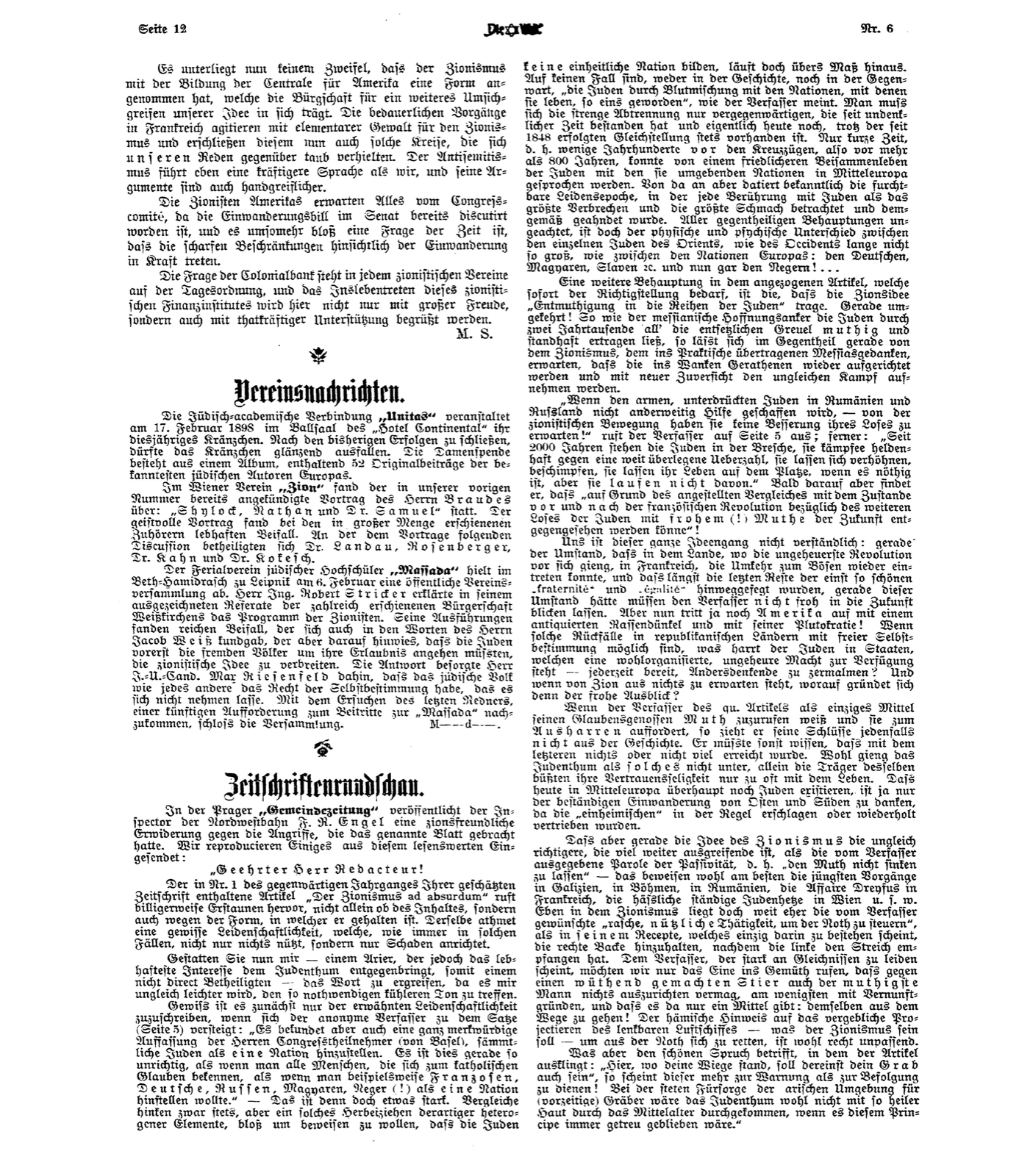
Page 12. — "Die Welt" — No. 6.
There is now no doubt that Zionism, with the formation of the Central Office for America, has assumed a form which carries within it the guarantee of a further spreading of our idea. The deplorable events in France agitate with elemental force on behalf of Zionism and now open up to it even those circles which remained deaf to our speeches. Anti-Semitism, in fact, speaks a more forcible language than we, and its arguments too are more palpable.
The Zionists of America expect everything from the Congress Committee, since the immigration bill has already been discussed in the Senate, and it is all the more merely a question of time before the severe restrictions with regard to immigration come into force.
The question of the Colonial Bank stands on the agenda in every Zionist society, and the coming into being of this Zionist financial institution will be welcomed here not only with great joy but also with vigorous support.
M. S.
Society News.
The Jewish Academic Association "Unitas" will hold its annual Kränzchen this year on the 17th of February 1898 in the ballroom of the "Hotel Continental." Judging by its successes hitherto, the Kränzchen is likely to prove a brilliant affair. The ladies' gift consists of an album containing 52 original contributions by the best-known Jewish authors of Europe.
In the Vienna society "Zion" the lecture by Herr Braudes on "Shylock, Nathan, and Dr. Samuel," already announced in our previous number, took place. The witty lecture met with lively applause from the listeners, who had appeared in great numbers. In the discussion following the lecture there took part Dr. Landau, Rosenberger, Dr. Kahn, and Dr. Kokesch.
The Vacation Society of Jewish University Students "Massada" held a public meeting of the society in the Beth-Hamidrash at Leipnik on the 6th of February. Herr Robert Stricker, engineer, expounded the programme of the Zionists in his excellent address to the numerously assembled townsfolk of Weißkirchen. His remarks met with abundant applause, which found expression also in the words of Herr Jacob Weiß, who, however, pointed out that the Jews would first have to approach the foreign nations for their permission to spread the Zionist idea. The reply was furnished by Herr Max Riesenfeld, candidate of law, to the effect that the Jewish people, like every other, had the right of self-determination, of which it would not let itself be deprived. With the last speaker's request that a future summons to join "Massada" be complied with, the meeting closed.
M----d-----.
Review of Periodicals.
In the Prague "Gemeindezeitung" the inspector of the North-Western Railway, F. R. Engel, publishes a reply friendly to Zion against the attacks that the said paper had made. We reproduce something from this communication, which is well worth reading:
"Esteemed Editor!
The article 'Zionism ad absurdum' contained in No. 1 of the current volume of your esteemed journal justly excites astonishment, not only on account of its content but also because of the form in which it is couched. It breathes a certain vehemence which, as always in such cases, not only does no good but only works harm.
Permit me now — an Aryan who nevertheless brings the liveliest interest to Judaism, and thus one not directly concerned — to take the floor, since it is incomparably easier for me to strike the cooler tone that is so necessary.
It is certainly, in the first place, only to the vehemence just mentioned that it is to be ascribed when the anonymous author rises to the sentence (page 5): 'But it also betokens a quite peculiar conception on the part of the gentlemen who took part in the Congress (of Basle) to represent all Jews as one nation. This is just as incorrect as if one wished to represent all persons who profess the Catholic faith — as if, for example, one wished to represent Frenchmen, Germans, Russians, Magyars, Negroes (!) — as one nation.' — That, after all, is rather too strong. Comparisons always limp, it is true, but such a dragging in of heterogeneous elements of that sort, merely in order to prove that the Jews form no unified nation, does indeed exceed all measure. On no account have, either in history or in the present, 'the Jews become so much one, through intermixture of blood, with the nations among whom they live,' as the author supposes. One need only call to mind the strict separation which has existed from time immemorial and which in fact is still present to-day, notwithstanding the equalization effected since 1848. Only for a short time — that is, a few centuries before the Crusades, and hence more than 800 years ago — could there be any talk of a peaceful living-together of the Jews with the nations surrounding them in Central Europe. But from that time dates, as is well known, the terrible epoch in which every contact with Jews was regarded as the greatest crime and the greatest disgrace, and was punished accordingly. All assertions to the contrary notwithstanding, the physical and psychical difference between the individual Jews of the Orient and of the Occident is by no means so great as that between the nations of Europe — the Germans, Magyars, Slavs, etc. — and, still more, the Negroes! ...
A further assertion in the article cited, which at once requires setting right, is that the idea of Zion carries 'discouragement into the ranks of the Jews.' Quite the reverse! Just as the messianic anchor of hope enabled the Jews through two millennia to endure all the frightful horrors bravely and steadfastly, so, on the contrary, it is precisely of Zionism — the messianic thought translated into the practical — that one may expect that those who have begun to waver will be raised up again and will take up the unequal struggle with new confidence.
'If no help is otherwise created for the poor, oppressed Jews in Roumania and Russia, — from the Zionist movement they have no bettering of their lot to expect!' the author exclaims on page 5; and further: 'For 2000 years the Jews have stood in the breach; they fight heroically against a vastly superior host, they let themselves be derided and reviled, they lay down their lives on the spot if it be necessary, but they do not run away.' Soon afterward, however, he finds that 'on the ground of the comparison drawn with the condition before and after the French Revolution, the future may, as regards the further lot of the Jews, be looked forward to with joyful (!) courage'!
To us this whole train of thought is unintelligible: precisely the circumstance that in the country where the most monstrous revolution took place, in France, the relapse into evil could set in again, and that the last remnants of the once so beautiful 'fraternité' and 'égalité' were long ago swept away — precisely this circumstance ought not to have let the author look forward joyfully to the future. But now America, too, comes upon the scene with an antiquated racial arrogance and with its plutocracy! If such relapses are possible in republican countries with free self-determination, what awaits the Jews in states which have at their disposal a well-organized, monstrous power — ready at any moment to crush those who think otherwise? And if nothing is to be expected from Zion, upon what, then, is the joyful prospect founded?
If the author of the article in question knows of no other means than to call courage to his co-religionists and to summon them to hold out, then he certainly does not draw his conclusions from history. He would otherwise have to know that by the latter nothing, or not much, was achieved. Judaism as such did not, indeed, perish; but the bearers of it only too often paid for their trustfulness with their lives. That Jews exist at all in Central Europe to-day is due solely to the constant immigration from the East and the South, since the 'native' ones were as a rule slain or repeatedly driven out.
But that the idea of Zionism is precisely the incomparably more correct one, the one reaching far further, than the watchword of passivity issued by the author — that is, 'not to let one's courage sink' — this is perhaps best proved by the most recent events in Galicia, in Bohemia, in Roumania, the Dreyfus affair in France, the hideous, incessant Jew-baiting in Vienna, and so forth. It is precisely in Zionism that there lies, far rather than in his prescription, the 'swift, useful activity for stemming the distress' which the author desires — a prescription which seems to consist solely in holding out the right cheek after the left has received the blow. To the author, who seems to suffer greatly from similes, we would call to mind but this one thing: that against a bull driven to fury even the bravest man can accomplish nothing, least of all with reasons of common sense, and that there is but one means available — to get out of its way! The spiteful allusion to the vain projecting of the dirigible airship — which is what Zionism is supposed to be — in order to save oneself from distress, is surely quite unfitting.
But as for the fine saying in which the article dies away: 'Here, where thy cradle stood, shall one day thy grave also be' — this seems to serve rather as a warning than as a precept to be followed! Given the constant solicitude of the Aryan environment for (premature) graves, Judaism would surely not have come through the Middle Ages with so whole a skin, had it always remained faithful to this principle."