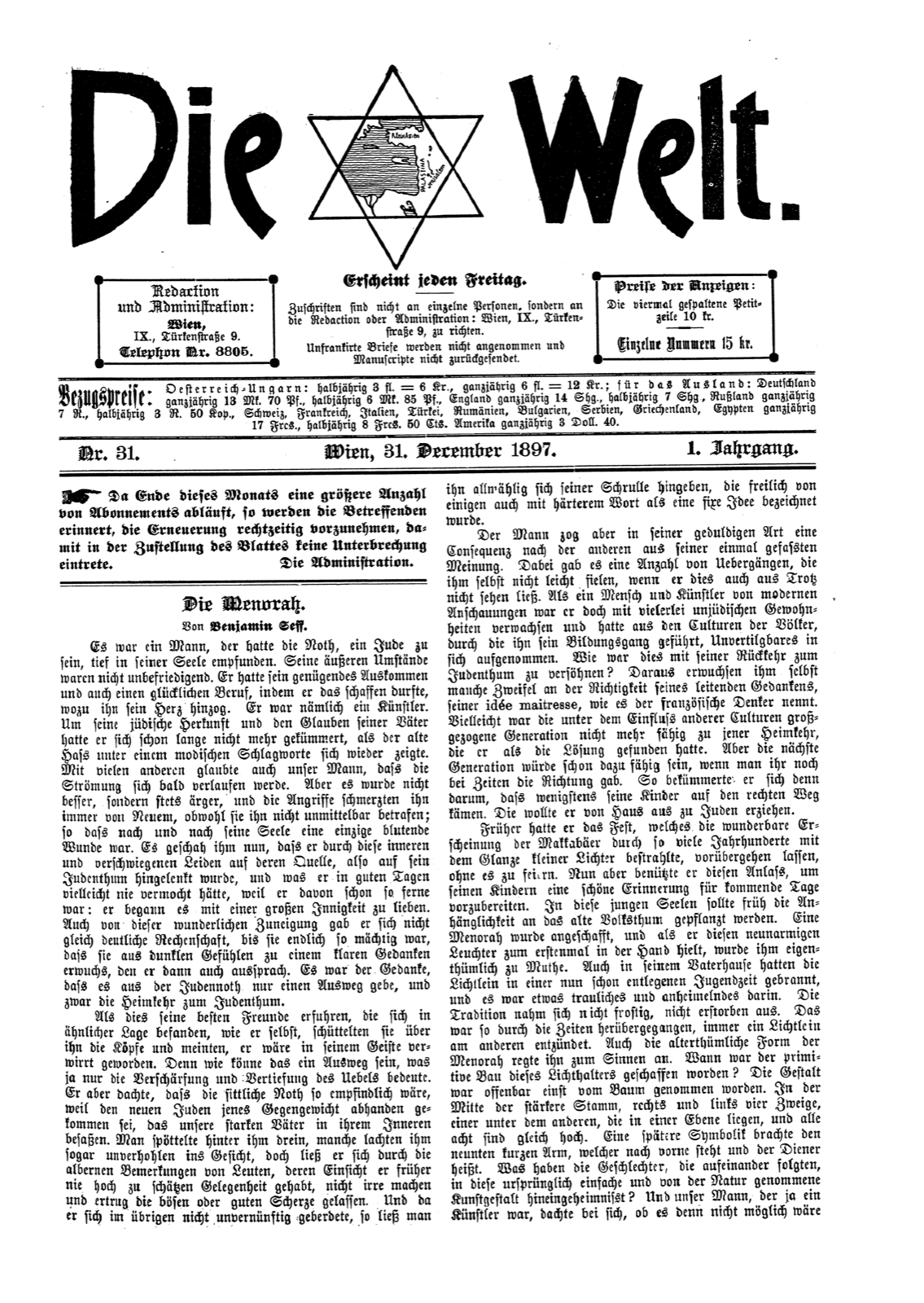
Die Welt.
Appears every Friday.
Editorial Office and Administration: Vienna, IX., Türkenstraße 9. Telephone No. 8805. Communications are to be addressed not to individual persons but to the Editorial Office or Administration: Vienna, IX., Türkenstraße 9. Unstamped letters are not accepted, and manuscripts are not returned. Advertising rates: the four-column petit line, 10 kr. Single numbers, 15 kr.
Subscription rates: Austria-Hungary: half-yearly 3 fl. = 6 Kr., yearly 6 fl. = 12 Kr.; for abroad: Germany yearly 13 Mk. 70 Pf., half-yearly 6 Mk. 85 Pf.; England yearly 14 Shg., half-yearly 7 Shg.; Russia yearly 7 R., half-yearly 3 R. 50 Kop.; Switzerland, France, Italy, Turkey, Roumania, Bulgaria, Servia, Greece, Egypt yearly 17 Frcs., half-yearly 8 Frcs. 50 Cts.; America yearly 3 Doll. 40.
No. 31. — Vienna, 31 December 1897. — First Year.
As a considerable number of subscriptions expire at the end of this month, those concerned are reminded to renew in good time, so that no interruption may occur in the delivery of the paper. The Administration.
The Menorah.
By Benjamin Seff.
There was a man who had felt deep in his soul the affliction of being a Jew. His outward circumstances were not unsatisfactory. He had a sufficient income and also a happy calling, for he was permitted to create the very things to which his heart drew him. He was, in fact, an artist. He had long since ceased to trouble himself about his Jewish descent and the faith of his fathers, when the old hatred showed itself once more under a fashionable catchword. Like many others, our man too believed that the current would soon run its course. But it did not grow better; it grew ever worse, and the attacks pained him anew each time, although they did not touch him directly, so that little by little his soul became a single bleeding wound. It now came to pass that through these inward and unspoken sufferings he was led back to their source, that is, to his Jewishness; and what in good days he might perhaps never have been able to do, because he was already so far removed from it, he now began to love with a great fervour. Nor did he at once render himself a clear account of this strange affection, until at last it grew so powerful that out of dark feelings it swelled into a clear thought, which he then also spoke aloud. It was the thought that there was but one way out of the Jewish affliction, namely, the homecoming to Judaism.
When his best friends, who found themselves in a situation similar to his own, learned of this, they shook their heads over him and held that he had become confused in his mind. For how could that be a way out which meant only the sharpening and deepening of the evil? He, however, thought that the moral affliction was so keenly felt because the new Jews had lost that counterweight which our strong forefathers possessed within them. People mocked him behind his back; some even laughed openly in his face; yet he did not let himself be disturbed by the foolish remarks of people whose insight he had never before had occasion to hold in high esteem, and he bore the ill-natured or good-natured jests with composure. And since in other respects he did not conduct himself unreasonably, they gradually let him give himself over to his whim, which indeed some also described with a harsher word as a fixed idea.
But the man, in his patient way, drew one consequence after another from the opinion he had once formed. In this there were a number of transitions that did not come easily to him, even though out of defiance he did not let it show. As a man and artist of modern views, he had after all grown together with many an un-Jewish habit, and had absorbed into himself things ineradicable from the cultures of the peoples through which his course of education had led him. How was this to be reconciled with his return to Judaism? From this there arose in him many a doubt as to the rightness of his guiding thought, his idée maîtresse, as the French thinker calls it. Perhaps the generation reared under the influence of other cultures was no longer capable of that homecoming which he had found to be the solution. But the next generation would surely be capable of it, if only the direction were given to it in good time. And so he took care that at least his children should come upon the right path. These he meant to raise as Jews from the very outset.
In earlier years he had let the festival pass without celebrating it — the festival which, through so many centuries, illumined the wondrous appearance of the Maccabees with the radiance of little lights. But now he made use of this occasion to prepare for his children a beautiful memory for days to come. Into these young souls devotion to the old national community was to be planted early. A Menorah was procured; and when for the first time he held this nine-armed candelabrum in his hand, a peculiar feeling came over him. In his father's house too the little lights had burned in a now far-off time of youth, and there was something cosy and homelike in it. The tradition did not appear frosty, not dead. It had come down thus through the ages, ever one little light kindled at another. The ancient form of the Menorah also moved him to reflection. When had the primitive structure of this light-holder been fashioned? The form had evidently once been taken from the tree. In the middle the stronger trunk, to right and left four branches, one below the other, lying in one plane, and all eight of equal height. A later symbolism brought the ninth, short arm, which stands to the front and is called the servant. What secret meanings have the generations that followed one upon another read into this originally simple art-form, taken from nature? And our man, who was after all an artist, wondered to himself whether it might not be possible