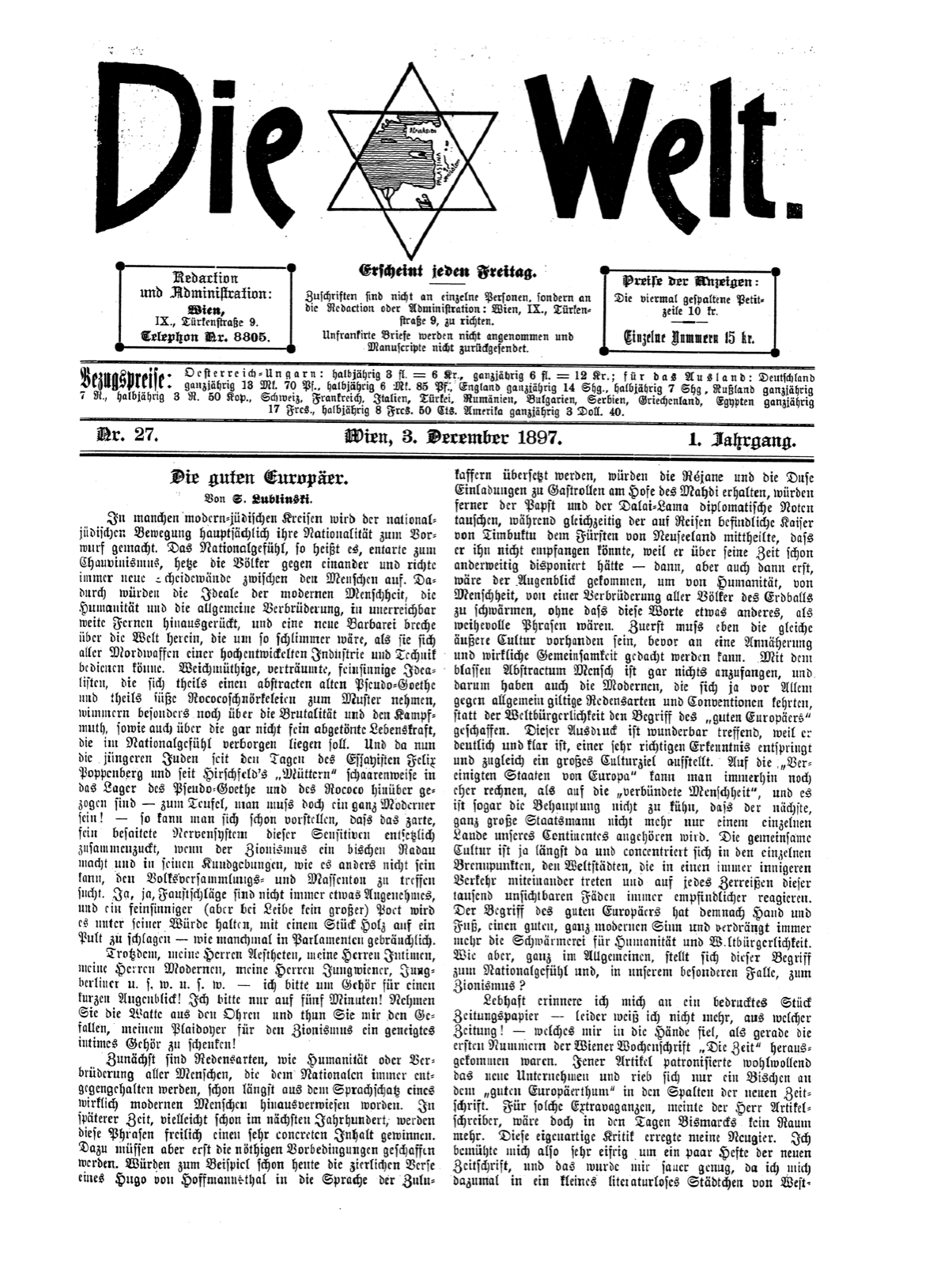
Die Welt.
Published every Friday.
Editorial Office and Administration: Vienna, IX., Türkenstraße 9. Telephone No. 8805.
Communications should be addressed not to individual persons, but to the Editorial Office or Administration: Vienna, IX., Türkenstraße 9.
Unstamped letters are not accepted, and manuscripts are not returned.
Advertising rates: The four-column petit line, 10 kr. Single numbers 15 kr.
Subscription rates: Austria-Hungary: half-yearly 3 fl. = 6 Kr., yearly 6 fl. = 12 Kr.; for abroad: Germany yearly 13 Mk. 70 Pf., half-yearly 6 Mk. 85 Pf.; England yearly 14 Shg., half-yearly 7 Shg.; Russia yearly 7 R., half-yearly 3 R. 50 Kop.; Switzerland, France, Italy, Turkey, Roumania, Bulgaria, Servia, Greece, Egypt yearly 17 Frcs., half-yearly 8 Frcs. 50 Cts.; America yearly 3 Doll. 40.
No. 27. — Vienna, 3 December 1897. — Vol. I.
The Good Europeans.
By S. Lublinski.
In certain modern-Jewish circles the national-Jewish movement is reproached chiefly for its very nationality. National feeling, so it is said, degenerates into chauvinism, incites the peoples against one another, and raises ever new partitions between men. Thereby the ideals of modern humanity — humaneness and universal brotherhood — would be thrust off into unattainable far distances, and a new barbarism would break in upon the world, all the worse in that it could avail itself of every murderous weapon of a highly developed industry and technology. Soft-hearted, dreamy, subtle-minded idealists, who take for their model partly an abstract old pseudo-Goethe and partly sweet rococo flourishes, whimper besides especially over the brutality and the combative spirit, as well as over the not at all delicately shaded vital force said to lie hidden in national feeling. And since the younger Jews, ever since the days of the essayist Felix Poppenberg and since Hirschfeld's "Mothers," have gone over in droves into the camp of the pseudo-Goethe and of the rococo — the deuce, one simply must be an utter modern! — one can well imagine that the tender, finely strung nervous system of these sensitive souls shudders horribly whenever Zionism makes a bit of a racket and, in its manifestations, as it cannot well be otherwise, seeks to strike the tone of the popular assembly and of the masses. Yes, yes, blows of the fist are not always something agreeable, and a subtle-minded (but by no means a great) poet will hold it beneath his dignity to strike a desk with a piece of wood — as is sometimes the custom in parliaments.
Nevertheless, my dear aesthetes, my dear intimates, my dear moderns, my dear Young-Viennese, Young-Berliners, and so forth and so forth — I beg a hearing for one brief moment! I ask but five minutes! Take the cotton wool from your ears and do me the favour of lending my plea for Zionism a gracious and intimate hearing!
To begin with, such turns of phrase as humaneness or the brotherhood of all men, which are forever held up against the national, have long since been banished from the vocabulary of a truly modern man. In a later time, perhaps as soon as the next century, these phrases will indeed acquire a very concrete content. But first the necessary preconditions for it must be created. Were, for example, the dainty verses of a Hugo von Hofmannsthal to be translated even today into the language of the Zulu Kaffirs; were a Réjane and a Duse to receive invitations to guest appearances at the court of the Mahdi; were, further, the Pope and the Dalai Lama to exchange diplomatic notes, while at the same time the travelling Emperor of Timbuctoo informed the Prince of New Zealand that he could not receive him, because he had already disposed of his time otherwise — then, but only then, would the moment have come to wax rapturous over humaneness, over mankind, over a brotherhood of all the peoples of the globe, without these words being anything other than solemn phrases. First of all the same outward culture must simply be present before any approach and real community can be thought of. With the pale abstraction "Man" nothing whatever can be done, and this is why the moderns too, who turned above all against generally valid turns of phrase and conventions, created in place of cosmopolitanism the concept of the "good European." This expression is wonderfully apt, because it is plain and clear, springs from a very sound insight, and at the same time sets up a great cultural goal. Upon the "United States of Europe" one may after all reckon rather sooner than upon a "confederated humanity," and it is not even too bold an assertion that the next truly great statesman will no longer belong to but a single country of our continent. The common culture is indeed long since here and concentrates itself in its several focal points, the great world-cities, which enter into an ever more intimate intercourse with one another and react ever more sensitively to every tearing of these thousand invisible threads. The concept of the good European accordingly has hand and foot — a sound, thoroughly modern sense — and increasingly displaces the rapturous devotion to humaneness and cosmopolitanism. But how, quite in general, does this concept stand toward national feeling and, in our particular case, toward Zionism?
Vividly I recall a printed scrap of newspaper — alas, I no longer know from which paper! — which fell into my hands just when the first numbers of the Vienna weekly "Die Zeit" had come out. That article benevolently patronized the new venture and chafed a little at the "good Europeanism" in the columns of the new journal. For such extravagances, opined the gentleman article-writer, there was surely no more room in the days of Bismarck. This peculiar criticism aroused my curiosity. I therefore exerted myself very eagerly to obtain a few issues of the new journal, and that came hard enough to me, since at that time I found myself in a small, literatureless little town of West-