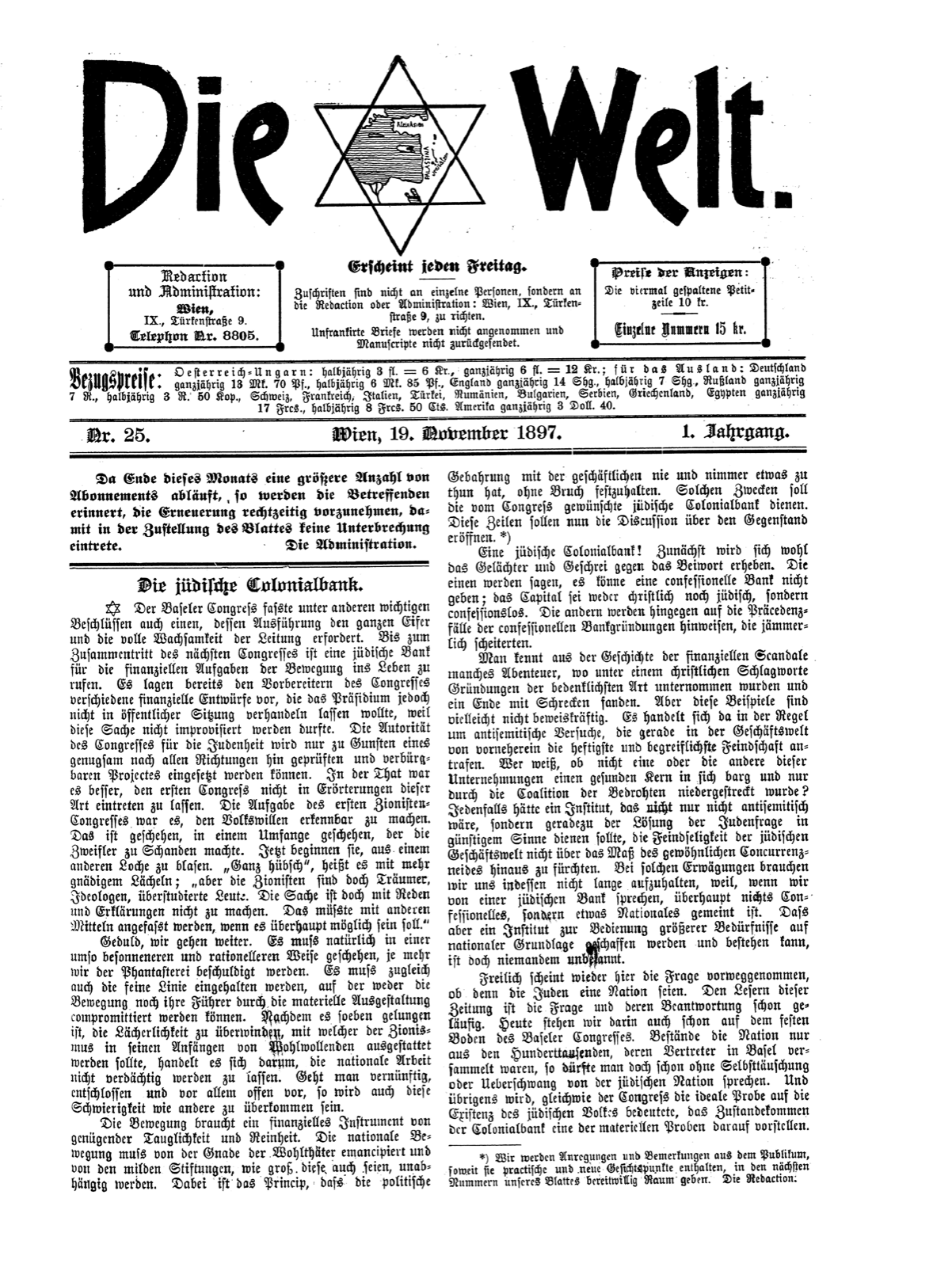
Die Welt.
Appears every Friday.
Editorial Office and Administration: Vienna, IX., Türkenstraße 9. Telephone No. 8805. Communications are to be addressed not to individual persons but to the Editorial Office or the Administration: Vienna, IX., Türkenstraße 9. Unstamped letters will not be accepted, and manuscripts will not be returned. Advertisement rates: the four-column petit line, 10 kr. Single numbers, 15 kr.
Subscription prices: Austria-Hungary: half-yearly 3 fl. = 6 Kr., yearly 6 fl. = 12 Kr.; for abroad: Germany yearly 13 Mk. 70 Pf., half-yearly 6 Mk. 85 Pf.; England yearly 14 Shg., half-yearly 7 Shg.; Russia yearly 7 R., half-yearly 3 R. 50 Kop.; Switzerland, France, Italy, Turkey, Roumania, Bulgaria, Servia, Greece, Egypt yearly 17 Frcs., half-yearly 8 Frcs. 50 Cts. America yearly 3 Doll. 40.
No. 25. Vienna, 19 November 1897. Vol. I.
As a considerable number of subscriptions expire at the end of this month, those concerned are reminded to effect their renewal in good time, so that no interruption may occur in the delivery of the paper. The Administration.
The Jewish Colonial Bank.
Among other important resolutions, the Basle Congress passed one whose execution demands the whole zeal and the full vigilance of the leadership. Before the next Congress assembles, a Jewish bank is to be called into being for the financial tasks of the movement. Various financial schemes had already been laid before those who prepared the Congress, but the presidency did not wish to have them debated in public session, because this matter must not be improvised. The authority of the Congress over Jewry can be pledged only in favour of a project sufficiently examined in every direction and capable of being vouched for. It was in truth better not to let the first Congress enter upon discussions of this kind. The task of the first Zionist Congress was to make the will of the people discernible. That has been done, and done to an extent that put the doubters to shame. Now they are beginning to pipe from another hole. "Very pretty," it is said with a more gracious smile; "but the Zionists are dreamers after all, ideologues, over-studied people. The thing is not to be done with speeches and declarations. It would have to be taken in hand by other means, if it is to be possible at all."
Patience, we are going further. It must of course be done in a manner all the more circumspect and rational, the more we are accused of fantasy. At the same time the fine line must be kept to, upon which neither the movement nor its leaders can be compromised by the material organisation. Now that we have just succeeded in overcoming the ridicule with which well-wishers sought to fit out Zionism in its beginnings, the point is to keep the national work from falling under suspicion. If one proceeds sensibly, resolutely, and above all openly, this difficulty too will be surmounted like the others.
The movement needs a financial instrument of sufficient serviceableness and purity. The national movement must be emancipated from the favour of benefactors and become independent of charitable endowments, however great these may be. Withal the principle that political conduct has never and in no wise anything to do with business conduct is to be maintained without a breach. Such purposes are to be served by the Jewish Colonial Bank desired by the Congress. These lines are now to open the discussion upon the subject. *)
A Jewish Colonial Bank! To begin with, the laughter and the outcry will no doubt be raised against the epithet. Some will say that there can be no confessional bank; capital is neither Christian nor Jewish, but without confession. Others, on the contrary, will point to the precedents of confessional bank foundations that failed miserably.
From the history of financial scandals one knows many an adventure in which, under a Christian catchword, foundations of the most questionable sort were undertaken and came to an end with terror. But these examples are perhaps not conclusive. As a rule they were antisemitic attempts, which met from the outset, precisely in the business world, with the most violent and most comprehensible enmity. Who knows whether one or another of these undertakings did not harbour a sound kernel within it, and was struck down only by the coalition of those it threatened? In any case, an institution which was not merely not antisemitic, but was intended directly to serve the solution of the Jewish question in a favourable sense, would have no cause to fear the hostility of the Jewish business world beyond the measure of ordinary competitive envy. With such considerations, however, we need not detain ourselves long, because when we speak of a Jewish bank nothing confessional whatever is meant, but something national. And that an institution for the service of larger needs can be created and can subsist upon a national foundation is surely unknown to no one.
To be sure, the question seems here again to be anticipated, whether the Jews are a nation. To the readers of this paper the question and its answer are already familiar. To-day we stand in this matter upon the firm ground of the Basle Congress as well. Did the nation consist only of the hundreds of thousands whose representatives were assembled at Basle, one might even so speak of the Jewish nation without self-deception or extravagance. And besides, just as the Congress signified the ideal test of the existence of the Jewish people, the establishment of the Colonial Bank will constitute one of the material tests thereof.
*) We shall willingly give room in the next numbers of our paper to suggestions and remarks from the public, in so far as they contain practical and new points of view. The Editorial Office.