Page 8. — "Die Welt" — No. 25.
(continued from page 7)
… and "Hedone" were, like all other Jews, declared devoid of honour by the notorious "resolution of incapacity to give satisfaction"), who nevertheless rendered it their allegiance; Jews who did homage to a Schönerer, who with bared head swore fealty to a Wolf; subjects who, as they put it, "as appointed guardians of German custom," declared the whole of the Jewish-national student body devoid of honour and who, though themselves Jews, in their shamelessness heaped upon us the most loathsome anti-Semitic insults; Jewish Schönerians, who have brought disgrace and shame upon our people — these have been chastised and branded. That is what happened, and nothing more. — Though a tenfold superiority of numbers, reinforced by Jewish renegades and the policeman's sabre, did in the end succeed in overpowering us, let the Jewish people receive this assurance: hereafter also we mean to guard faithfully the honour of the Jewish people, which is our own, and loyally to fulfil our duty as sons of the Jewish people!
With the expression of our highest esteem, on behalf of the Jewish-national student body
jur. Richard Wagner. jur. Max Bernhardt.
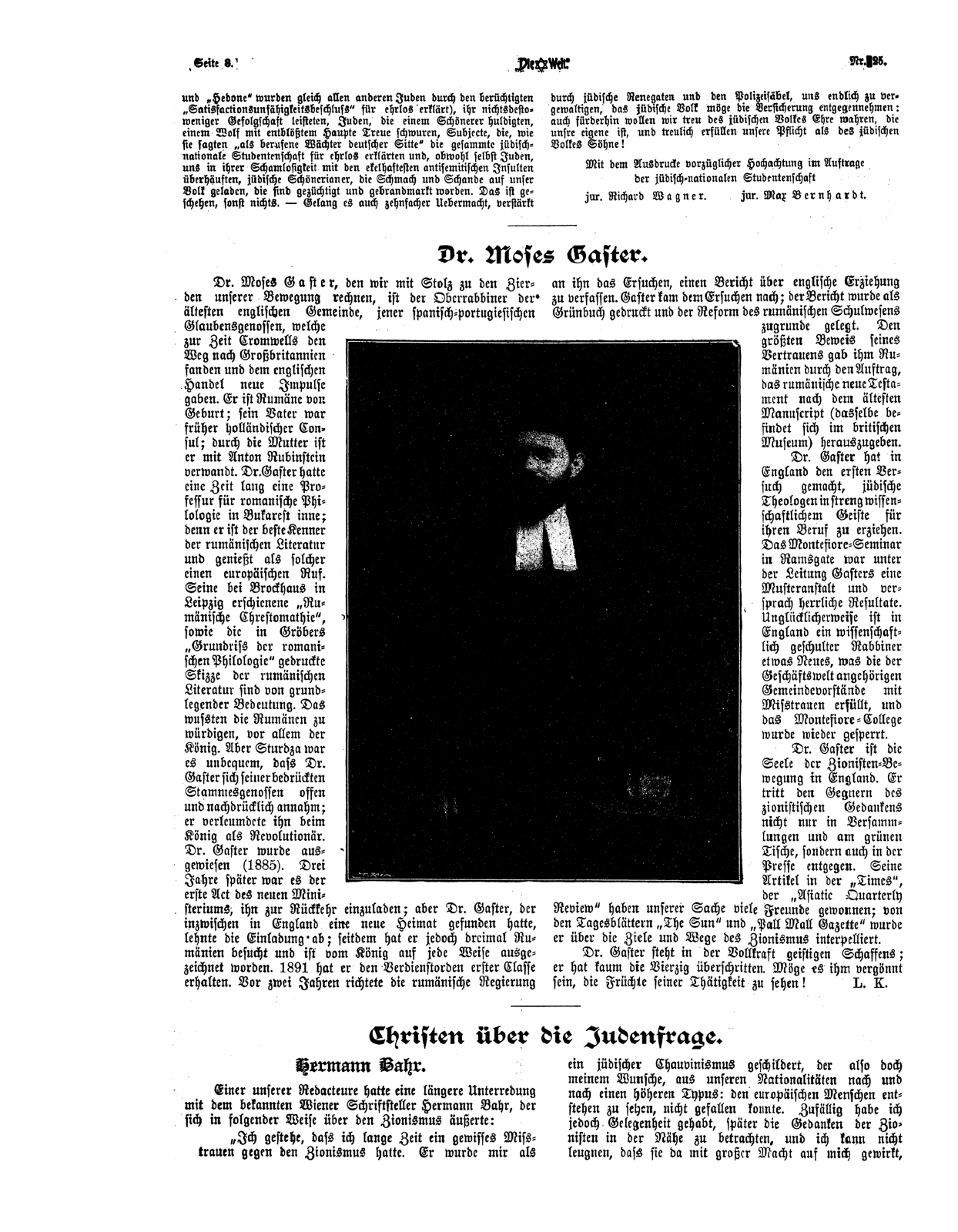
Dr. Moses Gaster.
Dr. Moses Gaster, whom we count with pride among the ornaments of our movement, is the Chief Rabbi of the oldest English congregation, that body of Spanish-Portuguese co-religionists who in the time of Cromwell found their way to Great Britain and gave fresh impulses to English commerce. He is a Roumanian by birth; his father was formerly Dutch consul; through his mother he is related to Anton Rubinstein. Dr. Gaster held for a time a professorship of Romance philology in Bucharest; for he is the foremost authority upon Roumanian literature and enjoys as such a European reputation. His "Roumanian Chrestomathy," published by Brockhaus in Leipsic, as well as the sketch of Roumanian literature printed in Gröber's "Grundriß der romanischen Philologie," are of fundamental importance. The Roumanians knew how to appreciate this, and the King above all. But it was inconvenient to Sturdza that Dr. Gaster should openly and emphatically take up the cause of his oppressed brethren; he calumniated him to the King as a revolutionary. Dr. Gaster was expelled (1885). Three years later the first act of the new Ministry was to invite him to return; but Dr. Gaster, who had meanwhile found a new home in England, declined the invitation; since then, however, he has three times visited Roumania and has been distinguished by the King in every way. In 1891 he received the Order of Merit of the first class. Two years ago the Roumanian Government addressed to him the request that he should draw up a report upon English education. Gaster complied with the request; the report was printed as a Green Book and was made the basis of the reform of the Roumanian school system. The greatest proof of its confidence Roumania gave him in the commission to edit the Roumanian New Testament after the oldest manuscript (the same is in the British Museum).
Dr. Gaster made in England the first attempt to train Jewish theologians for their calling in a strictly scientific spirit. The Montefiore Seminary at Ramsgate was under Gaster's direction a model institution and promised splendid results. Unhappily a scientifically trained rabbi is something new in England, a thing which fills the congregational boards, drawn as they are from the business world, with mistrust, and the Montefiore College was closed again.
Dr. Gaster is the soul of the Zionist movement in England. He meets the opponents of the Zionist idea not only in assemblies and at the council table, but in the press as well. His articles in the "Times" and the "Asiatic Quarterly Review" have won our cause many friends; by the daily papers "The Sun" and "Pall Mall Gazette" he has been questioned upon the aims and ways of Zionism.
Dr. Gaster stands in the full vigour of intellectual creation; he has scarcely passed his fortieth year. May it be granted him to see the fruits of his labours! L. K.
Christians on the Jewish Question.
Hermann Bahr.
One of our editors had a somewhat lengthy conversation with the well-known Vienna author Hermann Bahr, who expressed himself upon Zionism in the following manner:
"I confess that for a long time I harboured a certain mistrust of Zionism. It was described to me as a Jewish chauvinism, which therefore could not please my wish to see arise out of our nationalities, little by little, a higher type: the European man. By chance, however, I had occasion later to observe the ideas of the Zionists at close quarters, and I cannot deny that they there worked upon me with great power,