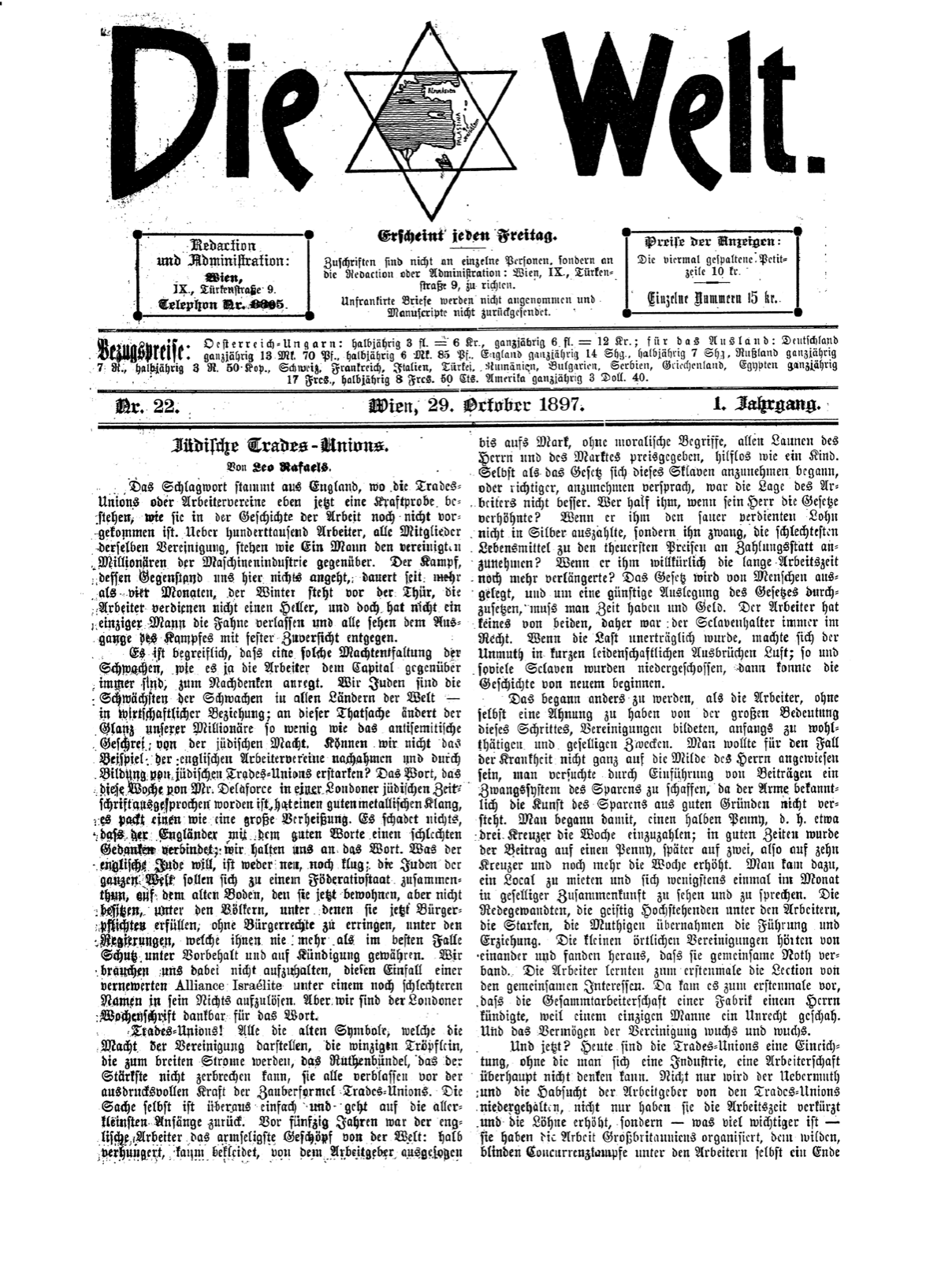
Die Welt.
Appears every Friday.
Editorial Office and Administration:
Vienna,
IX., Türkenstrasse 9.
Telephone No. 3005.
Communications are to be addressed not to individual persons, but to the Editorial Office or the Administration: Vienna, IX., Türkenstrasse 9.
Unstamped letters are not accepted, and manuscripts are not returned.
Advertising rates:
The four-column petit line, 10 kr.
Single numbers 15 kr.
Subscription rates: Austria-Hungary: half-yearly 3 fl. = 6 Kr., yearly 6 fl. = 12 Kr.; for abroad: Germany yearly 13 Mk. 70 Pf., half-yearly 6 Mk. 85 Pf., England yearly 14 Shg., half-yearly 7 Shg, Russia yearly 7 R., half-yearly 3 R. 50 Kop., Switzerland, France, Italy, Turkey, Roumania, Bulgaria, Servia, Greece, Egypt yearly 17 Frcs., half-yearly 8 Frcs. 50 Cts. America yearly 3 Doll. 40.
No. 22. Vienna, 29 October 1897. 1st Year of Issue.
Jewish Trades-Unions.
By Leo Rafaels.
The catchword comes from England, where the Trades-Unions, or workmen's associations, are at this very moment sustaining a trial of strength such as has never yet occurred in the history of labour. Over a hundred thousand workmen, all members of the same association, stand as one man against the united millionaires of the machine industry. The struggle, the subject of which does not concern us here, has lasted more than four months; winter is at the door, the workmen earn not a farthing, and yet not a single man has deserted the flag, and all look forward to the issue of the contest with firm confidence.
It is intelligible that such a display of power by the weak — as the workmen always are in the face of capital — should provoke reflection. We Jews are the weakest of the weak in every country of the world — in the economic respect; and this fact is altered as little by the splendour of our millionaires as by the anti-Semitic outcry about Jewish power. Can we not imitate the example of the English workmen's associations and grow strong through the formation of Jewish Trades-Unions? The word uttered this week by Mr. Delaforce in a London Jewish periodical has a good metallic ring; it seizes one like a great promise. It does no harm that the Englishman couples a bad thought with the good word; we hold fast to the word. What the English Jew wants is neither new nor wise: the Jews of the whole world are to combine into a federative state, upon the old soil which they now inhabit but do not possess, among the peoples among whom they now fulfil the duties of citizens without attaining the rights of citizens, under the governments which never grant them more than, in the best case, protection under reservation and subject to withdrawal. We need not delay here to dissolve into its own nothingness this notion of a rehashed Alliance Israélite under a still worse name. But we are grateful to the London weekly for the word.
Trades-Unions! All the old symbols which represent the power of union — the tiny droplets that become a broad stream, the bundle of rods that the strongest man cannot break — all of them pale before the expressive force of the magic formula Trades-Unions. The thing itself is exceedingly simple, and goes back to the very smallest beginnings. Fifty years ago the English workman was the most wretched creature in the world: half starved, scarcely clothed, sucked dry to the marrow by his employer, without moral notions, abandoned to every caprice of his master and of the market, helpless as a child. Even when the law began to take up the cause of this slave — or, more correctly, promised to take it up — the workman's position was no better. Who helped him when his master mocked the laws? When he paid him his hard-earned wage not in silver, but forced him to accept the worst provisions at the dearest prices in lieu of payment? When he arbitrarily lengthened still further the long hours of work? The law is interpreted by men, and to carry through a favourable interpretation of the law one must have time and money. The workman had neither of the two; therefore the slaveholder was always in the right. When the burden became insupportable, the discontent found vent in brief passionate outbreaks; so and so many slaves were shot down, and then the story could begin afresh.
This began to alter when the workmen, without themselves having any inkling of the great significance of the step, formed associations, at first for benevolent and convivial purposes. They did not wish, in case of sickness, to be wholly dependent upon the master's clemency; they sought, by the introduction of contributions, to create a compulsory system of saving, since the poor man, as is well known, does not for good reasons understand the art of saving. They began by paying in half a penny, that is, about three kreuzer a week; in good times the contribution was raised to a penny, later to two, that is, to ten kreuzer and more a week. They came to hire a room and to see and speak with one another at least once a month in social gathering. The ready speakers, the intellectually eminent among the workmen, the strong, the courageous, took over the leadership and the education. The small local associations heard of one another and discovered that a common distress bound them together. The workmen learned for the first time the lesson of common interests. Then it happened for the first time that the entire body of workmen in a factory gave notice to a master because a wrong had been done to a single man. And the property of the association grew and grew.
And now? To-day the Trades-Unions are an institution without which an industry, a body of workmen, cannot be conceived at all. Not only are the arrogance and the greed of the employers held down by the Trades-Unions, not only have they shortened the hours of work and raised wages, but — what is far more important — they have organized the labour of Great Britain, and to the wild, blind struggle of competition among the workers themselves an end