No. 18. — "Die Welt" — Page 7.
(continued from page 6)
… do the Magyars a great deal of good. The liberal papers resignedly shut both eyes to such antisemitic utterances, which pass by in in every possible disguise. They are glad that the veil is there Woe if it should fall! For with this veil there would vanish a fair illusion as well.
Dr. R.
Cardinal Vaughan
Archbishop of Westminster
on Zionism.
London, 21 September 1897.
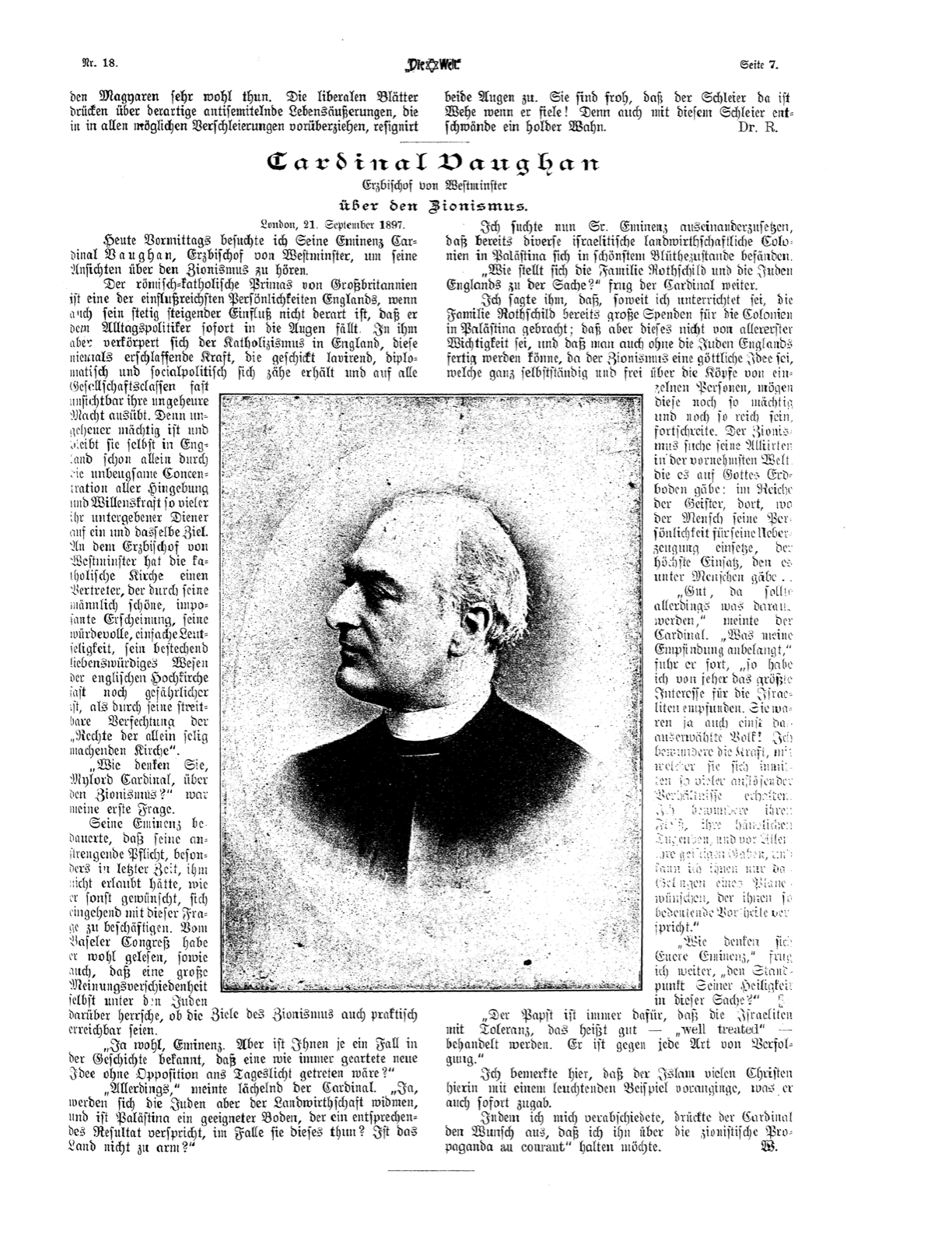
This forenoon I called upon His Eminence Cardinal Vaughan, Archbishop of Westminster, in order to hear his views upon Zionism.
The Roman Catholic Primate of Great Britain is one of the most influential personages in England, even though his steadily rising influence is not of the sort that strikes the everyday politician at once. In him, however, there is embodied Catholicism in England, that never-slackening force which, tacking skilfully, diplomatic and social-political at once, maintains itself tenaciously and exercises its enormous power over all classes of society almost invisibly. For enormously powerful it is and remains, even in England, by virtue alone of the unbending concentration of all the devotion and strength of will of so many servants subject to it upon one and the same end. In the Archbishop of Westminster the Catholic Church possesses a representative who, by his manly and handsome, imposing presence, his dignified, unaffected affability, his captivatingly amiable nature, is almost more dangerous to the English High Church than by his militant advocacy of the "rights of the only Church that maketh blessed."
"What is your opinion, my Lord Cardinal, of Zionism?" was my first question.
His Eminence regretted that his exacting duties, especially of late, had not permitted him, as he had otherwise wished, to occupy himself closely with this question. Of the Basle Congress he had indeed read, and likewise that a great difference of opinion prevailed even among the Jews themselves as to whether the aims of Zionism were also practically attainable.
"Quite so, Eminence. But is any case known to you in history in which a new idea of whatever kind came to light without opposition?"
"Indeed," said the Cardinal, smiling. "But will the Jews devote themselves to agriculture, and is Palestine a suitable soil, one that promises a corresponding result in case they do so? Is the land not too poor?"
I then endeavoured to set forth to His Eminence that divers Israelite agricultural colonies in Palestine were already in the fairest state of flourishing.
"How do the Rothschild family and the Jews of England stand towards the matter?" the Cardinal asked further.
I told him that, so far as I was informed, the Rothschild family had already made large donations for the colonies in Palestine; that this, however, was not of the very first importance, and that one could get on even without the Jews of England, since Zionism was a divine idea which advanced quite independently and freely over the heads of individual persons, be they never so powerful and never so rich. Zionism sought its allies in the most exalted world that existed upon God's earth: in the realm of the spirit, there where a man stakes his personality for his conviction, the highest stake there is among men . .
"Well, in that case something ought indeed to come of it," said the Cardinal. "As for my own feeling," he continued, "I have always felt the greatest interest in the Israelites. They were once the chosen people! I admire the strength with which they have maintained themselves in the midst of so many dissolving conditions. I admire their art, their domestic virtues, and above all that gift of the spirit, and one can only wish them the success of a plan which promises them such considerable advantages."
"How do you conceive, Your Eminence," I asked further, "the standpoint of His Holiness in this matter?"
"The Pope is always in favour of the Israelites being treated with tolerance, that is to say well — "well treated." He is against every kind of persecution."
I remarked here that Islam had gone before many Christians in this with a shining example, which he at once conceded.
As I took my leave, the Cardinal expressed the wish that I should keep him au courant" of the Zionist propaganda. W.