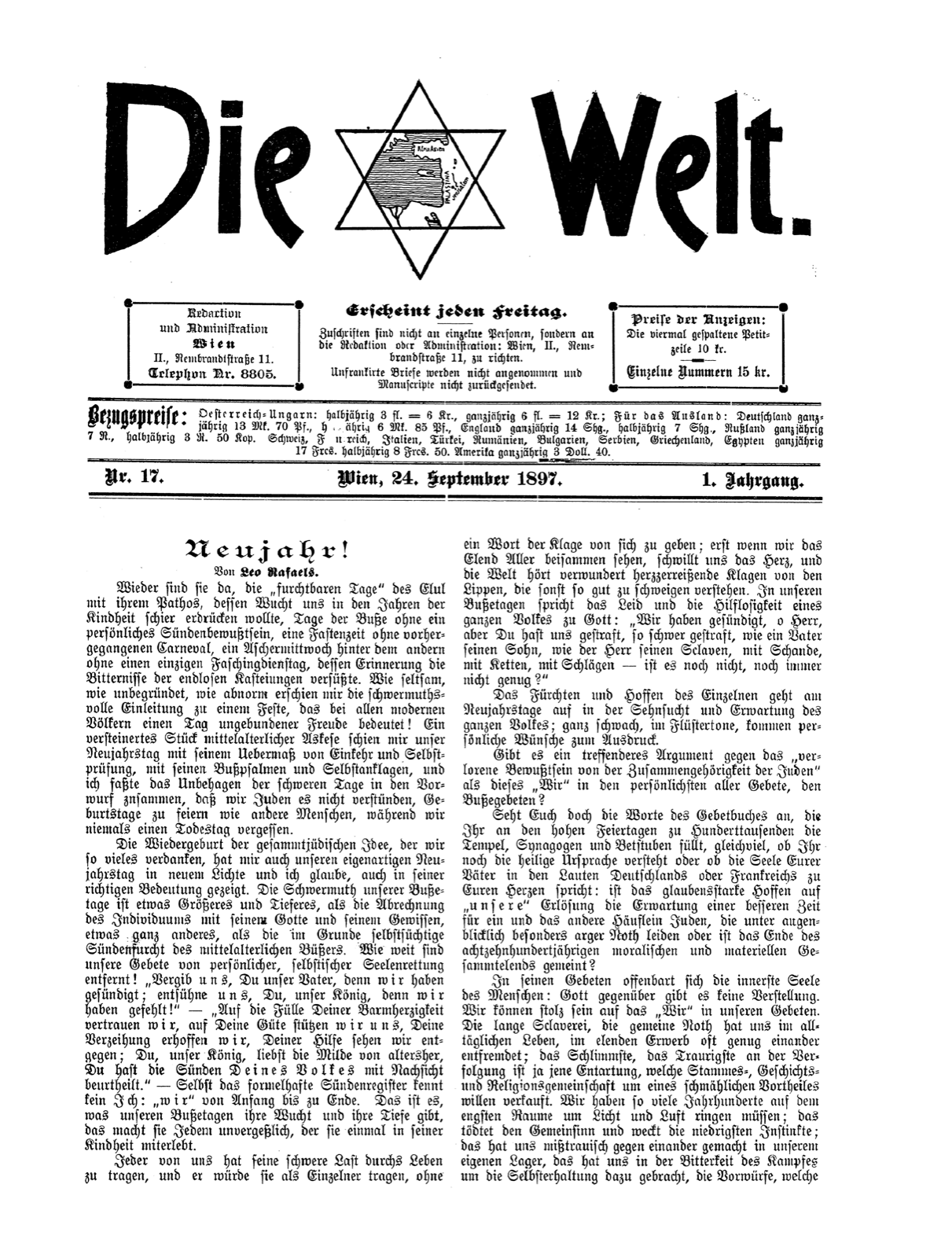
Die Welt.
Editorial Office and Administration: Vienna, II., Rembrandtstrasse 11. Telephone No. 8805. — Published every Friday. — Advertising rates: the four-column petit line, 10 kr. Communications are to be addressed not to individual persons but to the Editorial Office or the Administration: Vienna, II., Rembrandtstrasse 11. Unstamped letters are not accepted, and manuscripts are not returned. Single numbers 15 kr.
Subscription rates: Austria-Hungary: half-yearly 3 fl. = 6 Kr., yearly 6 fl. = 12 Kr.; for abroad: Germany yearly 13 Mk. 70 Pf., half-yearly 6 Mk. 85 Pf., England yearly 14 shg., half-yearly 7 shg., Russia yearly 7 R., half-yearly 3 R. 50 kop. Switzerland, France, Italy, Turkey, Roumania, Bulgaria, Servia, Greece, Egypt yearly 17 frcs., half-yearly 8 frcs. 50. America yearly 3 doll. 40.
No. 17. | Vienna, 24 September 1897. | Vol. I.
New Year!
By Leo Rafaels.
They are here again, the "dreadful days" of Elul with their pathos, whose weight all but crushed us in the years of childhood: days of penitence without any personal consciousness of sin, a season of fasting with no preceding carnival, one Ash Wednesday after another without a single Shrove Tuesday whose memory might sweeten the bitterness of the endless mortifications. How strange, how groundless, how abnormal seemed to me that melancholy prelude to a festival which among all modern peoples means a day of unbounded joy! A petrified fragment of mediaeval asceticism our New Year's Day appeared to me, with its excess of self-communion and self-examination, with its penitential psalms and self-accusations; and I summed up the discomfort of those heavy days in the reproach that we Jews do not know how to celebrate birthdays as other men do, while we never forget a day of death.
The rebirth of the all-Jewish idea, to which we owe so much, has shown me our peculiar New Year's Day too in a new light, and, I believe, in its true significance as well. The melancholy of our days of penitence is something greater and deeper than the reckoning of the individual with his God and his conscience, something wholly other than the at bottom selfish dread of sin felt by the mediaeval penitent. How far removed our prayers are from personal, selfish salvation of the soul! "Forgive us, Thou our Father, for we have sinned; absolve us, Thou our King, for we have transgressed!" — "Upon the fulness of Thy mercy do we trust, upon Thy goodness do we lean, Thy pardon do we hope for, Thy help do we await; Thou, our King, hast loved clemency from of old, Thou hast judged the sins of Thy people with forbearance." — Even the formulaic register of sins knows no I: "we" from beginning to end. That is what gives our days of penitence their weight and their depth; that is what makes them unforgettable to everyone who has once lived through them in his childhood.
Each of us has his heavy burden to bear through life, and he would bear it as a single man, without uttering one word of complaint; only when we see the misery of all gathered together does the heart swell within us, and the world hears with astonishment heart-rending lamentations from lips that otherwise know so well how to keep silence. In our days of penitence the suffering and the helplessness of a whole people speak to God: "We have sinned, O Lord, but Thou hast punished us, punished us as heavily as a father punishes his son, as the master his slave, with shame, with chains, with blows — is it not yet, is it still not enough?"
The fear and the hope of the individual are merged, on New Year's Day, in the longing and expectation of the whole people; only very faintly, in a whisper, do personal wishes find expression.
Is there a more telling argument against the "lost consciousness of the solidarity of the Jews" than this "We" in the most personal of all prayers, the prayers of penitence?
Look, then, at the words of the prayer-book, you who on the high festivals fill by the hundred thousand the temples, synagogues and houses of prayer, no matter whether you still understand the holy original tongue or whether the soul of your fathers speaks to your hearts in the accents of Germany or of France: is the faith-strong hope of "our" redemption the expectation of a better time for one little group of Jews and another, who happen at the moment to be suffering under particularly grievous distress, or is the end of the eighteen-hundred-year-old moral and material misery of the whole meant?
In his prayers the innermost soul of man is revealed: before God there is no dissembling. We may be proud of the "We" in our prayers. The long slavery, the common distress, have often enough estranged us from one another in everyday life, in the wretched pursuit of a livelihood; the worst, the saddest thing about persecution is indeed that degeneracy which sells the community of race, of history and of religion for the sake of some shameful advantage. For so many centuries we have had to struggle for light and air within the narrowest compass; that kills public spirit and awakens the lowest instincts; that has made us mistrustful of one another within our own camp; that has brought us, in the bitterness of the struggle for self-preservation, to this, that the reproaches which