Page 16. — "Die Welt" — No. 15.
(continued from page 15)
... but with what the reader loves" ... And now in parenthesis. These are the very words of one of these gentlemen, which the writer of the present lines possesses in a letter. Shall I write to you also of the opinion of the anti-Semitic and clerical press? This is in part insincere and interested.
Paris, September 5, 1897.
A. L.
An Orthodox Rabbi.
The Rabbi of Basle, Dr. Cohn, writes in the leading place in the Mayence "Israelit" — which, as is well known, had taken up a pronouncedly hostile attitude toward Zionism — an enthusiastic article upon the Congress, from which we take the following:
Still under the full impression of the Zionist Congress, which was the most imposing manifestation of the Jewish people I have ever witnessed, I take up the pen to lay before your esteemed circle of readers the thoughts which it has stirred in me.
As an opponent I stood, as doubtless all those in Germany who share my views stood, over against Zionism. In national Judaism we see before us a peculiar phenomenon, for which the believing Jew has little understanding. National Judaism is, to use a famous saying, a knife without a blade, whose haft is wanting. The kernel of our being and of our people's soul is the Thora; nationality, the nation, is only the vessel which holds this precious content. Why, if religious grounds do not restrain us from it, should we not mingle with Aryans and Hamites, with Christians, Mohammedans and heathen, among whom we dwell scattered; why should we not, like all peoples that have lost their homeland, be absorbed among the other peoples, and, amalgamating ourselves with them, do away with the "Jewish distress"?
The Congress ran its course in a thoroughly dignified manner. (There follow some friendly words for the chairman.)
Beside him Max Nordau discharged his office as Vice-President. Nordau, be it remarked in passing, a grandson of the famous Rabbi of Lissa, is the best and in any case the most effective speaker I have ever heard. Not only the dazzling flashes of intellect with which he illuminates familiar facts, the psychological subtlety with which he analyses the inner life of the individual and of the whole people, but also the downright classical form in which he clothes his thoughts and the inimitable art of his delivery, explain the stormy enthusiasm to which his speech carried away the friends, and likewise the spectators, nay, even the opponents of the movement.
And gathered about the two of them more than 200 men aflame for Zion and Jerusalem! How there vanished before this sight the generally credited legend that only young students are the standard-bearers of Zionism. Here we behold countless men of ripe years, venerable graybeards too with silver hair, among them some 70 men of academic training from all the faculties, professors, technicians, engineers, men who had not shrunk from a long, toilsome and costly journey, some even from beyond the sea, in order to take part in the Congress; and all, young as well as old, filled with the same enthusiasm for Zion and Jerusalem!
What an elevating sight for the believing Jew! How long is it since the destroyers of Judaism, who euphemistically called themselves "reformers," wished to strike out of our prayer-book every passage that bears upon the return to Jerusalem; how short a time has passed since that sermon of the Rabbi von Mayer which bore the audacious title: "Stuttgart is our Jerusalem!" And now! Tempora mutantur! —
Yet not only in intensity is the Zionist movement mightier than was supposed; the longer the Congress lasted, the clearer did it become to every hearer — and this alone is important and significant — that we have all quite considerably underestimated the Zionist movement.
When we heard, and in part convinced ourselves by our own eyes, that petitions with about 50,000 signatures from Roumania alone had come in to the Congress; that many thousands of Galician families had declared themselves ready, as soon as the summons should go forth to them, to set out upon the migration to Palestine; that 550 telegrams from all parts of the inhabited world, for the most part proceeding not from individuals but from societies, communities, corporate bodies, had arrived — then we were bound to say to ourselves: This is a quite tremendous and powerful popular movement, which cannot have been called into being by individuals in so short a time, but which must have its deep and mightily working causes.
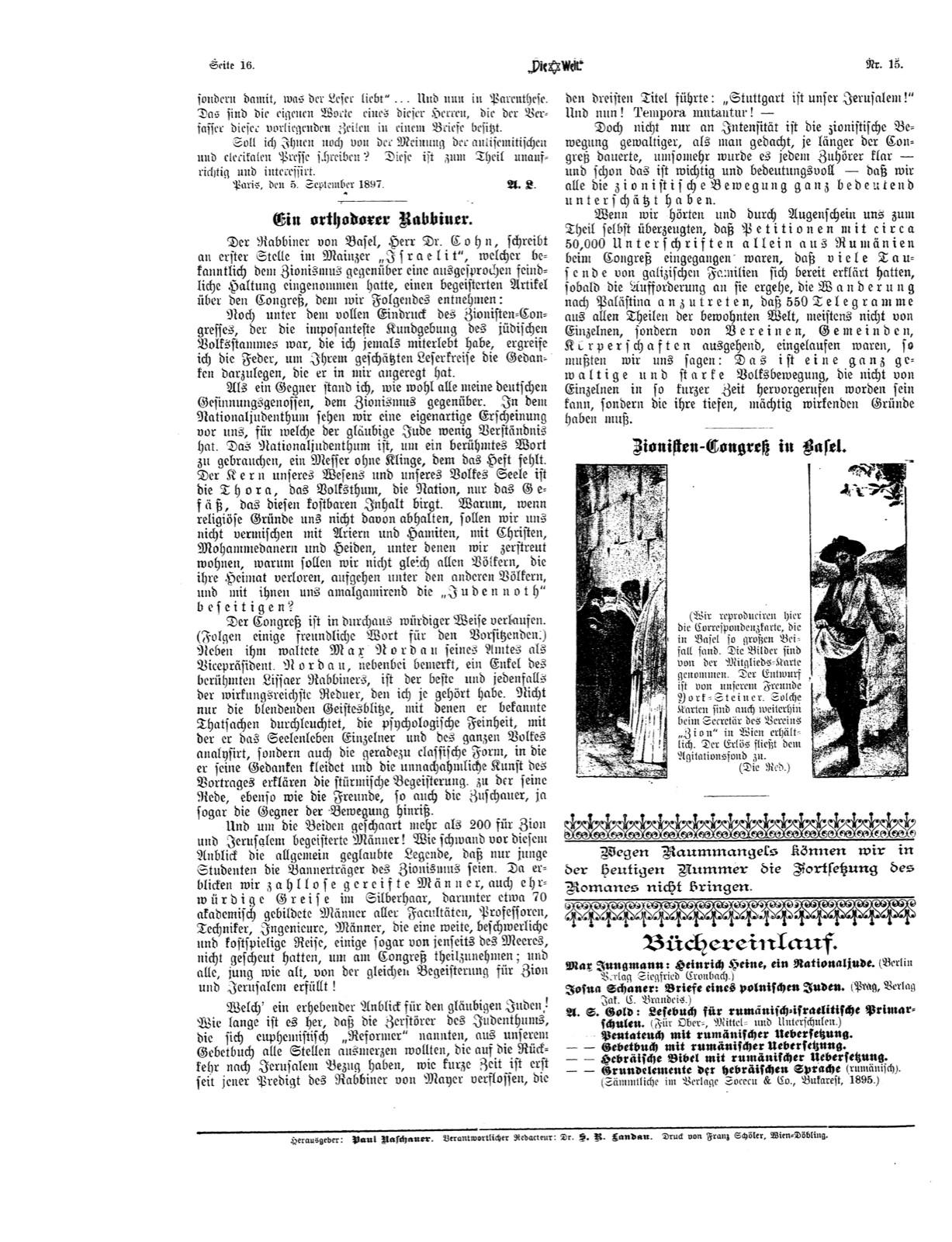
Zionist Congress at Basle.
(We reproduce here the correspondence card which met with such great applause at Basle. The pictures are taken from the membership card. The design is by our friend Yorck-Steiner. Such cards are obtainable henceforth also from the secretary of the society "Zion" in Vienna. The proceeds go to the agitation fund. — The Editors.)
For want of space we are unable to give the continuation of the novel in to-day's number.
Books Received.
Max Jungmann: Heinrich Heine, ein Nationaljude. (Berlin, Siegfried Cronbach.) Josua Schaner: Briefe eines polnischen Juden. (Prague, Jak. S. Brandeis.) A. S. Gold: Reader for Roumanian-Israelite Primary Schools. (For upper, middle and lower schools.) — — Pentateuch with Roumanian Translation. — — Prayer-book with Roumanian Translation. — — Hebrew Bible with Roumanian Translation. — — Fundamental Elements of the Hebrew Language (in Roumanian). (All published by Socecu & Co., Bucharest, 1895.)
Publisher: Paul Naschauer. Responsible Editor: Dr. S. R. Landau. Printed by Franz Schöler, Vienna-Döbling.