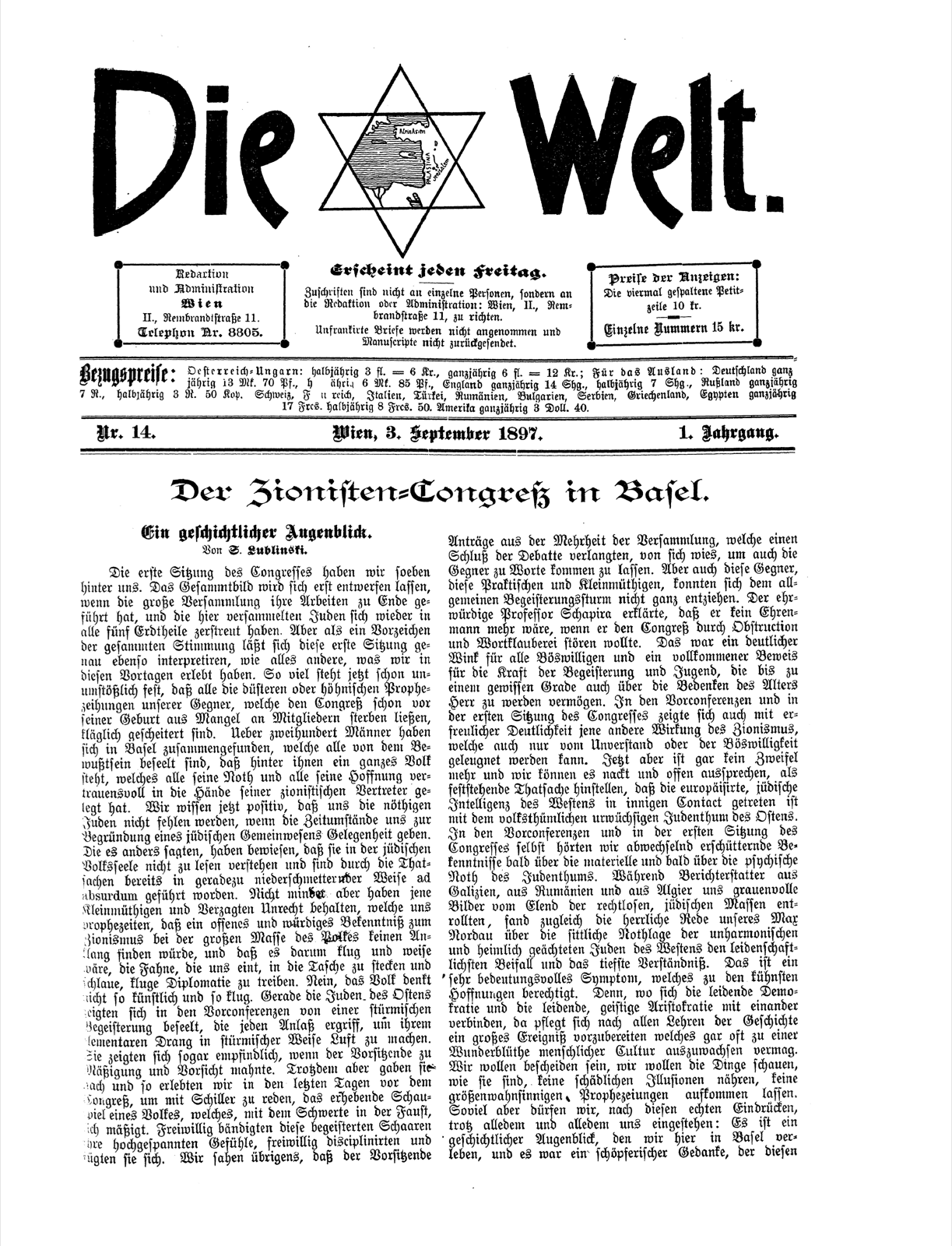
Die Welt.
Editorial Office and Administration VIENNA II., Rembrandtstrasse 11. Telephone No. 8805.
Appears every Friday. Communications are to be addressed not to individual persons, but to the Editorial Office or the Administration: Vienna, II., Rembrandtstrasse 11. Unstamped letters will not be accepted, and manuscripts will not be returned.
Advertising rates: The four-column petit line, 10 kr. Single numbers, 15 kr.
Subscription rates: Austria-Hungary: half-yearly 3 fl. = 6 Kr., yearly 6 fl. = 12 Kr.; for abroad: Germany yearly 13 Mk. 70 Pf., half-yearly 6 Mk. 85 Pf.; England yearly 14 shg., half-yearly 7 shg.; Russia yearly 7 R., half-yearly 3 R. 50 kop. Switzerland, France, Italy, Turkey, Roumania, Bulgaria, Servia, Greece, Egypt yearly 17 frcs., half-yearly 8 frcs. 50. America yearly 3 doll. 40.
No. 14. Vienna, 3 September 1897. 1st Year.
The Zionist Congress at Basle.
A Historic Moment.
By S. Lublinski.
The first sitting of the Congress lies just behind us. The picture as a whole will not admit of being drawn until the great assembly has carried its labours to a close and the Jews gathered here have scattered again to all five quarters of the globe. But as a foretoken of the general temper, this first sitting may be interpreted precisely as everything else may be that we have lived through in these preceding days. This much already stands beyond overthrow: that all the gloomy or derisive prophecies of our opponents, who let the Congress die of a want of members before ever it was born, have failed miserably. Above two hundred men have come together in Basle, all of them animated by the consciousness that behind them stands a whole people which has laid all its distress and all its hope trustfully in the hands of its Zionist representatives. We now know positively that we shall not lack the necessary Jews when the circumstances of the time afford us occasion to found a Jewish commonwealth. Those who said otherwise have proved that they do not understand how to read in the soul of the Jewish people, and have already been reduced ad absurdum by the facts in a downright crushing fashion. No less, however, have those faint-hearted and despondent men been put in the wrong who prophesied to us that an open and dignified confession of Zionism would find no echo among the great mass of the people, and that it were therefore shrewd and wise to pocket the banner that unites us and to practise a sly and clever diplomacy. No, the people does not think so artificially and so cleverly. The Jews of the East in particular showed themselves in the preliminary conferences animated by a tempestuous enthusiasm, which seized upon every occasion to give stormy vent to its elemental urgency. They even showed themselves sensitive when the chairman counselled moderation and caution. Nevertheless they gave way, and so, in the last days before the Congress, we witnessed, to speak with Schiller, the elevating spectacle of a people which, with the sword in its fist, moderates itself. Of their own free will these enthusiastic hosts curbed their high-strung feelings; of their own free will they disciplined themselves and submitted. We saw, moreover, that the chairman rejected motions from the majority of the assembly which demanded the closing of the debate, in order that the opponents too might have their say. But these opponents also, these practical and faint-hearted men, could not wholly withdraw themselves from the general storm of enthusiasm. The venerable Professor Schapira declared that he would be a man of honour no longer if he sought to disturb the Congress by obstruction and hair-splitting. That was a plain hint for all the ill-disposed, and a complete proof of the power of enthusiasm and youth, which is able in a certain degree to master even the misgivings of age. In the preliminary conferences and in the first sitting of the Congress there showed itself, too, with gratifying distinctness, that other effect of Zionism which only want of understanding or ill-will can deny. Now, however, there is no doubt whatever remaining, and we may utter it nakedly and openly, may set it down as an established fact, that the Europeanised Jewish intelligence of the West has entered into intimate contact with the popular, native Judaism of the East. In the preliminary conferences and in the first sitting of the Congress itself we heard by turns shattering confessions, now of the material and now of the spiritual distress of Jewry. While reporters from Galicia, from Roumania and from Algiers unrolled before us horrifying pictures of the misery of the rightless Jewish masses, the splendid speech of our Max Nordau upon the moral plight of the disharmonious and secretly ostracised Jews of the West found at the same time the most passionate applause and the deepest understanding. That is a very significant symptom, which warrants the boldest hopes. For where suffering democracy and a suffering intellectual aristocracy join themselves one to the other, there, by all the teachings of history, a great event is wont to be in preparation, which full often is able to grow into a wondrous flowering of human culture. We will be modest, we will look upon things as they are, nourish no harmful illusions, let no megalomaniac prophecies arise. So much, however, we may after these genuine impressions, in spite of all and all, confess to ourselves: it is a historic moment that we are living through here in Basle, and it was a creative thought which this