Page 18.
(continued from page 17)
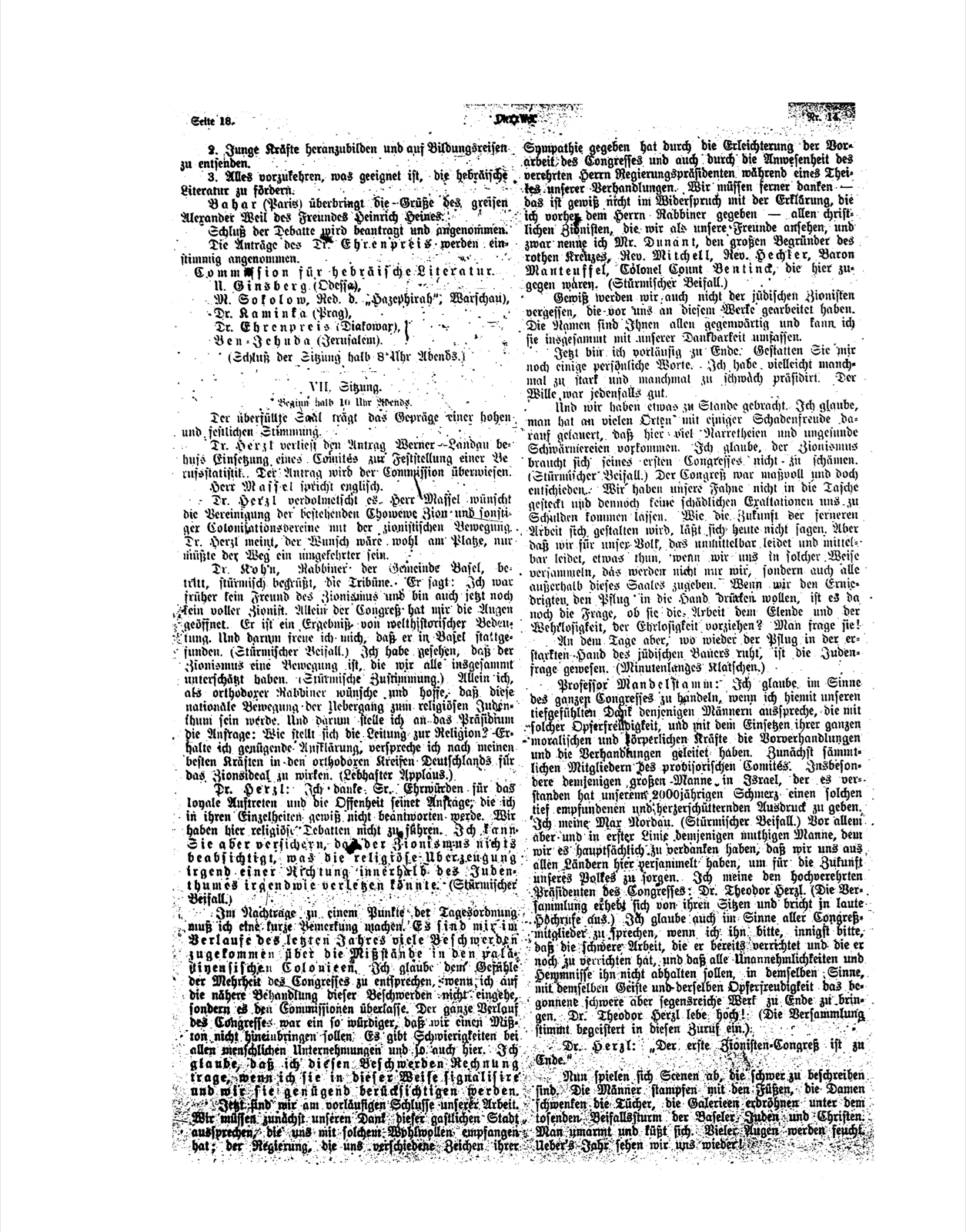
2. To train up young talents and to send them out on educational journeys. 3. To take every measure suited to the advancement of Hebrew literature.
Bahar (Paris) conveys the greetings of the aged Alexander Weil, the friend of Heinrich Heine.
The closure of the debate is moved and carried.
The motions of Dr. Ehrenpreis are adopted unanimously.
Commission for Hebrew Literature.
- U. Ginsberg (Odessa),
- M. Sokolow, editor of "Hazephenah," Warsaw,
- Dr. Kaminka (Prague),
- Dr. Ehrenpreis (Diakowar),
- Ben-Jehuda (Jerusalem).
(Close of the sitting at half-past 7 in the evening.)
VII. Sitting.
Opened at half-past 9 in the evening.
The overcrowded hall bears the impress of a lofty and festive mood.
Dr. Herzl reads out the Werner-Landau motion for the appointment of a committee to establish an occupational statistic. The motion is referred to the Commission.
Mr. Massel speaks in English.
Dr. Herzl interprets it. Mr. Massel desires the union of the existing Chowewe Zion and other colonisation societies with the Zionist movement. Dr. Herzl observes that the wish would be well in place, only that the road would have to be the reverse one.
Dr. Kohn, Rabbi of the Basle congregation, mounts the tribune amid tempestuous greeting. He says: I was formerly no friend of Zionism, and even now I am no complete Zionist. But the Congress has opened my eyes. It is an event of world-historic significance. And for that reason I rejoice that it has taken place in Basle. (Tempestuous applause.) I have seen that Zionism is a movement which we have one and all underrated. (Tempestuous assent.) But I, as an orthodox rabbi, wish and hope that this national movement may be the passage to religious Judaism. And therefore I put this question to the presidency: What is the attitude of the leadership towards religion? If I receive sufficient enlightenment, I promise to work with my best powers in the orthodox circles of Germany for the ideal of Zion. (Lively applause.)
Dr. Herzl: I thank his Reverence for his loyal bearing and for the frankness of his question, which I shall certainly not answer in its particulars. We have no religious debates to conduct here. But I can assure you that Zionism intends nothing that could in any way wound the religious conviction of any tendency whatever within Judaism. (Tempestuous applause.)
As a supplement to one point of the order of the day I must make a brief remark. In the course of the past year many complaints have reached me concerning the abuses in the Palestinian colonies. I believe I meet the feeling of the majority of the Congress if I do not enter upon a closer treatment of these complaints, but leave it to the Commissions. The whole course of the Congress has been so dignified that we ought not to bring a discordant note into it. There are difficulties in all human undertakings, and so here also. I believe that I do justice to these complaints if I signalize them in this manner and if we give them sufficient consideration.
Now we are at the provisional close of our work. We must first express our thanks to this hospitable city, which has received us with such good will; to the Government, which has given us various tokens of its sympathy by facilitating the preliminary work of the Congress, and also by the presence of the honoured Government President during a part of our deliberations. We must further thank — and this is certainly not at variance with the declaration I gave a moment ago to the Rabbi — all Christian Zionists, whom we regard as our friends, and I name in particular Mr. Dunant, the great founder of the Red Cross, Rev. Mitchell, Rev. Hechler, Baron Manteuffel, Colonel Count Bentinck, who were present here. (Tempestuous applause.)
Nor shall we forget the Jewish Zionists who laboured at this work before us. Their names are present to you all, and I may embrace them all together in our gratitude.
Now I am for the present at an end. Permit me a few personal words. I have perhaps presided sometimes too strongly and sometimes too weakly. The will, at any rate, was good.
And we have brought something to pass. I believe that in many quarters people have lain in wait, with some malicious glee, for a great deal of folly and unwholesome extravagance to appear here. I believe that Zionism has no need to be ashamed of its first Congress. (Tempestuous applause.) The Congress was measured and yet decided. We have not put our banner in our pocket, and nevertheless we have suffered ourselves no harmful exaltations. How the future of the further work will shape itself cannot be said to-day. But that we do something for our people, which suffers directly and suffers indirectly, when we assemble in such a manner — that will be granted not only by ourselves, but by all outside this hall as well. If we would press the plough into the hand of the degraded, is it still a question whether they will prefer the work to misery, to defencelessness, to dishonour? Let them be asked!
But on the day when the plough rests once more in the strengthened hand of the Jewish husbandman, the Jewish question will have been. (Applause lasting several minutes.)
Professor Mandelstamm: I believe I act in the sense of the whole Congress when I herewith express our deeply felt thanks to those men who, with such readiness for sacrifice, and with the exertion of all their moral and bodily powers, have conducted the preliminary negotiations and the deliberations. First of all to all the members of the provisional committee. In particular to that great man in Israel who has known how to give to our two-thousand-year-old pain so deeply felt and heart-shaking an expression. I mean Max Nordau. (Tempestuous applause.) But above all and in the first place to that courageous man to whom we chiefly owe it that we have assembled here out of all lands to care for the future of our people. I mean the highly honoured President of the Congress: Dr. Theodor Herzl. (The assembly rises from its seats and breaks into loud cheers.) I believe also that I speak in the sense of all the members of the Congress when I beg him, most earnestly beg him, that the heavy labour which he has already performed and which he has still to perform, and that all vexations and hindrances, may not hold him back from carrying to its end, in the same sense, with the same spirit and the same readiness for sacrifice, the heavy but blessed work he has begun. Long live Dr. Theodor Herzl! (The assembly joins with enthusiasm in this acclamation.)
Dr. Herzl: "The first Zionist Congress is at an end."
There now follow scenes which are hard to describe. The men stamp with their feet, the ladies wave their handkerchiefs, the galleries resound under the roaring storm of applause of the Jews and Christians of Basle. People embrace and kiss one another. Many eyes grow moist. A year hence we shall meet again!