Page 16. — "Die Welt" — No. 10.
(continued from page 15)
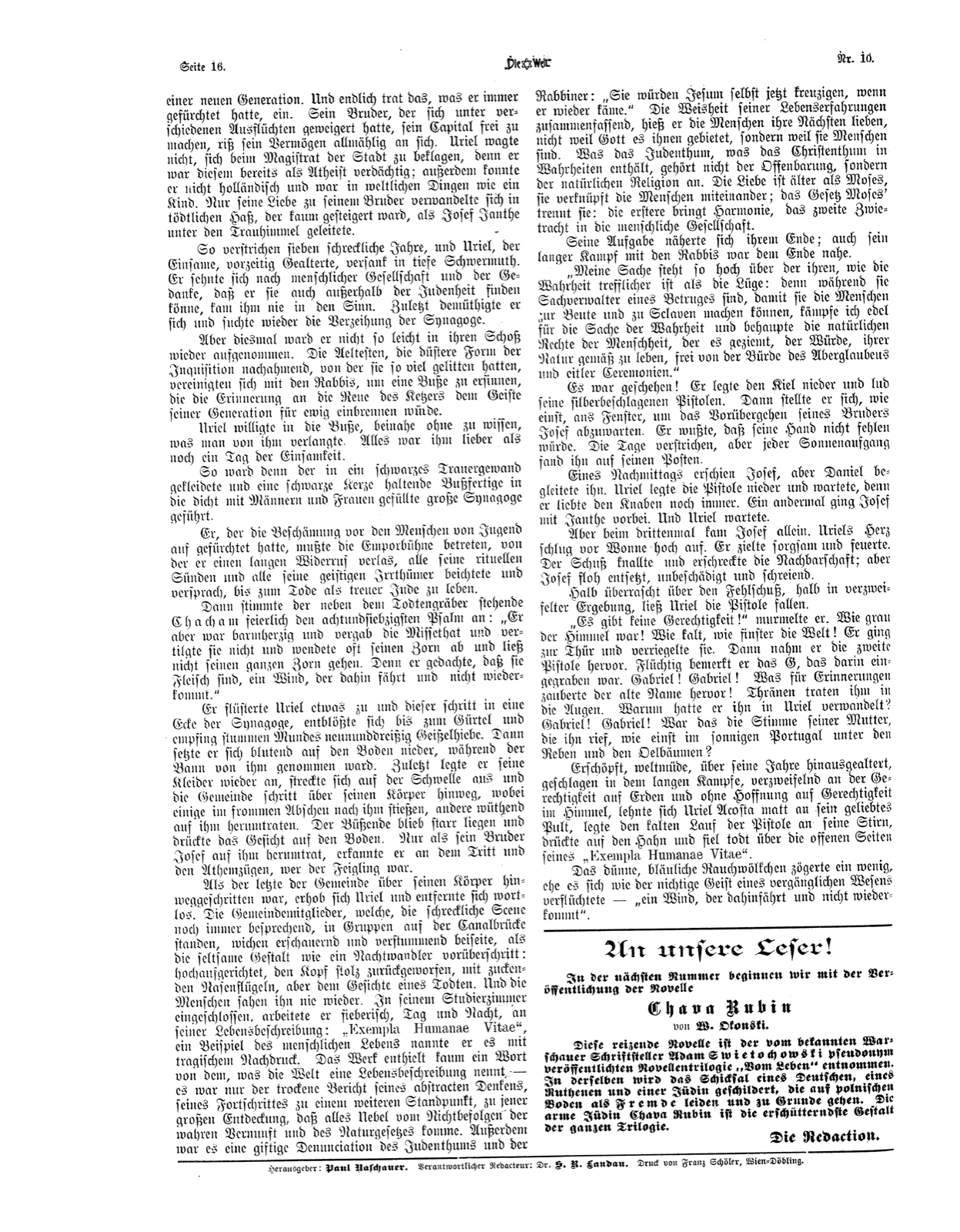
...of a new generation. And at last that came to pass which he had always feared. His brother, who under various pretexts had refused to release his capital, gradually seized his fortune. Uriel did not dare complain to the magistrate of the city, for he was already suspect to that body as an atheist; besides, he knew no Dutch and in worldly matters was as a child. Only his love for his brother turned into deadly hatred, which was scarcely heightened when Josef led Janthe beneath the marriage canopy.
Thus seven dreadful years went by, and Uriel, solitary and prematurely aged, sank into deep melancholy. He longed for human society, and the thought that he might find it also outside of Jewry never entered his mind. At last he humbled himself and sought once more the forgiveness of the synagogue.
But this time he was not so easily received again into her bosom. The Elders, imitating the gloomy forms of that Inquisition from which they had suffered so much, joined with the Rabbis to devise a penance that should burn the memory of the heretic's repentance into the spirit of his generation for ever.
Uriel consented to the penance, almost without knowing what was demanded of him. Anything was dearer to him than one more day of solitude.
And so the penitent, clad in a black mourning garment and holding a black candle, was led into the great synagogue, which was densely filled with men and women.
He who from his youth up had dreaded shame before men was obliged to ascend the raised platform, from which he read out a long recantation, confessed all his ritual sins and all his intellectual errors, and promised to live until death as a faithful Jew.
Then the Chacham, standing beside the gravedigger, solemnly intoned the seventy-eighth Psalm: "But he was merciful and forgave their iniquity and destroyed them not, and many a time turned he his anger away and did not let all his wrath go forth. For he remembered that they are flesh, a wind that passeth away and cometh not again."
He whispered something to Uriel, and Uriel stepped into a corner of the synagogue, bared himself to the girdle, and received in silence nine-and-thirty lashes of the scourge. Then he sat down bleeding upon the floor, while the ban was lifted from him. At the last he put on his clothes again, stretched himself upon the threshold, and the congregation strode across his body, some spurning him in pious abhorrence, others trampling upon him in fury. The penitent lay rigid and pressed his face to the ground. Only when his brother Josef trampled upon him did he know by the tread and the breathing who the coward was.
When the last of the congregation had strode across his body, Uriel rose and withdrew without a word. The members of the congregation, who stood in groups upon the canal bridge, still discussing the terrible scene, shrank shuddering and silent aside as the strange figure passed by like a sleepwalker: erect, the head thrown proudly back, the nostrils quivering, but with the face of a dead man. And men never saw him again. Shut up in his study, he laboured feverishly, day and night, at the account of his life: "Exempla Humanae Vitae," an example of human life, he called it with tragic emphasis. The work contained scarcely a word of what the world calls the account of a life — it was but the dry report of his abstract thinking, of his progress toward a wider standpoint, toward that great discovery, that all fog comes of the non-observance of true reason and of the law of nature. Besides this it was a venomous denunciation of Judaism and of the Rabbis: "They would crucify Jesus himself now, were he to come again." Summing up the wisdom of his life's experience, he bade men love their neighbours, not because God commands it of them, but because they are men. Whatsoever Judaism, whatsoever Christianity contains of truths belongs not to revelation but to natural religion. Love is older than Moses; it binds men to one another; the law of Moses divides them: the former brings harmony, the latter discord into human society.
His task drew near its end; his long struggle with the Rabbis, too, was near its end.
"My cause stands as far above theirs as truth is more excellent than falsehood: for whereas they are the advocates of an imposture, that they may make men their prey and their slaves, I fight nobly for the cause of truth and maintain the natural rights of mankind, whom it beseems to live in the dignity conformable to their nature, free from the burden of superstition and of vain ceremonies."
It was done! He laid down the quill and loaded his silver-mounted pistols. Then he placed himself, as once before, at the window, to await the passing of his brother Josef. He knew that his hand would not fail. The days went by, but every sunrise found him at his post.
One afternoon Josef appeared, but Daniel was with him. Uriel laid down the pistol and waited, for he loved the boy still. Another time Josef went past with Janthe. And Uriel waited.
But the third time Josef came alone. Uriel's heart leapt high with rapture. He aimed carefully and fired. The shot rang out and startled the neighbourhood; but Josef fled in terror, unharmed and shrieking.
Half surprised at the missed shot, half in despairing resignation, Uriel let the pistol fall.
"There is no justice!" he murmured. How grey the sky was! How cold, how dark the world! He went to the door and bolted it. Then he took out the second pistol. In passing he notices the G that was engraved upon it. Gabriel! Gabriel! What memories the old name conjured up! Tears came into his eyes. Why had he changed it into Uriel? Gabriel! Gabriel! Was that his mother's voice calling him, as once in sunny Portugal among the vines and the olive trees?
Exhausted, weary of the world, aged beyond his years, beaten in the long struggle, despairing of justice upon earth and without hope of justice in heaven, Uriel Acosta leaned faintly against his beloved desk, laid the cold barrel of the pistol to his brow, pressed the trigger, and fell dead across the open pages of his "Exempla Humanae Vitae."
The thin, bluish cloudlet of smoke lingered a little before it vanished away like the fleeting spirit of a perishable being — "a wind that passeth away and cometh not again."
To our Readers!
In the next number we begin the publication of the novella
Chava Rubin
by W. Okonßti.
This charming novella is taken from the trilogy of novellas "Vom Leben," published pseudonymously by the well-known Warsaw writer Adam Swietochowski. Therein is portrayed the fate of a German, a Ruthenian, and a Jewess, who as strangers suffer and perish upon Polish soil. The poor Jewess Chava Rubin is the most harrowing figure of the whole trilogy.
The Editors.
Publisher: Paul Aschauer. Responsible Editor: Dr. S. R. Landau. Printed by Franz Schöler, Vienna-Döbling.