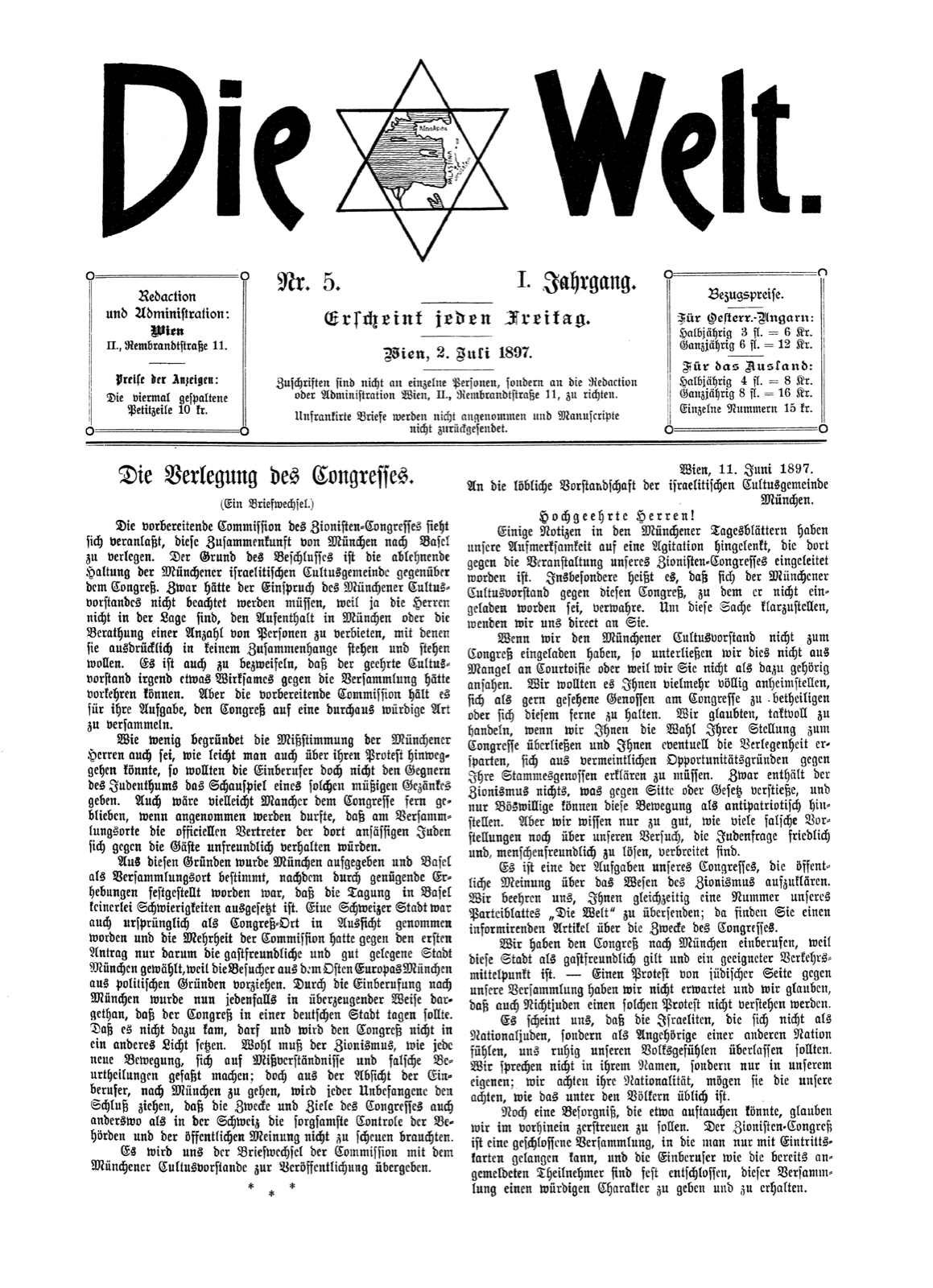
Die Welt.
No. 5. Vol. I.
Appears every Friday.
Vienna, 2 July 1897.
| Editorial Office and Administration: Vienna II., Rembrandtstrasse 11. Advertising rates: the four-column petit line, 10 kr. | Communications are to be addressed not to individual persons, but to the Editorial Office or the Administration, Vienna, II., Rembrandtstrasse 11. Unstamped letters will not be accepted, and manuscripts are not returned. | Subscription rates. For Austria-Hungary: half-yearly 3 fl. = 6 kr. Yearly 6 fl. = 12 kr. For abroad: half-yearly 4 fl. = 8 kr. Yearly 8 fl. = 16 kr. Single numbers 15 kr. |
|---|
The Transfer of the Congress.
(A Correspondence.)
The preparatory Commission of the Zionist Congress finds itself obliged to transfer this assembly from Munich to Basle. The ground of the resolution is the attitude of refusal taken up by the Israelitish Congregation of Munich towards the Congress. The objection of the Munich Board of the Congregation need not, indeed, have been heeded, for these gentlemen are in no position to forbid the sojourn in Munich, or the deliberation, of a number of persons with whom they expressly stand, and wish to stand, in no connection whatever. It is likewise to be doubted whether the honoured Board of the Congregation could have taken any effective measure against the assembly. But the preparatory Commission holds it to be its task to convene the Congress in a thoroughly dignified manner.
However ill-founded the displeasure of the Munich gentlemen may be, however easily one might pass over their protest, the conveners were nevertheless unwilling to afford the adversaries of Jewry the spectacle of such an idle wrangle. Moreover, this or that person might perhaps have stayed away from the Congress, had it been permissible to suppose that at the place of assembly the official representatives of the Jews resident there would bear themselves unkindly towards the guests.
For these reasons Munich was given up and Basle fixed upon as the place of assembly, after sufficient inquiries had established that the sitting at Basle is exposed to no difficulties of any kind. A Swiss town had also originally been contemplated as the seat of the Congress, and the majority of the Commission had, against the first proposal, chosen the hospitable and well-situated city of Munich only because visitors from the East of Europe prefer Munich on political grounds. By the summons to Munich it has at any rate now been shown in convincing fashion that the Congress was to sit in a German city. That this did not come to pass may not and will not set the Congress in any other light. Zionism must indeed, like every new movement, be prepared for misunderstandings and false judgments; yet from the intention of the conveners to go to Munich every impartial person will draw the conclusion that the purposes and aims of the Congress had no need to shun the most careful scrutiny of the authorities and of public opinion elsewhere than in Switzerland.
The correspondence of the Commission with the Munich Board of the Congregation is handed to us for publication.
* * *
Vienna, 11 June 1897.
To the worshipful Board of the Israelitish Congregation
Munich.
Highly honoured Gentlemen!
Certain notices in the Munich daily papers have directed our attention to an agitation which has been set on foot there against the holding of our Zionist Congress. In particular it is stated that the Munich Board of the Congregation protests against this Congress, to which it has not been invited. In order to place this matter in a clear light, we turn directly to you.
If we have not invited the Munich Board of the Congregation to the Congress, we omitted to do so neither from any want of courtesy nor because we did not regard you as belonging thereto. We wished rather to leave it entirely to you whether to take part in the Congress as welcome associates or to hold aloof from it. We believed we were acting with tact in leaving to you the choice of your attitude towards the Congress, and in sparing you, as the case might be, the embarrassment of having to declare yourselves, upon supposed grounds of expediency, against your own kinsmen. Zionism contains, to be sure, nothing that offends against custom or law, and only the ill-disposed can represent this movement as unpatriotic. But we know only too well how many false conceptions are still current concerning our attempt to solve the Jewish question peaceably and, humanely.
It is one of the tasks of our Congress to enlighten public opinion as to the essence of Zionism. We have the honour at the same time to forward to you a number of our party organ, "Die Welt"; there you will find an informing article upon the purposes of the Congress.
We have summoned the Congress to Munich because that city passes for hospitable and is a convenient centre of communication. — A protest from Jewish quarters against our assembly we did not expect, and we believe that non-Jews also will not understand such a protest.
It seems to us that those Israelites who feel themselves to be, not national Jews, but members of another nation, ought quietly to leave us to our national sentiments. We do not speak in their name, but only in our own; we respect their nationality, and may they respect ours, as is customary among the peoples.
One further apprehension which might possibly arise we believe we ought to dispel beforehand. The Zionist Congress is a closed assembly, to which admission can be had only by ticket, and the conveners, like the participants already enrolled, are firmly resolved to give and to preserve to this assembly a dignified character.