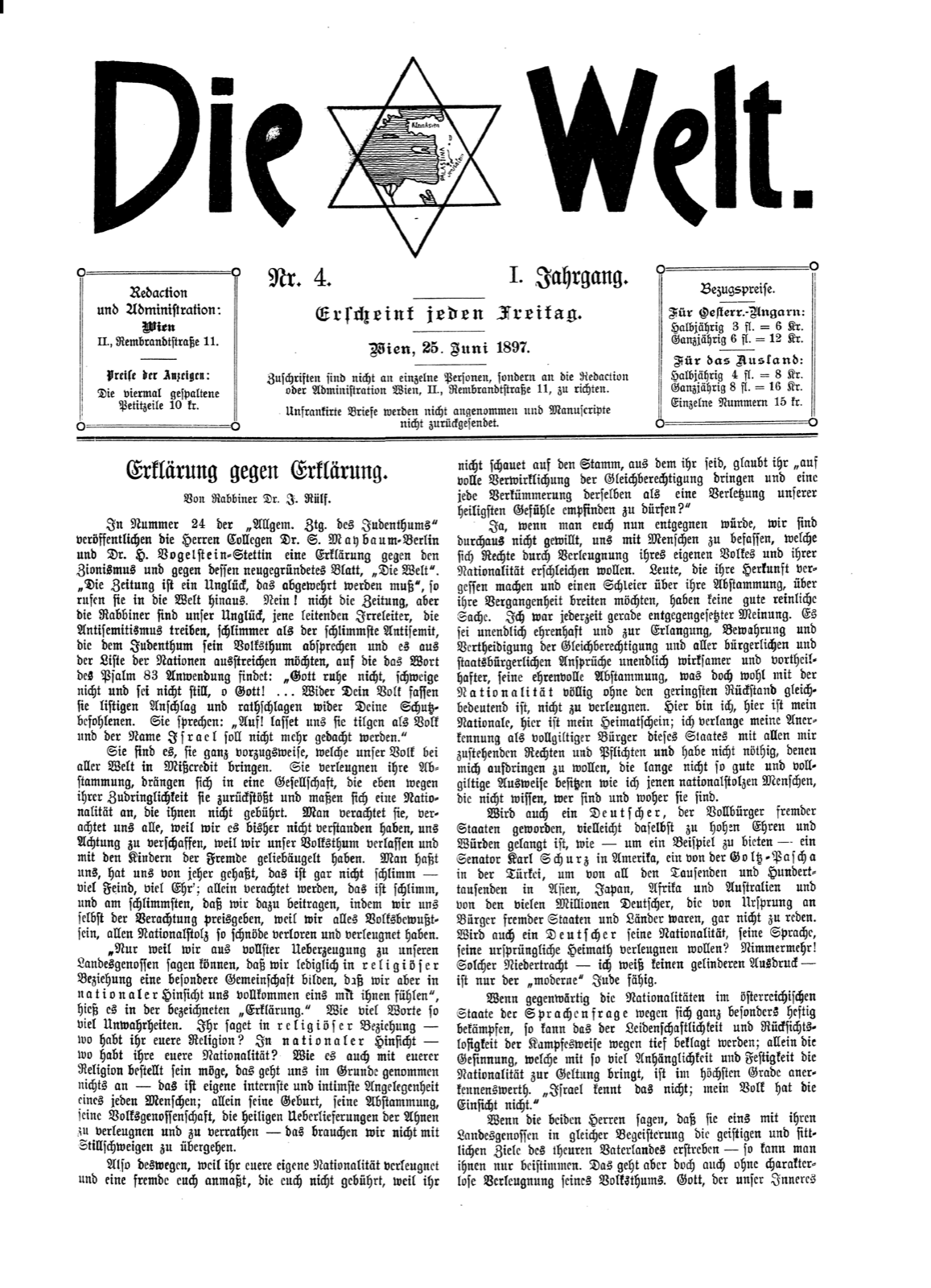
Die Welt.
No. 4. Vol. I.
Appears every Friday.
Vienna, 25 June 1897.
Editorial Office and Administration: Vienna II., Rembrandtstrasse 11. Advertising rates: the four-column nonpareil line, 10 kr. — Communications are to be addressed not to individual persons but to the Editorial Office or the Administration, Vienna, II., Rembrandtstrasse 11. Unstamped letters will not be accepted, and manuscripts will not be returned. — Subscription prices. For Austria-Hungary: half-yearly 3 fl. = 6 Kr.; yearly 6 fl. = 12 Kr. For abroad: half-yearly 4 fl. = 8 Kr.; yearly 8 fl. = 16 Kr. Single numbers 15 kr.
Declaration against Declaration.
By Rabbi Dr. I. Rülf.
In number 24 of the "Allgem. Ztg. des Judenthums" our colleagues Dr. S. Maybaum of Berlin and Dr. H. Vogelstein of Stettin publish a declaration against Zionism and against its newly founded paper, "Die Welt". "The newspaper is a misfortune that must be warded off," so they cry out to the world. No! not the newspaper, but the rabbis are our misfortune — those leading misleaders who practise antisemitism, worse than the worst antisemite, who deny Jewry its peoplehood and would strike it from the roll of the nations, and to whom the word of Psalm 83 finds application: "Keep not Thou silence, O God: hold not Thy peace, and be not still, O God! ... They have taken crafty counsel against Thy people, and consulted against Thy hidden ones. They have said: Come, and let us cut them off from being a nation; that the name of Israel may be no more in remembrance."
It is they, they above all others, who bring our people into discredit before the whole world. They disown their descent, press themselves into a society which for that very importunity thrusts them back, and arrogate to themselves a nationality that is not their due. They are despised, and we are all despised with them, because we have not hitherto understood how to win respect for ourselves, because we have forsaken our peoplehood and made eyes at the children of the stranger. We are hated, we have been hated from of old — that is no great evil; much enmity, much honour. But to be despised, that is an evil; and worst of all, that we ourselves contribute to it, delivering ourselves up to contempt, because we have so basely lost and disowned all consciousness of a people, all national pride.
"Only because we can say to our fellow countrymen out of the fullest conviction that we form a distinct community in a religious respect alone, but that in a national respect we feel ourselves wholly one with them" — so ran the aforesaid "Declaration." As many words, so many untruths. You say, in a religious respect — where is your religion? In a national respect — where is your nationality? However matters may stand with your religion, that at bottom is no concern of ours; it is the innermost and most intimate affair of every man for himself. But to disown and to betray one's birth, one's descent, one's fellowship of people, the sacred traditions of the fathers — that we need not pass over in silence.
And so, because you disown your own nationality and arrogate to yourselves a foreign one that is not your due, because you do not look to the stock from which you are sprung, you believe you may "press for the full realisation of equal rights and feel every curtailment of them as a violation of our most sacred sentiments"?
Yes — and what if one were now to answer you: we are by no means willing to occupy ourselves with men who seek to obtain rights by stealth through the disowning of their own people and their own nationality. People who would have their origin forgotten and would spread a veil over their descent, over their past, have no good and clean cause. I have at all times been of precisely the opposite opinion. It is infinitely honourable, and for the attainment, the preservation and the defence of equal rights and of all civil and political claims infinitely more effectual and advantageous, not to disown one's honourable descent — which is surely, without the least remainder, one and the same thing as one's nationality. Here I am, here is my national register, here is my certificate of domicile; I demand my recognition as a fully valid citizen of this State with all the rights and duties belonging to me, and I have no need to thrust myself upon those who possess credentials nowhere near so good and so fully valid as I do upon those men of national pride who know not who are and whence they are.
Will a German too, who has become a full citizen of foreign States and has perhaps there attained to high honours and dignities — as, to offer an example, a Senator Karl Schurz in America, a von der Goltz-Pasha in Turkey, to say nothing at all of the thousands and hundreds of thousands in Asia, Japan, Africa and Australia, and of the many millions of Germans who were from their origin citizens of foreign States and lands. Will a German too be willing to disown his nationality, his language, his original homeland? Never! Of such baseness — I know no milder expression — only the "modern" Jew is capable.
If at the present time the nationalities in the Austrian State are contending with one another with especial vehemence over the language question, that may, for the passion and the ruthlessness of the manner of the struggle, be deeply lamented; but the sentiment which with so much attachment and firmness asserts nationality is in the highest degree worthy of recognition. "Israel doth not know; my people doth not consider."
When the two gentlemen say that, one with their fellow countrymen, they strive with equal enthusiasm after the intellectual and moral aims of the dear fatherland — one can only agree with them. But that is possible even without the characterless disowning of one's peoplehood. God, who our inmost