No. 2. — "Die Welt" — Page 9.
The words of your divinely gifted royal poet David I too call out to you:
שַׁאֲלוּ שְׁלוֹם יְרוּשָׁלָםִ׃
"Pray for the peace of Jerusalem! They shall prosper that love thee!" Psalm 122:6.
Ye children of Abraham, awake! God Himself, the heavenly Father, calls you back to your ancient fatherland and will be your God.
And may this God of Abraham, Isaac and Jacob bless you with heavenly blessings beyond asking and understanding, and set you as a blessing to many more, as HE promised of old through His prophets.
Vienna, 4 June 1897.
William Henry Hechler, Chaplain to Her Britannic Majesty's Embassy in Vienna.
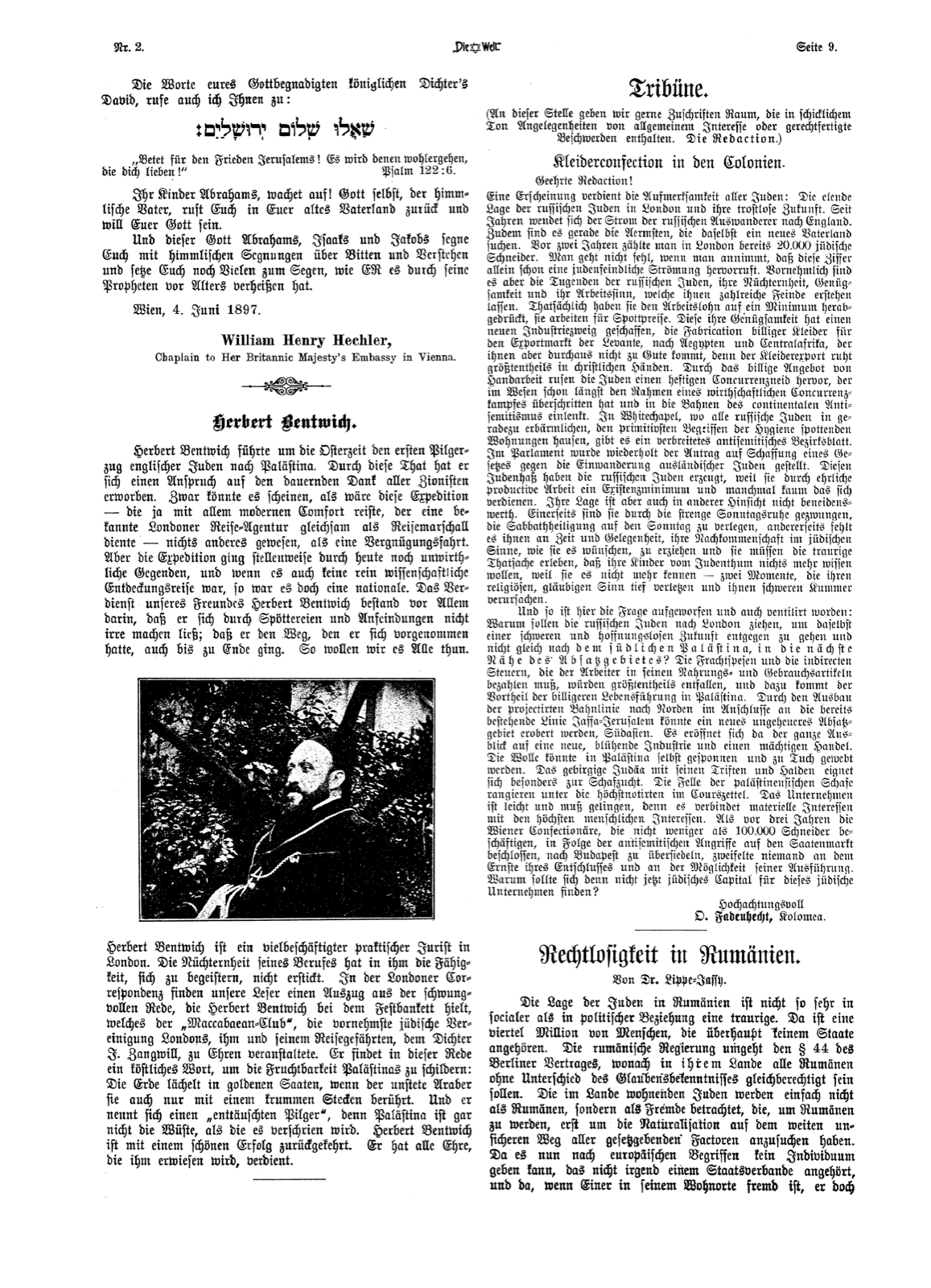
Herbert Bentwich.
At about Eastertide Herbert Bentwich led the first pilgrimage of English Jews to Palestine. By this deed he has earned a claim to the lasting gratitude of all Zionists. It might indeed appear as though this expedition — which travelled with every modern comfort, a well-known London travel agency serving it as a kind of marshal of the journey — had been nothing other than a pleasure trip. But the expedition passed in places through regions that are inhospitable even today, and if it was not a purely scientific voyage of discovery, it was nevertheless a national one. The merit of our friend Herbert Bentwich lay above all in this, that he did not let himself be put out by mockery and hostility; that he followed to the end the road he had set himself. So let us all do.
Herbert Bentwich is a much-occupied practising lawyer in London. The sobriety of his calling has not stifled in him the capacity for enthusiasm. In the London correspondence our readers will find an extract from the spirited address which Herbert Bentwich delivered at the banquet given in his honour, and in honour of his fellow traveller, the poet J. Zangwill, by the "Maccabaean Club," the most distinguished Jewish association in London. In that address he finds an exquisite phrase to describe the fruitfulness of Palestine: the earth smiles in golden harvests, though the roving Arab touch it with no more than a crooked stick. And he calls himself a "disappointed pilgrim," for Palestine is by no means the desert it is decried as being. Herbert Bentwich has returned with a fine success. He has deserved every honour that is shown him.
Tribune.
(In this place we gladly give room to communications which, in seemly tone, treat matters of general interest or contain justified complaints. The Editors.)
Clothing Manufacture in the Colonies.
Esteemed Editors!
One phenomenon deserves the attention of all Jews: the wretched condition of the Russian Jews in London and their comfortless future. For years the stream of Russian emigrants has turned toward England. And it is precisely the poorest who seek a new fatherland there. Two years ago there were already counted in London 20,000 Jewish tailors. One does not go wrong in assuming that this figure alone calls forth an anti-Jewish current. Chiefly, however, it is the virtues of the Russian Jews — their sobriety, their frugality and their industriousness — that raise up numerous enemies against them. They have in fact forced wages down to a minimum; they work for derisory prices. This frugality of theirs has created a new branch of industry, the manufacture of cheap clothing for the export market of the Levant, for Egypt and Central Africa — which, however, in no way benefits them, for the clothing export lies for the most part in Christian hands. By their cheap offer of handwork the Jews call forth a fierce envy of competition, which in its essence has long since overstepped the bounds of an economic struggle for custom and has turned into the paths of continental antisemitism. In Whitechapel, where all the Russian Jews are housed in downright miserable dwellings that mock the most primitive notions of hygiene, there is a widely circulated antisemitic district paper. In Parliament the motion has repeatedly been brought forward for the creation of a law against the immigration of foreign Jews. This hatred of the Jews the Russian Jews have brought upon themselves because by honest productive labour they earn a bare subsistence and sometimes scarcely that. But their situation is not enviable in other respects either. On the one hand they are compelled by the strict Sunday rest to transfer the hallowing of the Sabbath to the Sunday; on the other hand they lack the time and the opportunity to bring up their offspring in the Jewish spirit as they would wish, and they must live to see the sad fact that their children will know nothing more of Judaism because they no longer know it — two circumstances which wound their religious, believing sense deeply and cause them heavy sorrow.
And so the question has here been raised and also ventilated: Why should the Russian Jews move to London, there to go forward to a hard and hopeless future, and not rather at once to southern Palestine, into the immediate neighbourhood of the market itself? The freight charges and the indirect taxes which the workman must pay in his articles of food and use would for the most part fall away, and to this is added the advantage of cheaper living in Palestine. By the completion of the projected railway line to the north, in connection with the already existing Jaffa—Jerusalem line, an immense new market could be conquered: Southern Asia. There opens up the whole prospect of a new and flourishing industry and a mighty commerce. The wool could be spun in Palestine itself and woven into cloth. Mountainous Judaea, with its pastures and slopes, is particularly suited to sheep-rearing. The hides of Palestinian sheep rank among the highest quoted on the market list. The undertaking is easy and must succeed, for it unites material interests with the highest human interests. When three years ago the Vienna clothing manufacturers, who employ no fewer than 100,000 tailors, resolved in consequence of the antisemitic attacks upon the seed market to remove to Budapest, no one doubted the earnestness of their resolve or the possibility of its execution. Why then should Jewish capital not now be found for this Jewish undertaking?
Respectfully D. Fadeuhecht, Kolomea.
The Denial of Rights in Roumania.
By Dr. Lippe-Jassy.
The condition of the Jews in Roumania is a sad one, not so much in social as in political respects. Here is a quarter of a million human beings who belong to no state whatever. The Roumanian Government evades § 44 of the Treaty of Berlin, according to which all Roumanians in that country, without distinction of religious confession, are to enjoy equal rights. The Jews dwelling in the land are simply not regarded as Roumanians but as foreigners, who, in order to become Roumanians, must first apply for naturalisation by the long and uncertain road of all the legislative bodies. Since now, according to European notions, there can be no individual who does not belong to some state association, and since, if a man is a foreigner in his place of residence, he yet