— 374 —
One is without doubt justified in regarding the special constitution of the soils of the rain-poor (or at times rain-poor) regions as an important factor in the history of civilization, in that these tracts of land, contrary to our usual impressions, are fitted for the nourishment of larger populations than the rain-rich lands, whose fertility flows continually down into the ocean. In consequence of this circumstance, the struggle for existence in the arid region is a much easier one, so soon as only the life-giving water can be made available. A great part of the tracts of land which now pass for desert must in reality be regarded as extraordinarily fruitful ground, on which only the enterprising, wisely guided hand of man is needed to make possible the most intensive production of plants. The 'great American desert' has even now shrunk together to a comparatively small area; in the future it will doubtless fare likewise with a considerable part of the Asiatic and African deserts, so soon as conditions become such that they can be closed with in the right manner by measures of cultivation. Herein a suitable solution of the water question will always be the chief matter, but in many cases it will meet with no excessive difficulties."
I rejoice to be able to find in Hilgard's expositions of that time, as quite especially also in his more recent works, a confirmation of my conviction that a considerable part, too, of the unirrigated fields of Syria and Palestine, to-day of small productive capacity and appearing more or less desert-like, bears within itself the germ of great fertility. May the day soon come which everywhere wakes the slumbering germ to life!
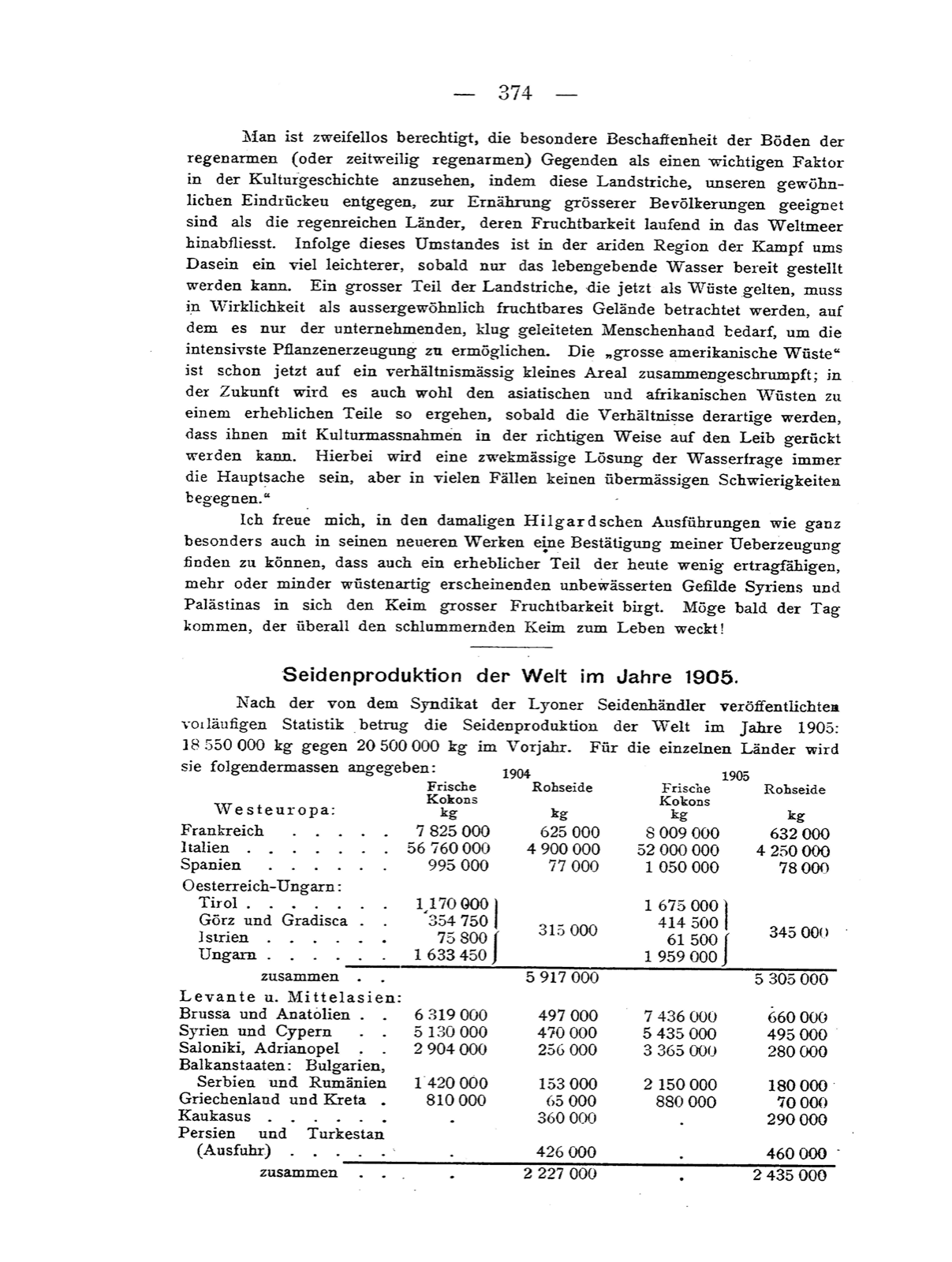
Silk Production of the World in the Year 1905.
According to the preliminary statistics published by the Syndicate of the Lyons silk merchants, the silk production of the world in the year 1905 amounted to: 18,550,000 kg against 20,500,000 kg in the previous year. For the several countries it is given as follows:
                            1904                        1905
                        Fresh       Raw silk            Fresh       Raw silk
                        cocoons                         cocoons
                           kg          kg                  kg          kg
Western Europe:
France . . . .          7,825,000    625,000            8,009,000    632,000
Italy . . . . .        56,760,000  4,900,000           52,000,000  4,250,000
Spain . . . . .           995,000     77,000            1,050,000     78,000
Austria-Hungary:
Tyrol . . . . .         1,170,000                       1,675,000
Görz and Gradisca .       354,750      315,000            414,500      345,000
Istria . . . .             75,800                          61,500
Hungary . . . . .       1,633,450                       1,959,000
      together . . . . . . . .         5,917,000                   5,305,000

Levant and Central Asia:
Brussa and Anatolia .   6,319,000    497,000            7,436,000    660,000
Syria and Cyprus . .    5,130,000    470,000            5,435,000    495,000
Salonica, Adrianople .  2,904,000    256,000            3,365,000    280,000
Balkan States: Bulgaria,
  Servia and Roumania   1,420,000    153,000            2,150,000    180,000
Greece and Crete . .      810,000     65,000              880,000     70,000
Caucasus . . . . .        .          360,000                .          290,000
Persia and Turkestan
  (export) . . . .        .          426,000                .          460,000
      together . . . . . . . .         2,227,000                   2,435,000