Facsimile · scan 38 of 56
English · AI translation, checked against the German
— 326 —
| Zichron Jacob | Melhamije | Kasr Hadschla | |
|---|---|---|---|
| January 1906. | |||
| Amount of rain . . . | 132.5 mm | 96.1 mm | 25.5 mm |
| Daily mean . . . | 4.3 „ | 3.1 „ | 0.8 „ |
| Number of rain days | 8 | 14 | 3 |
| Dates of rain days | 2.–3., 5., 8., 11., 14., 21. and 28. 1. | 1.–4., 7.–8., 10. to 11., 13.–14., 19.–20., 27.–28. 1. | 17., 28.–29. 1. |
| Maximum . . . | 40.5 mm on 2. 1. | 44.5 mm on 1. 1. | 10.5 mm on 17. 1. |
| February 1906. | |||
| Amount of rain . . . | 116.5 mm | 120.7 mm | 52 mm |
| Daily mean . . . | 4.1 „ | 4.3 „ | 1.5 „ |
| Number of rain days | 9 | 16 | 5 |
| Dates of rain days | 4., 10.–12., 14., 20. to 21., 23. and 27. 2. | 2.–3., 9.–12., 14. to 17., 19.–21., 23. and 26.–27. 2. | 11., 15., 21., 27. to 28. 2. |
| Maximum . . . | 21.0 mm on 11. 2. | 27.5 mm on 15. 2. | 20 mm on 21. and 28. 2. |
| March 1906. | |||
| Amount of rain . . . | Report not yet received. | 61.7 mm | 0 ? |
| Daily mean . . . | 1.9 „ | ||
| Number of rain days | 9 | ||
| Dates of rain days | 8.–9., 15.–16., 18., 28.–31. 3. | ||
| Maximum . . . | 17 mm on 29. 3. | ||
| April 1906. | |||
| Amount of rain . . . | 29.9 mm | 28 mm | |
| Daily mean . . . | 0.9 „ | 0.9 „ | |
| Number of rain days | 5 | 1 | |
| Dates of rain days | 2.–6. 4. | 17. 4. | |
| Maximum . . . | 19 mm on 4. 4. | 28 mm on 17. 4. | |
| May 1906. | |||
| Amount of rain . . . | 18.3 mm | 13 mm | |
| Daily mean . . . | 0.6 „ | 0.4 „ | |
| Number of rain days | 10 | 1 | |
| Dates of rain days | 4.–10., 13.–15. 5. | 14. 5. | |
| Maximum . . . | 5.4 mm on 14. 5. | 13 mm on 14. 5. ? | |
| Total amount, winter 1905/6 | ? | 667.2 mm | 187 mm ? |
| Number of rain days | ? | 65 | 17 ? |
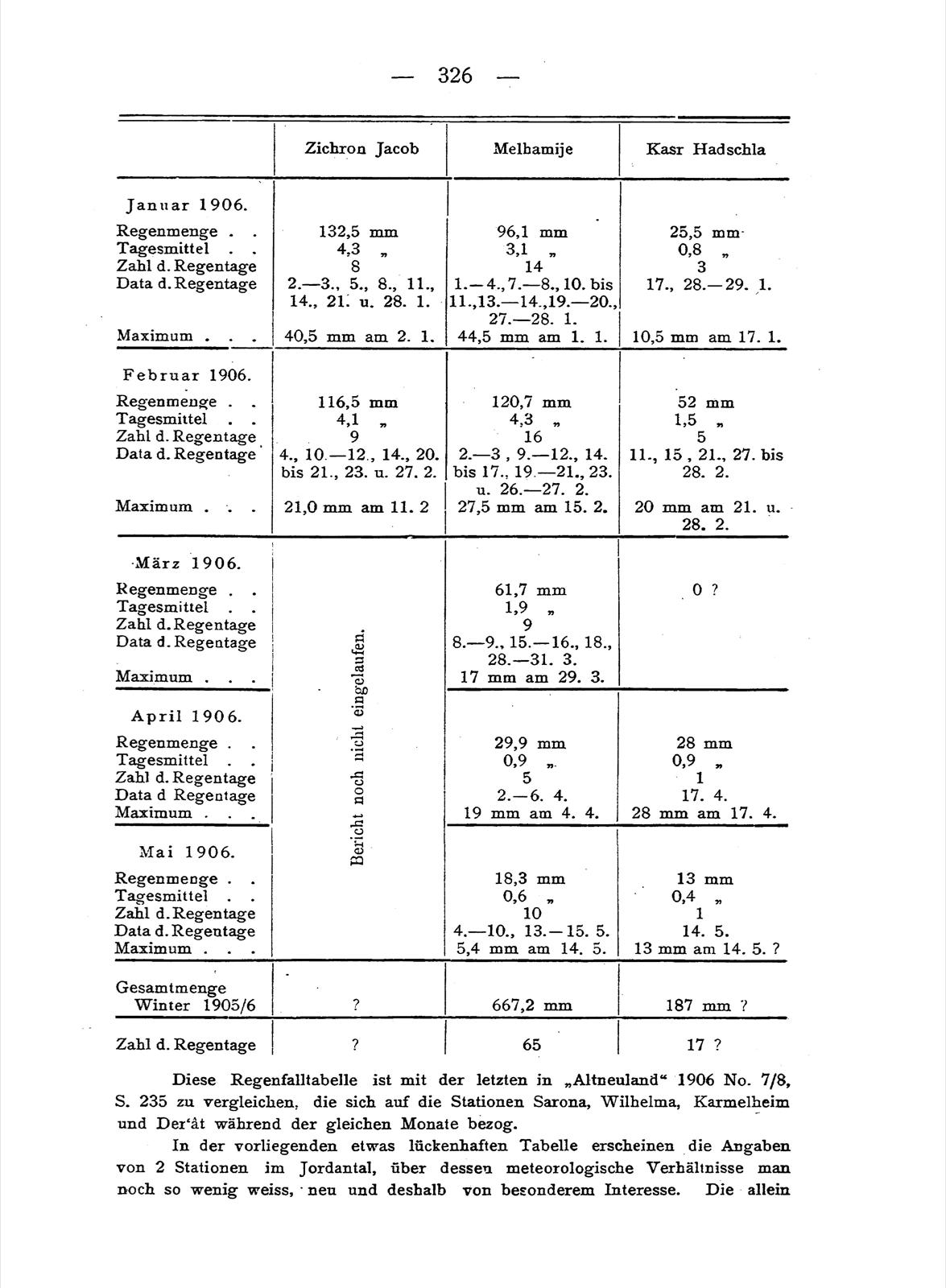
This rainfall table is to be compared with the last one in "Altneuland" 1906, No. 7/8, p. 235, which referred to the stations Sarona, Wilhelma, Karmelheim, and Der‘ât during the same months.
In the present somewhat incomplete table, the data of 2 stations in the Jordan valley, of whose meteorological conditions so little is as yet known, appear new and therefore of especial interest. The only