— 58 —
Of the import quantity for January to October 1905 set out in the foregoing compilation, 195,000 hl fell to Spanish wines, 11,000 hl to Italian, 3,872,000 hl to wines from Algeria, and 16,000 hl to those from Tunis.
The production of wine from dried grapes amounted, for the period November 1904 to November 1905, to 19,283 hl. The manufacture of wine by the addition of sugar and water to marc came to 317,015 hl, against 437,333 hl in the previous year. The production of after-wine for household drinking is estimated at 1,327,221 hl.
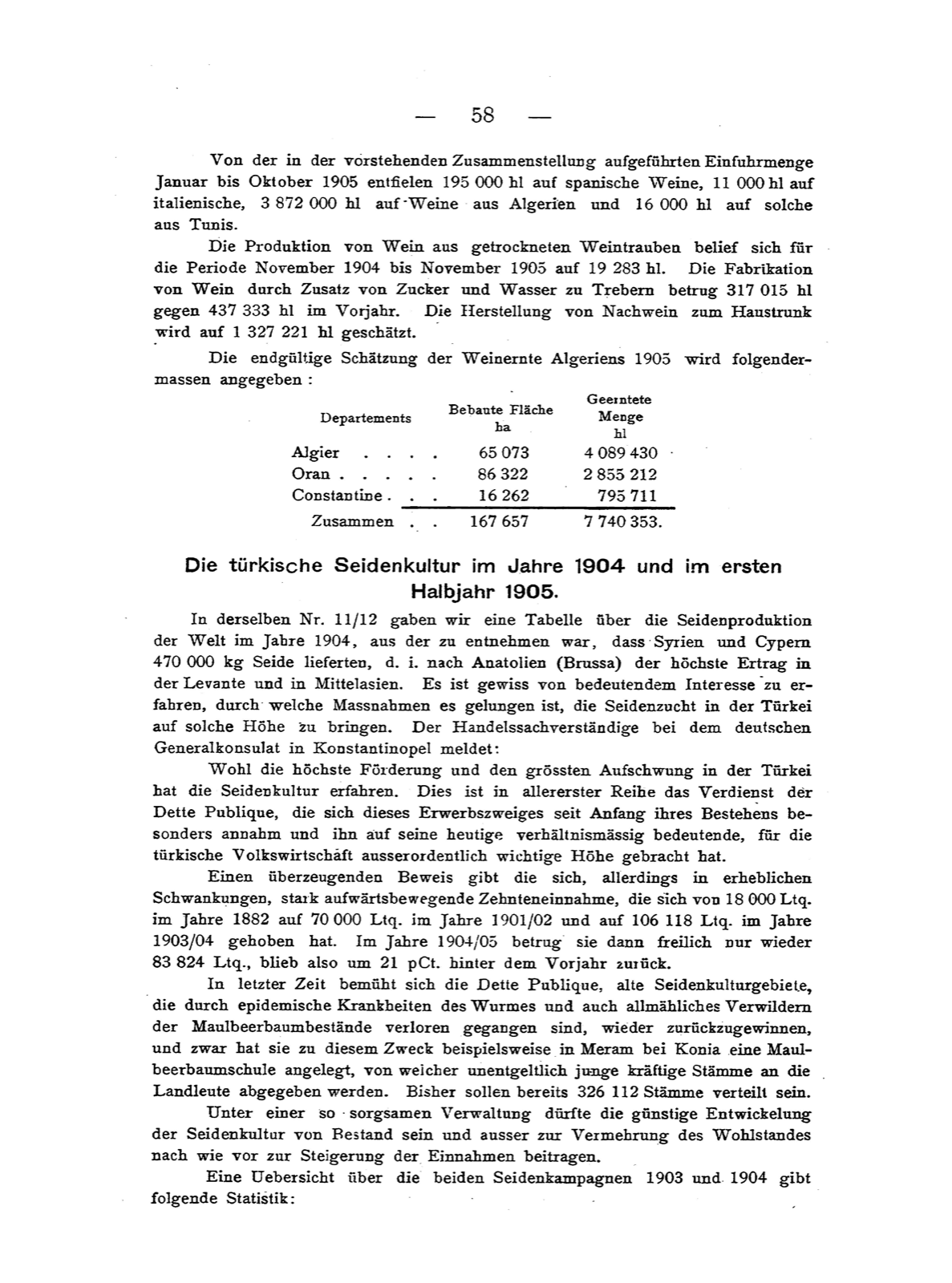
The final estimate of the wine harvest of Algeria in 1905 is given as follows:
| Departments | Area under cultivation, ha | Quantity harvested, hl |
|---|---|---|
| Algiers . . . . . | 65,073 | 4,089,430 |
| Oran . . . . | 86,322 | 2,855,212 |
| Constantine . . . | 16,262 | 795,711 |
| Together . . | 167,657 | 7,740,353. |
Turkish Silk Culture in the Year 1904 and in the First Half-Year of 1905.
In the same No. 11/12 we gave a table of the silk production of the world in the year 1904, from which it was to be gathered that Syria and Cyprus supplied 470,000 kg of silk, that is, after Anatolia (Brussa), the highest yield in the Levant and in Central Asia. It is certainly of considerable interest to learn by what measures it has been possible to bring silk-rearing in Turkey to such a height. The commercial expert attached to the German Consulate-General in Constantinople reports:
It is silk culture that has probably experienced the highest promotion and the greatest upswing in Turkey. This is in the very first place the merit of the Dette Publique, which has taken special care of this branch of industry since the beginning of its existence, and has brought it to its present comparatively considerable height, extraordinarily important for the Turkish national economy.
A convincing proof is given by the tithe receipts, moving strongly upward, though indeed with considerable fluctuations, which have risen from 18,000 Ltq. in the year 1882 to 70,000 Ltq. in the year 1901/02 and to 106,118 Ltq. in the year 1903/04. In the year 1904/05, it is true, they amounted once more to only 83,824 Ltq., thus remaining 21 per cent behind the previous year.
Of late the Dette Publique has been endeavouring to win back old silk-culture regions which have been lost through epidemic diseases of the worm and also through the gradual running wild of the mulberry-tree stocks; for this purpose it has, for example, laid out at Meram near Konia a mulberry-tree nursery, from which young vigorous stems are given out gratuitously to the country people. So far 326,112 stems are said to have been distributed already.
Under so careful an administration, the favourable development of silk culture should be of lasting duration, and should, besides increasing prosperity, continue as before to contribute to the raising of the revenues.
A survey of the two silk campaigns of 1903 and 1904 is given by the following statistics: