— 380 —
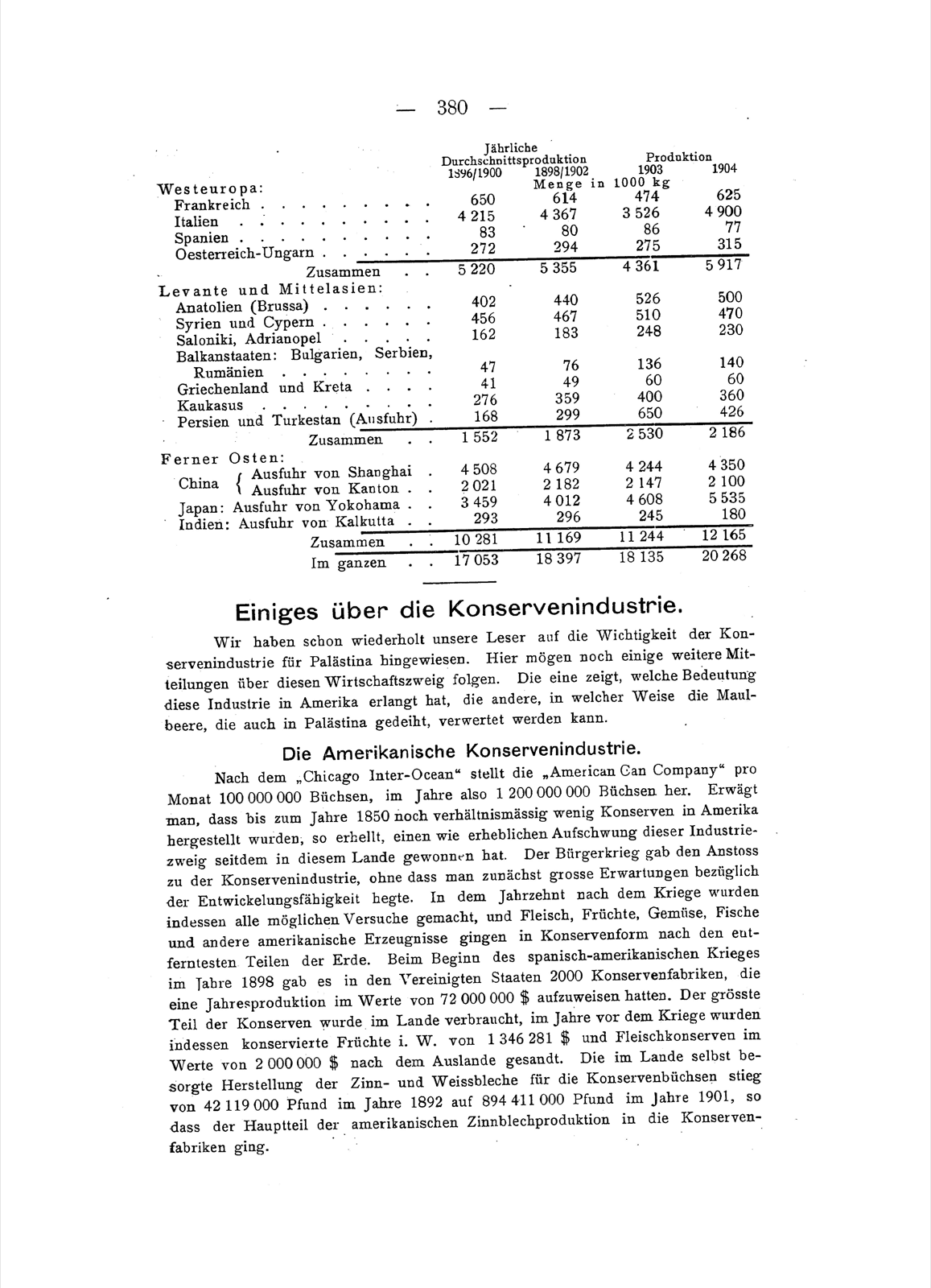
| Yearly average production 1896/1900 | 1898/1902 | Production 1903 Quantity in 1000 kg | 1904 | |
|---|---|---|---|---|
| Western Europe: | ||||
| France . . . . . . . . . . | 650 | 614 | 474 | 625 |
| Italy . . . . . . . . . . . | 4,215 | 4,367 | 3,526 | 4,900 |
| Spain . . . . . . . . . . . | 83 | 80 | 86 | 77 |
| Austria-Hungary . . . . . . | 272 | 294 | 275 | 315 |
| Together . . . . . . . . . | 5,220 | 5,355 | 4,361 | 5,917 |
| Levant and Central Asia: | ||||
| Anatolia (Brussa) . . . . . . | 402 | 440 | 526 | 500 |
| Syria and Cyprus . . . . . . . | 456 | 467 | 510 | 470 |
| Salonica, Adrianople . . . . . | 162 | 183 | 248 | 230 |
| Balkan States: Bulgaria, Serbia, | ||||
| Roumania . . . . . . . . . . | 47 | 76 | 136 | 140 |
| Greece and Crete . . . . | 41 | 49 | 60 | 60 |
| Caucasus . . . . . . . . . . . | 276 | 359 | 400 | 360 |
| Persia and Turkestan (export) | 168 | 299 | 650 | 426 |
| Together . . . . . . . . . | 1,552 | 1,873 | 2,530 | 2,186 |
| Far East: | ||||
| China { export from Shanghai . | 4,508 | 4,679 | 4,244 | 4,350 |
| { export from Canton . . | 2,021 | 2,182 | 2,147 | 2,100 |
| Japan: export from Yokohama . . | 3,459 | 4,012 | 4,608 | 5,535 |
| India: export from Calcutta . . | 293 | 296 | 245 | 180 |
| Together . . . . . . . . . | 10,281 | 11,169 | 11,244 | 12,165 |
| In all . . . . . . . . . | 17,053 | 18,397 | 18,135 | 20,268 |
Some Notes on the Preserving Industry.
We have already repeatedly directed the attention of our readers to the importance of the preserving industry for Palestine. Here may follow some further communications on this branch of economy. The one shows what importance this industry has attained in America; the other, in what manner the mulberry, which also thrives in Palestine, can be turned to account.
The American Preserving Industry.
According to the "Chicago Inter-Ocean," the "American Can Company" manufactures 100,000,000 tins per month, in the year therefore 1,200,000,000 tins. If one considers that up to the year 1850 comparatively few preserves were as yet manufactured in America, it becomes clear what a considerable upswing this branch of industry has since gained in that country. The Civil War gave the impulse to the preserving industry, without great expectations being at first entertained as to its capacity for development. In the decade after the war, however, all possible experiments were made, and meat, fruits, vegetables, fish, and other American products went in preserved form to the most distant parts of the earth. At the beginning of the Spanish-American War in the year 1898 there were in the United States 2000 preserving factories, which had a yearly production to the value of $72,000,000 to show. The greatest part of the preserves was consumed in the country; in the year before the war, however, preserved fruits to the value of $1,346,281 and meat preserves to the value of $2,000,000 were sent abroad. The manufacture, carried on in the country itself, of the tin and white plates for the preserving tins rose from 42,119,000 pounds in the year 1892 to 894,411,000 pounds in the year 1901, so that the chief part of the American tin-plate production went into the preserving factories.