— 264 —
sumption regions. We have Egypt lying in our immediate neighbourhood, a land which even now consumes much, and which, with its rising prosperity, will offer ever-growing possibilities of sale.
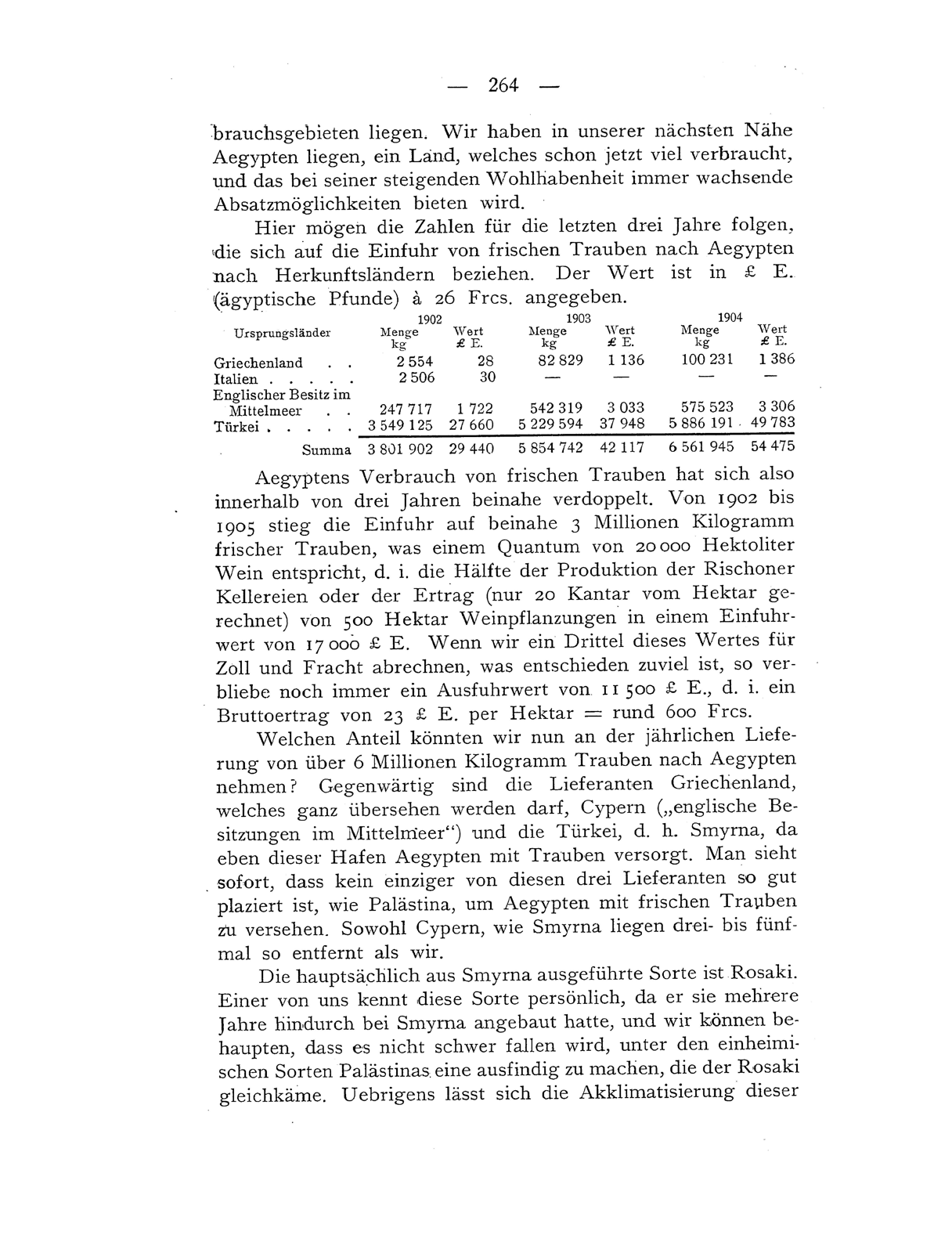
Here may follow the figures for the last three years relating to the import of fresh grapes into Egypt by countries of origin. The value is given in £ E. (Egyptian pounds) at 26 Frcs.
| Countries of origin | 1902 Quantity kg | 1902 Value £ E. | 1903 Quantity kg | 1903 Value £ E. | 1904 Quantity kg | 1904 Value £ E. |
|---|---|---|---|---|---|---|
| Greece | 2,554 | 28 | 82,829 | 1,136 | 100,231 | 1,386 |
| Italy | 2,506 | 30 | — | — | — | — |
| English possessions in the Mediterranean | 247,717 | 1,722 | 542,319 | 3,033 | 575,523 | 3,306 |
| Turkey | 3,549,125 | 27,660 | 5,229,594 | 37,948 | 5,886,191 | 49,783 |
| Total | 3,801,902 | 29,440 | 5,854,742 | 42,117 | 6,561,945 | 54,475 |
Egypt's consumption of fresh grapes has thus nearly doubled within three years. From 1902 to 1905 the import rose by nearly 3 million kilogrammes of fresh grapes, which corresponds to a quantity of 20,000 hectolitres of wine — that is, half the production of the Rishon cellars, or the yield (reckoning only 20 kantar to the hectare) of 500 hectares of vine plantations, at an import value of 17,000 £ E. If we deduct a third of this value for duty and freight, which is decidedly too much, there would still remain an export value of 11,500 £ E., that is, a gross return of 23 £ E. per hectare = roughly 600 Frcs.
What share, now, could we take in the yearly supply of over 6 million kilogrammes of grapes to Egypt? At present the suppliers are Greece, which may be quite disregarded, Cyprus ("English possessions in the Mediterranean"), and Turkey — that is, Smyrna, since it is that port which provides Egypt with grapes. One sees at once that not a single one of these three suppliers is so well placed as Palestine to furnish Egypt with fresh grapes. Both Cyprus and Smyrna lie three to five times as far away as we.
The sort chiefly exported from Smyrna is Rosaki. One of us knows this sort personally, having cultivated it for several years near Smyrna, and we can affirm that it will not be difficult to discover among the native sorts of Palestine one which would equal the Rosaki. Moreover, the acclimatization of this