— 254 —
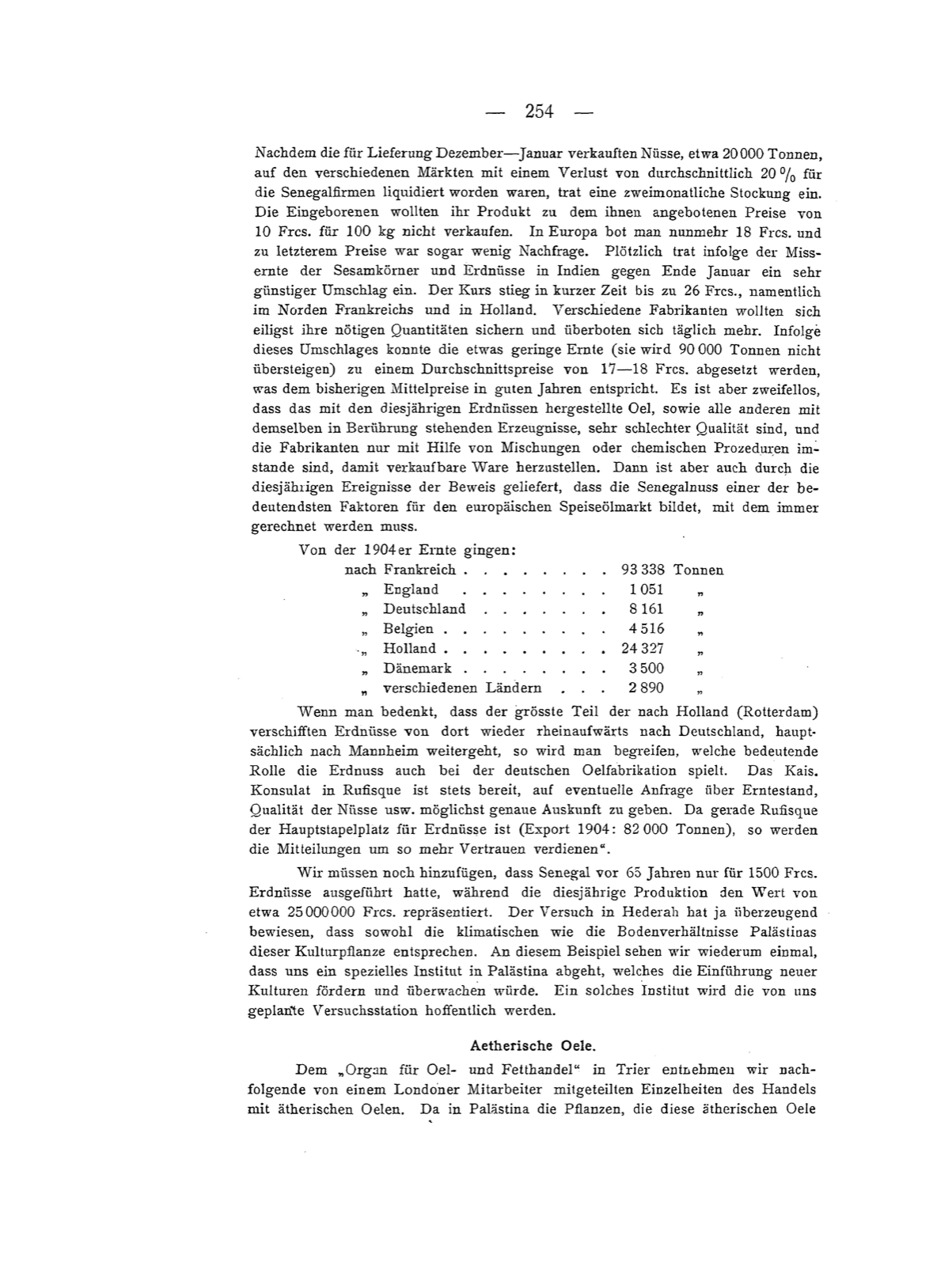
After the nuts sold for December—January delivery, some 20,000 tons, had been liquidated on the various markets with a loss averaging 20% for the Senegal firms, a stagnation of two months set in. The natives would not sell their product at the price of 10 Frcs. per 100 kg offered them. In Europe no more than 18 Frcs. was now bid, and even at the latter price there was little demand. Suddenly, in consequence of the failure of the sesame-seed and ground-nut crops in India, a very favourable turn came about toward the end of January. The quotation rose in a short time to as much as 26 Frcs., especially in the North of France and in Holland. Various manufacturers wished in all haste to secure the quantities they required, and outbid one another more every day. In consequence of this turn, the somewhat small harvest (it will not exceed 90,000 tons) could be disposed of at an average price of 17—18 Frcs., which corresponds to the hitherto usual mean price in good years. It is beyond doubt, however, that the oil produced from this year's ground-nuts, as well as all the other products standing in contact with it, is of very bad quality, and that the manufacturers are able to produce saleable wares from it only with the help of blendings or chemical procedures. But then, too, the proof has been furnished by this year's events that the Senegal nut forms one of the most important factors for the European edible-oil market, with which account must always be taken.
Of the harvest of 1904 there went: to France . . . . . . . . . . 93,338 tons „ England . . . . . . . . . . . 1,051 „ „ Germany . . . . . . . . . 8,161 „ „ Belgium . . . . . . . . . . . 4,516 „ „ Holland . . . . . . . . . . . 24,327 „ „ Denmark . . . . . . . . . 3,500 „ „ various countries . . . . 2,890 „
When one considers that the greatest part of the ground-nuts shipped to Holland (Rotterdam) goes on from there again up the Rhine to Germany, chiefly to Mannheim, one will comprehend what an important part the ground-nut plays in the German oil manufacture also. The Imperial Consulate at Rufisque is always ready, upon inquiry, to give the most exact information possible on the state of the harvest, the quality of the nuts, etc. Since Rufisque is precisely the chief staple-place for ground-nuts (export 1904: 82,000 tons), its communications will deserve the more confidence."
We must further add that 65 years ago Senegal had exported ground-nuts to the value of only 1500 Frcs., whereas this year's production represents a value of about 25,000,000 Frcs. The experiment at Hederah has indeed convincingly proved that both the climatic and the soil conditions of Palestine suit this culture-plant. In this example we see once again that we lack a special institute in Palestine which would promote and supervise the introduction of new cultures. Such an institute, it is to be hoped, the experiment station planned by us will become.
Ethereal Oils.
From the "Organ für Oel- und Fetthandel" of Trier we take the following details of the trade in ethereal oils, communicated by a London contributor. Since in Palestine the plants which yield these ethereal oils