— 113 —
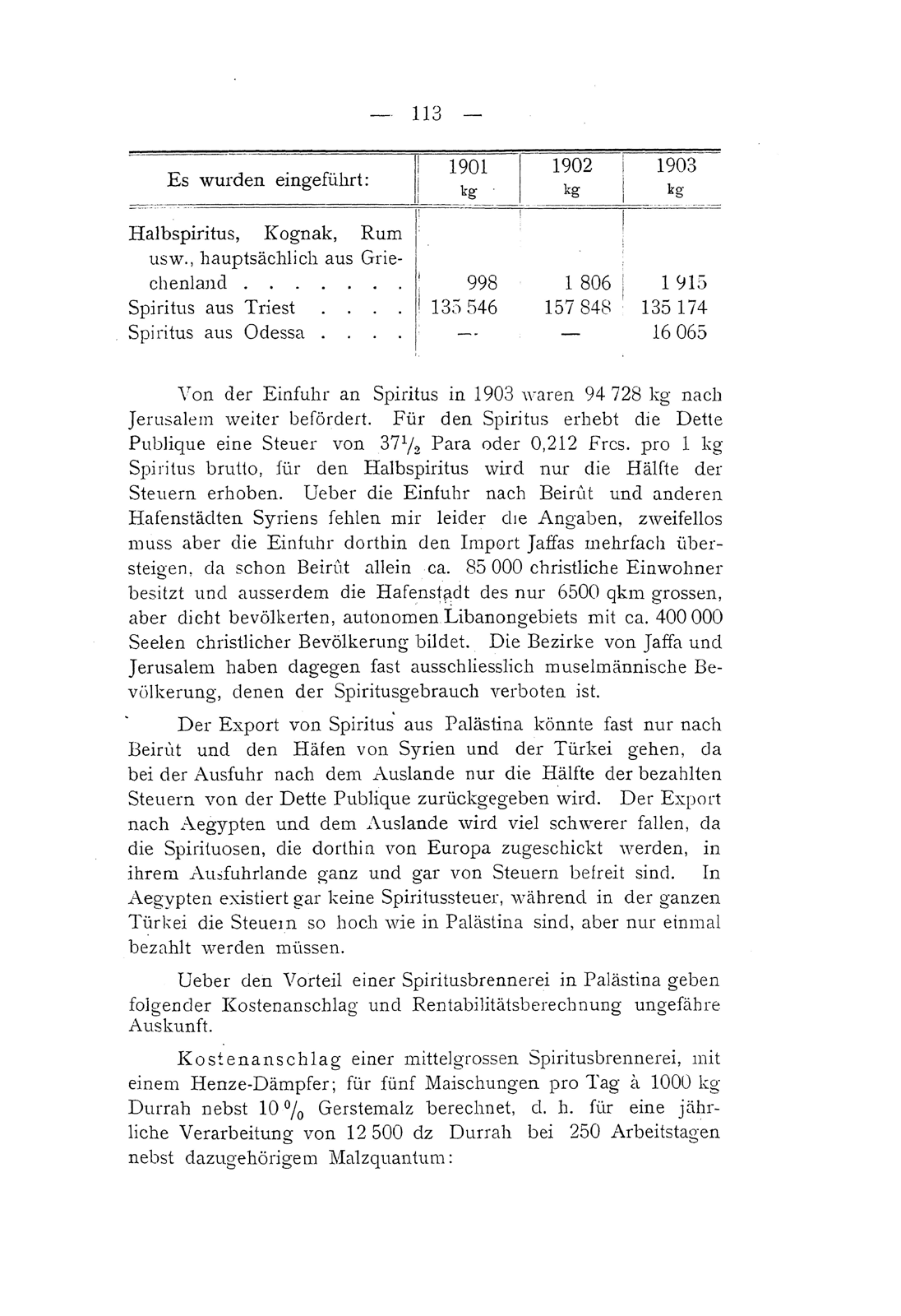
| There were imported: | 1901 kg | 1902 kg | 1903 kg |
|---|---|---|---|
| Half-spirit, cognac, rum, etc., chiefly from Greece | 998 | 1,806 | 1,915 |
| Spirit from Trieste | 135,546 | 157,848 | 135,174 |
| Spirit from Odessa | — | — | 16,065 |
Of the import of spirit in 1903, 94,728 kg were forwarded onward to Jerusalem. On spirit the Dette Publique levies a tax of 37½ para, or 0,212 Frcs., per 1 kg of spirit gross; for the half-spirit only half of the taxes is levied. Concerning the import into Beirût and other port towns of Syria, the particulars are unfortunately lacking to me; but without doubt the import thither must exceed the import of Jaffa several times over, since Beirût alone possesses about 85,000 Christian inhabitants, and moreover forms the port town of the autonomous Lebanon region — only 6500 sq. km in extent, but densely peopled, with about 400,000 souls of Christian population. The districts of Jaffa and Jerusalem have, on the other hand, an almost exclusively Mussulman population, to whom the use of spirit is forbidden.
The export of spirit from Palestine could go almost only to Beirût and the ports of Syria and of Turkey, since on export abroad only half of the taxes paid is refunded by the Dette Publique. Export to Egypt and to foreign countries will prove much harder, since the spirituous liquors which are sent thither from Europe are wholly and entirely freed from taxes in their land of export. In Egypt there exists no spirit tax at all, while in the whole of Turkey the taxes are as high as in Palestine, but need be paid only once.
Concerning the advantage of a spirit distillery in Palestine, the following estimate of costs and calculation of profitableness give approximate information.
Estimate of costs of a middle-sized spirit distillery, with one Henze steamer; calculated for five mashings per day at 1000 kg of durrah together with 10 % of barley malt — that is, for a yearly working-up of 12,500 dz of durrah in 250 working days, together with the appertaining quantity of malt: