— 357 —
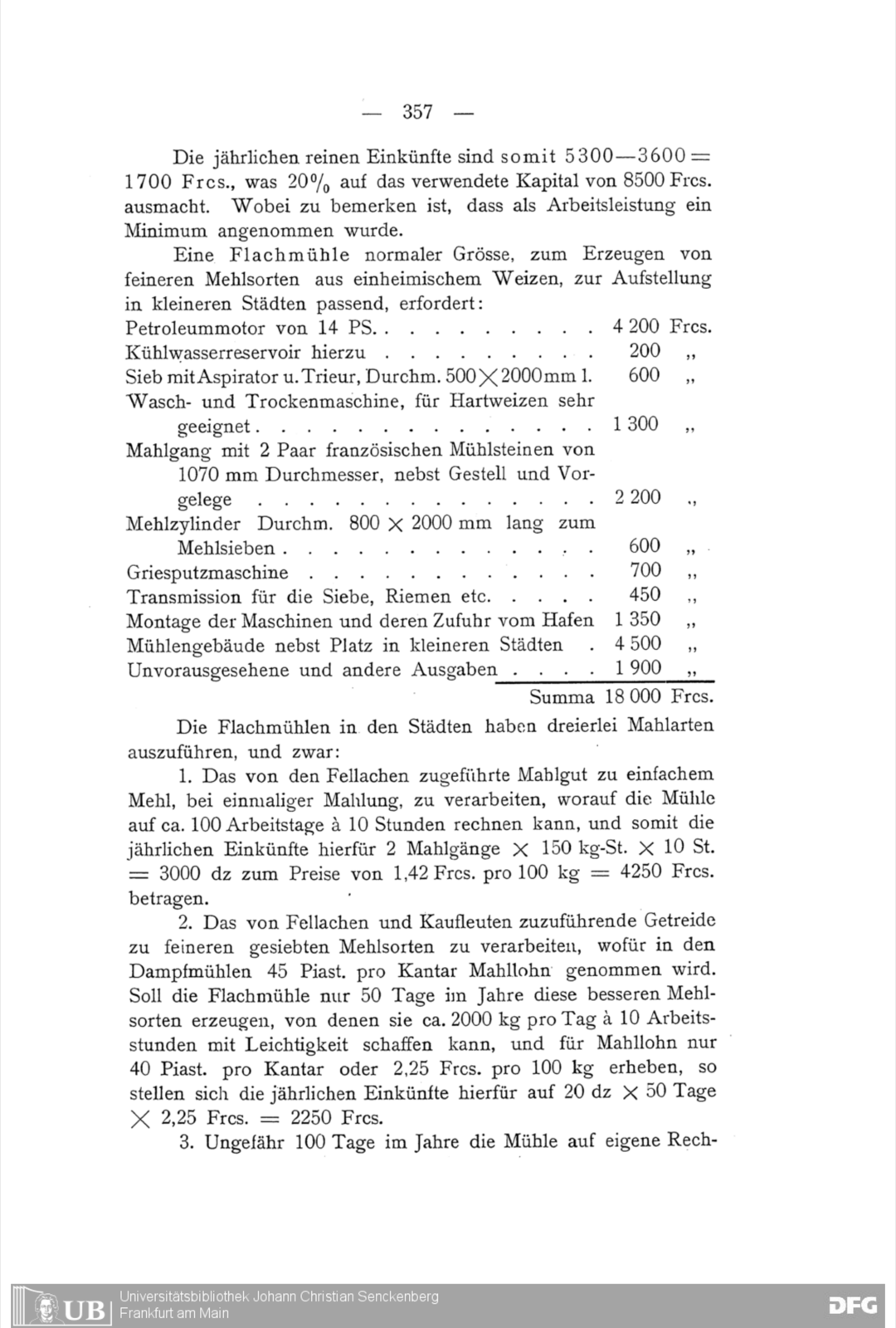
The annual net receipts are thus 5,300 − 3,600 = 1,700 Frcs., which makes 20% on the capital of 8,500 Frcs. employed. And here it is to be observed that a minimum was assumed as the working performance.
A flat-grinding mill of normal size, for the production of finer grades of flour from native wheat, suitable for erection in the smaller towns, requires:
Petroleum motor of 14 HP . . . . . . . . . . 4,200 Frcs. Cooling-water reservoir for the same . . . . . . . 200 „ Sieve with aspirator and trieur, diam. 500 × 2000 mm 600 „ Washing and drying machine, very suitable for hard wheat . . . . . . . . . . . . . . 1,300 „ Grinding-course with 2 pairs of French millstones of 1070 mm diameter, together with frame and countershaft . . . . . . . . . . . . . 2,200 „ Flour cylinder, diam. 800 × 2000 mm long, for sifting the flour . . . . . . . . . . . . . 600 „ Semolina-purifying machine . . . . . . . . . . 700 „ Transmission for the sieves, belts, etc. . . . . . 450 „ Erection of the machines and their carriage from the harbour . . . . . . . . . . . . . . 1,350 „ Mill building, together with the site, in smaller towns 4,500 „ Unforeseen and other expenses . . . . 1,900 „
Total 18,000 Frcs.
The flat-grinding mills in the towns have three kinds of milling to perform, namely:
-
To work up the grist brought in by the fellaheen into plain flour, at a single grinding, for which the mill can count on about 100 working days at 10 hours; and thus the annual receipts for this amount to 2 grinding-courses × 150 kg per hour × 10 hrs. = 3,000 dz at the price of 1.42 Frcs. per 100 kg = 4,250 Frcs.
-
To work up the grain to be brought in by fellaheen and merchants into finer, sifted grades of flour, for which 45 Piasters per Kantar is taken as milling fee in the steam mills. Should the flat-grinding mill produce these better grades of flour only 50 days in the year — of which it can easily manage some 2,000 kg per day at 10 working hours — and charge as milling fee only 40 Piasters per Kantar, or 2.25 Frcs. per 100 kg, the annual receipts for this come to 20 dz × 50 days × 2.25 Frcs. = 2,250 Frcs.
-
To run the mill about 100 days in the year on its own ac-